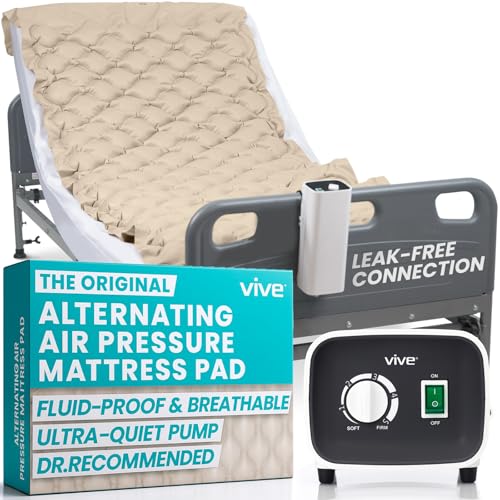
The Vive 8-inch Alternating Pressure Mattress is a powered air mattress designed as a hospital bed topper for pressure relief and prevention of bedsores. It features 19 alternating air chambers within an 8″-thick vinyl mattress pad (dimensions 80″×35″×8″, twin size) and comes with a digital compressor pump and hose . The mattress cover is durable, waterproof vinyl (latex-free) that is removable for cleaning . It supports patients up to 350 pounds , with a minimum recommended user weight of about 80 lbs. When plugged into a standard 110V outlet, the pump inflates the mattress in about an hour and then continuously alternates inflation and deflation of every other air cell. As one set of cells fills and firms, the next set softens, shifting pressure points to improve blood flow and reduce skin breakdown . This alternating action aims to prevent and help heal pressure ulcers in bedridden or immobile patients, as recommended for those confined to bed 15+ hours per day or at medium to high ulcer risk .
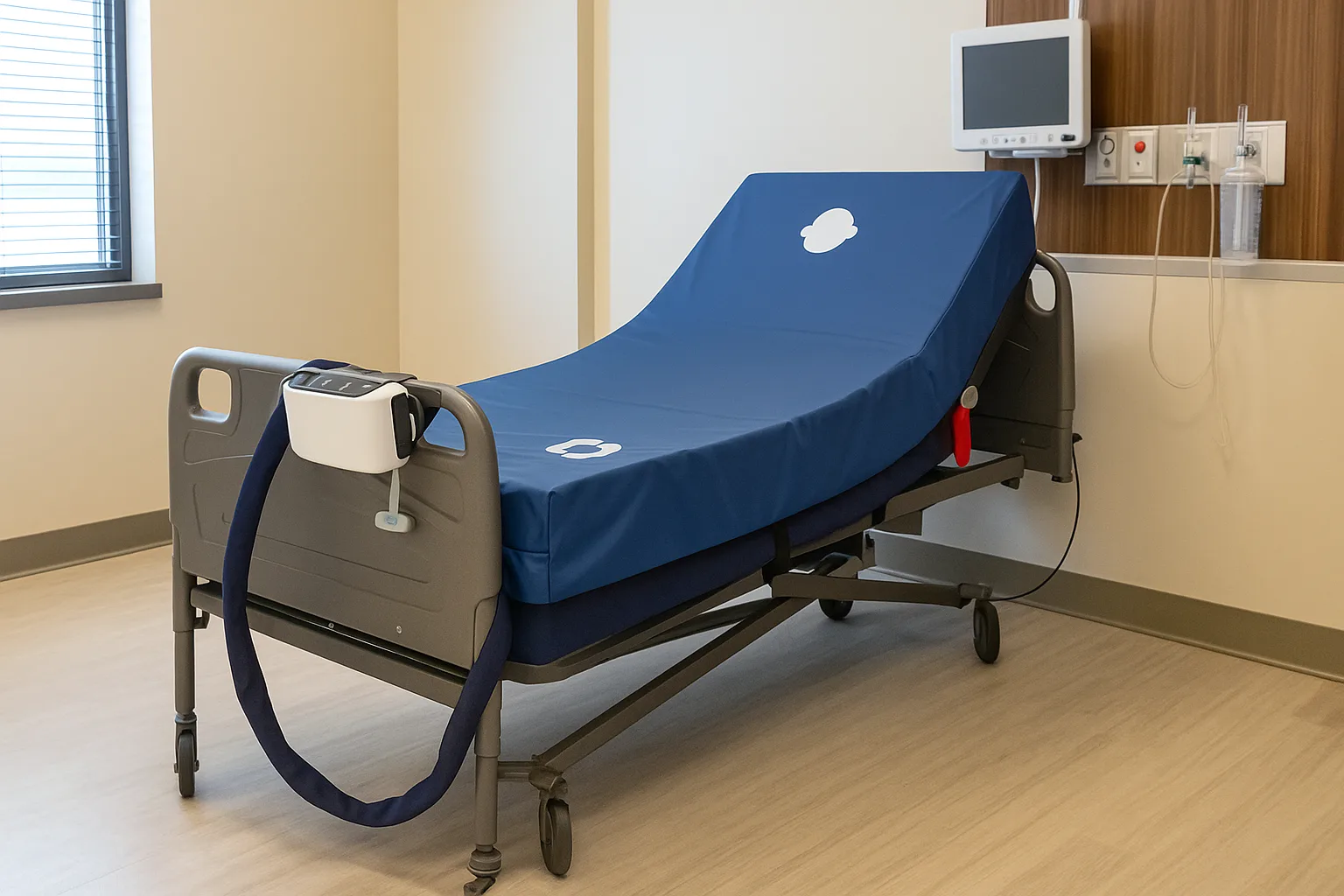
The Vive 8″ alternating pressure mattress on a hospital bed frame with its digital pump unit hooked at the foot. The blue vinyl cover is waterproof and easy to wipe clean, and the pump uses hooks to attach at the bed’s footboard for convenience.
Setup and Installation of the Vive Alternating Pressure Mattress
Getting started with the Vive alternating-pressure hospital mattress is straightforward. The package includes the 8″ air mattress, the Vive digital compressor pump, a flexible hose, one spare air chamber, straps, and a patch kit . To install the mattress:
-
Place the mattress on the bed frame: Lay the mattress directly on a box-spring or hospital bed frame (no other mattress needed) so the labeled “head” end is at the bed’s head. The Vive mattress is twin-size (80″×35″) and is designed to fit standard hospital beds or regular twin bed frames .
-
Secure with straps: Most models include straps or Velcro flaps. Wrap these around the bed rails or frame to hold the mattress firmly in place as it inflates. (Tip: Leave the straps loose at first and only tighten once the mattress is fully inflated to avoid stress on the seams .)
-
Connect the pump: Hang or place the compressor pump at the foot of the bed. The pump has built-in hooks so it can be attached to the bed’s footboard or placed on a stable surface near the bed .
-
Attach the hose: Connect the flexible air hose from the pump to the mattress. The hose has keyed connectors that twist and lock into the inflating nozzles on the pump and mattress. Ensure the hose locks into place on both ends (you should hear a click) so there are no leaks .
-
Check CPR valves (safety valves): On the top-side near the head, the mattress has two red CPR quick-release valves. These valves must be fully pushed in and locked; otherwise the mattress will continuously vent air and fail to inflate . (Keep these valves closed during normal operation. In an emergency, pulling them will rapidly deflate the mattress.)
-
Power on and inflate: Plug the pump’s power cord into a standard 110V outlet. Then turn the pump on. It may be in a default “Static” or “Auto” mode on first use. Allow the mattress about 40–60 minutes to completely inflate before using it . An indicator light shows when inflation is complete (green light for normal pressure).
Once fully set up, the mattress automatically begins its alternating cycles. If it does not inflate, recheck all hose connections and CPR valves to ensure a tight seal . After inflation, you can attach a patient or proceed with use. The Vive pump also offers a “static” setting (all cells equal pressure) for rapid inflation or when alternating is not needed .
Controls and Ease of Use
The Vive system is designed for simple, intuitive operation by caregivers. The digital pump’s control panel has clear buttons and indicators. Key controls include:
-
Power On/Off: A large power button toggles the pump. Once on, the pump will inflate all cells (static mode) and then switch to alternating mode unless otherwise set.
-
Pressure Adjustment (+/–): Two buttons increase or decrease the firmness level by changing the cycle pressure. You first enter the patient’s weight range (80–350 lbs). A higher setting makes the mattress firmer, a lower setting softer. This quick “weight input” tuning ensures optimal pressure for the user .
-
Mode Select (Static / Alternating / Sitting): The pump offers a Static Mode (all cells inflated equally, used for initial fill or procedures) and a Sitting Mode (alternation paused and pressure maximized so the patient can sit up comfortably). A normal alternating mode runs automatically when neither static nor sitting is selected . LED indicators light up to show the current mode.
-
Alarm Indicator: If a leak or disconnection occurs, the pump will trigger an alarm. (For example, if a hose comes loose or an air cell fails to pressurize, an audible alarm sounds and an indicator light or icon illuminates.) This alerts caregivers to check connections.
-
CPR Quick-Release Valves: While not buttons, the two red CPR valves at the top of the mattress act as safety releases. Pulling a CPR valve instantly vents air, fully flattening the mattress in seconds for emergency CPR or patient transfer .
Overall, using the Vive pump is straightforward. Many caregivers find it as simple as plug-and-play: connect everything, plug in, and let the system run. The presets (static/sitting) and pressure dial mean adjustments can be made on the fly without complicated steps. In fact, a Vive representative notes, “It’s very easy. Position the mattress … Connect the pipes… Plug in… Turn on the mattress and begin use” . The large digital display and clear icons make it easy to see current pressure (in mmHg or weight) and selected mode. No special training is needed beyond following the quick-start guide.
Key control features:
-
Adjustable inflation cycles (10–12 minute alternating cycle ).
-
Quiet, constantly running pump (despite operating constantly, it emits only a slight hum ).
-
Auto “inflate” or static mode for easy setup.
-
Seating mode for sitting up or transfers.
-
Alarm alert for disconnection/leak events.
The pump’s quietness and simplicity make it user-friendly. Patients can sleep and move without feeling or hearing the pump running (the air shift is gentle). Caregivers can easily toggle modes and settings to suit the patient’s needs (e.g. firming the mattress to help a heavy patient sit up). The hose and pump hooks keep the system organized and out of the way at the bed’s foot. In short, ease of use is a strong point: once set up, the Vive mattress largely “self-manages” and only requires occasional monitoring.
Build Quality and Materials
The Vive alternating-pressure mattress is built for durability under medical use. Its 8″-thick core consists of heavy-duty vinyl air bladders. The outer cover is made from a waterproof, latex-free vinyl fabric . According to the maker, the vinyl is “durable, latex-free” and supports even weight distribution . The cover is also breathable (to help heat escape) and is finished with sewn-in straps and non-slip feet or pads on the bottom to keep it stable on the bed frame. All seams and air cells are machine heat-welded or double-sealed to minimize leaks. In fact, many competing “air mattress pads” use similar construction (nylon/PVC bladders and vinyl covers) and Vive’s construction quality is on par with other high-spec models.
Key aspects of the build:
-
Waterproof Cover: Protects the internal bladders from spills and makes cleaning easy .
-
Latex-Free Material: Safe for patients with latex sensitivities (important in medical settings) .
-
Removable Cover: The cover unzips, allowing caregivers to inspect and clean the mattress interior if needed .
-
19 Separate Air Cells: Each chamber is a heat-sealed bladder, so a puncture in one cell doesn’t deflate the entire pad . The inclusion of one spare chamber and a patch kit in the box lets users repair leaks without replacing the whole mattress .
-
Stable Attachment Points: Sturdy straps and bed attachments help keep the pad from shifting during use.
Although marketed with “low air loss” in the title, note that the Vive product does not actively ventilate air through the surface like a dedicated low-air-loss mattress (which pumps small amounts of air through tiny holes for moisture control). Instead, its emphasis is on alternating pressure relief. That said, the vinyl cover is somewhat breathable, and any escaping air (e.g. from the CPR valves when opened) indicates the design’s goal: pressure relief over bedsores.
Overall, the build quality is solid for home or clinical use. The pump enclosure is hard plastic, and cables and hoses are robust. In use reviews and product specs note the Vive pad is engineered for repeated inflation/deflation cycles without bursting. Vive even includes an extra chamber in case of failure, suggesting confidence that the system can be maintained over time . In short, the materials and construction are comparable to professional alternating-pressure mattresses used in hospitals, but offered at consumer-friendly pricing.
Patient Comfort and Clinical Effectiveness
The primary purpose of an alternating-pressure mattress is to improve patient comfort and prevent pressure ulcers in patients who spend extended time in bed. By shifting support points periodically, these mattresses reduce static pressure on any one area. Clinical guidelines list power mattresses (like alternating pressure systems) as an effective support surface to redistribute pressure and increase blood flow .
For patients, the Vive 8″ pad feels like a soft, gently rolling surface. Most users report that it provides a subtle “massage” sensation. The alternating cycles (about every 10–12 minutes ) mean the patient’s hips, shoulders, and buttocks get relief from constant loading. This movement can reduce the risk of skin breakdown and also aid healing of existing sores. One user testimonial described how using the Vive mattress prevented new sores and helped heal others. Another noted that for an immobilized elderly patient, sleeping on this mattress resulted in feeling better rested and fewer circulation issues in the morning.
Feature highlights related to comfort and therapy:
-
19 Alternating Air Chambers: These inflate and deflate in turn, continually changing pressure points . By not leaving any area under constant pressure, blood flow to skin and tissue is preserved.
-
Customizable Pressure: The pump’s variable settings allow caregivers to adjust firmness. A patient recovering from surgery or an elderly person may need a softer, more gentle setting, while others may prefer firmer support .
-
Three Static Cells at Head: The top 3 cells (near the head) remain always inflated to act as a comfortable pillow. This design prevents head-sliding and ensures a stable headrest .
-
Static and Sitting Modes: Static mode lets the mattress inflate evenly (useful when first placing a patient or during procedures). Sitting mode holds all cells firm so the patient can sit up without the bed collapsing under them .
-
“Low Air Loss” Effect: Although not a true low-air-loss mattress, the cover’s slight breathability and the constant cycling help manage moisture. The promotional name suggests the pad’s design helps “alleviate pressure spots and bedsores.”
From a clinical perspective, alternating support is commonly recommended for at-risk patients. Studies and reviews acknowledge that powered surfaces like alternating air mattresses can lower ulcer risk compared to static foam pads . In practice, healthcare providers often use alternating mattresses for patients with Stage I–II pressure injuries or those who cannot be turned frequently. The Vive 8″ mattress is intended for home or institutional use in these scenarios. Indeed, the manufacturer’s guidance states it is for “those confined to a bed for an extended period of time” , essentially bed-bound patients who spend most of each day lying down.
In summary, users of the Vive alternating pressure pad can expect improved comfort through gentle movement and reduction in pressure spots. Caregivers report that the mattress does help reduce bed sores and keeps patients from feeling constant numbness in areas of contact. As one review noted, an elderly friend sleeping on the Vive felt “so much better” waking up after night-long use, with less circulation-related discomfort . While no surface can guarantee zero ulcers (regular turning and skin care are still advised), alternating pressure therapy is a proven strategy in an overall prevention plan .
Durability and Long-Term Use
The longevity of an air pressure mattress depends on material durability and how it’s maintained. The Vive 8″ mattress is marketed as a sturdy, medical-grade surface. The vinyl cover is thick and expected to withstand routine use (most similar products are rated for thousands of inflation cycles). Each internal air cell is made of nylon/PVC bladders; these are generally heat-welded and resistant to small punctures. In fact, Vive supplies a replacement air chamber and patch kit, acknowledging that accidents can happen but making repairs simple . This is a sign the product is built to last; instead of discarding the entire mattress when one cell fails, you can swap in the spare or patch the hole.
The compressor pump is also a key durability factor. Vive’s pump is rated for continuous operation (since it often runs 24/7) and only consumes about 7 watts, which is modest. The parts are all solid-state (no delicate mechanics), and a one-year guarantee on the pump reflects confidence in its lifespan . In user reports, even after months of use the pump remains quiet and functional. The pump’s air filter, if any, is not user-serviceable, but since it doesn’t draw in dirty air (only blows), filter issues are minimal.
In terms of physical wear:
-
The mattress cover will show some surface wear over time (scratches or scuffs are common in bed environments). However, as it’s waterproof and wipe-clean, minor damage can be sanitized easily. Care must be taken to avoid sharp objects or biting from patients.
-
The air hoses and connectors are tough rubber and plastic and should hold up well. The manual suggests checking o-rings in the hose fittings occasionally; replacement o-rings are included in case they wear out .
-
The straps and hook fasteners (to bed frame) are made to last but should be tightened properly to avoid straining the mattress seams.
For long-term use, the Vive mattress is rated up to 350 lbs weight. This makes it suitable for many patients, but one should not exceed the limit to prevent overstretching the bladder walls. The mattress also has a minimum 80 lb limit ; extremely light users may not trigger the pressure adjustment sensors properly.
In everyday home or clinic use, expect the Vive pad to last at least a couple of years under normal loads. The most likely issues are air leaks, which the patch kit solves. With routine maintenance (cleaning spills, inspecting for punctures, avoiding alcohol-based cleaners on the vinyl for longevity), the mattress can be a durable investment. Many caregivers note that they treat it much like a heavy-duty bed pad, which simply needs occasional care and is resilient to daily wear.
Maintenance and Cleaning
Keeping the Vive mattress clean and functional requires minimal effort. The vinyl cover is fully waterproof , so any fluid spills (blood, urine, liquids) sit on top and can be wiped off. To clean the mattress: unplug the pump and deflate if needed, then use a soft damp cloth with mild detergent to wipe all surfaces . The manufacturer explicitly advises mild soap/water or a diluted disinfectant. The cover can also be cleaned with isopropyl alcohol wipes for sanitization. After cleaning, dry the mattress thoroughly with a towel.
Because the cover is removable, you can unzip and lift it off if deeper cleaning or inspection of the bladders is needed . This allows caregivers to ensure the integrity of the seams or fix a patch more easily. The inner bladders should be wiped down if exposure to contaminants occurred. (However, the product does not have a washable outer fabric like a cloth pad; it is vinyl, so machine washing is not applicable.)
Routine maintenance points:
-
Inspect regularly for leaks: If the pump alarm sounds or the mattress softens abnormally, look for punctures. Small holes can be patched with the supplied kit following the manual’s instructions. The kit includes adhesive patches and a replacement cell if needed .
-
Check hose connections: Occasionally ensure the hoses are securely attached and the O-rings are intact. If a connection leaks air, replace the O-ring from the repair kit .
-
Avoid corrosive cleaners: Do not use harsh solvents, bleaches, or ammonia on the vinyl. They can degrade the material. Stick to gentle cleaners as recommended.
-
Filter maintenance (if applicable): Some similar pumps have inlet filters, but this pump is mostly closed; just keep the intake vents dust-free.
Because the cover is easy to wipe and the system includes a quick-change chamber, overall maintenance is quite simple. Many users find it “a breeze” to keep clean and sanitize – much easier than an ordinary foam topper which might absorb liquids . The one caveat: always dry completely before re-inflating fully, to prevent mold or mildew under the cover.
With proper care, the Vive mattress can be kept hygienic and functional long-term. If a serious tear occurs, the cover itself is not serviceable by replacement (Vive sells the pad only as a set), but the vinyl is thick enough that everyday use rarely causes rips. In short, “maintenance, cleaning and sanitation are a breeze” as one caregiver review put it .
Noise Level and Air Pump Performance
The Vive’s compressor pump is noted for being ultra-quiet. At full operation, it emits only a slight, low-level hum that most patients barely notice. Many product descriptions emphasize “whisper-quiet” or “ultra-quiet pump” . In practice, users report only a soft periodic sound when cells inflate and deflate; otherwise it is effectively silent. One FAQ answer confirms: “A slight hum may be heard while the pressure is alternating, but overall the pump is very quiet.” .
Sound measurements aren’t provided, but the consensus is that the pump noise is comparable to a running CPAP machine or white noise – not loud enough to disturb sleep. This makes the mattress suitable even for home use overnight, since the noise is less than, say, a hospital ventilator or an older blower mattress (some competing pressure pumps can be quite loud). Vive specifically highlights the quietness as a feature for “a peaceful rest with minimal noise.”
In terms of performance, the pump maintains steady pressure well. It inflates the mattress in under an hour and then runs continuously to modulate the air. There are multiple pressure levels: the default therapy range is between about 20 to 80 mmHg . Caregivers can hear the pump motor even at its quietest, because you will hear a gentle airflow sound during each inflation cycle. However, there are no thumps or loud surges. The display even shows an indicator (often labeled “Normal Pressure” green light) when target pressure is reached, at which point the pump may idle or cycle as needed.
For maximum effect (and longevity), the pump should remain on and running 24/7. It is designed for continuous duty, and its energy draw is low (about 7W). In fact, the product specs list the pump at only ~3 lbs weight and 120V/60Hz, implying a small footprint . Overall reliability is high: the pump fan and motor have no reported common failures, and with clean vents it can run indefinitely.
The only noise-related caution is when an alarm sounds – this is relatively loud to alert a caregiver. But the alarm only occurs on issues (leak, pressure fault). In normal use, one should rarely hear the alarm. Essentially, Vive’s pump is rated as hospital-grade silent operation, and user feedback supports that. Even very noise-sensitive individuals find it barely noticeable.
Safety Features and CPR Function
Patient safety is a priority in pressure mattress design. The Vive 8″ mattress includes standard safety elements:
-
CPR Quick-Release Valves: As noted, two red “CPR” valves on the mattress top allow instantaneous deflation. In an emergency (e.g. sudden cardiac arrest), a caregiver can pull these valves open to rapidly release all air. This quickly flattens the mattress for immediate chest compressions. The pump itself has no override – the valves mechanically vent the air. The user manual explicitly highlights CPR use for that purpose .
-
Electrical Safety: The pump is UL-listed and uses a standard grounded AC plug. No external battery is involved, so there is no risk of lithium failure – just ensure it’s plugged into a safe outlet. It should be on a dedicated circuit (avoid extension cords if possible). If the unit is ever wet, it must be unplugged before cleaning.
-
Alarms: The system includes an audible alarm for fault conditions. If an air chamber leaks or a hose disconnects, the pump will beep to alert staff to the problem. This reduces risk of unnoticed deflation (although the mattress would also slowly deflate under continuous use if a leak persists).
-
Overweight Prevention: The system will try to maintain pressure up to its limit, but users must not exceed 350 lbs. Operating the mattress beyond spec could damage it or cause it to fail. Users below the minimum (80 lbs) may need a lighter setting to avoid over-inflation.
-
Manual Handling: The mattress cover has cut-outs for handrails on hospital beds so that bed alarms or rail sensors are not blocked. The pump’s location at the foot keeps cords out of the way of the patient or caregiver. The two hoses are flexible and non-binding, minimizing entanglement risk.
Importantly, there are no unknown hidden safety issues. The mattress uses low-voltage (air) therapy rather than high tech sensors, so there are no radiation or electrical hazards. The CPR valves ensure compliance with medical standardfor bedside air surfaces. The manual advises always unplugging the pump before maintenance, but this is basic precaution. Overall, safety features align with what hospitals expect from an alternating-pressure surface.
Power-Outage Handling and Backup Considerations
An important practical question is what happens if the power goes out. The Vive 8″ mattress does not have an internal battery backup. If mains power fails, the pump will stop running. However, because the system is air-filled, the mattress will not instantly collapse. It will hold its last pressure for some time (the material is not heavily porous). Minor leaks will cause slow deflation over hours. In an extended outage, the pressure will gradually drop as air seeps out of valves and seams.
For high-risk patients, this gradual deflation could be dangerous if unattended. Thus, planning is key:
-
Short Interruptions: If power is restored quickly (minutes), the system will simply re-inflate and resume alternating. Patients should not be immediately harmed by brief outages, especially if the CPR valves remain closed.
-
Long Outages: If a patient cannot be repositioned easily and the outage is prolonged, alternative support should be arranged. Options include manual turning schedules or having a spare standard foam mattress ready.
-
UPS (Battery Backup): Some users protect the pump with a small uninterrupted power supply (UPS) or power bank designed for medical devices. A UPS can keep a 7W pump running for several hours, depending on battery capacity. This allows time for temporary arrangements or grid restoration. (Note: Vive’s pump is low wattage, so even a modest 100Wh battery could run it for ~10 hours at low level.)
-
Generator Use: In institutional settings, hooking the pump into the facility’s emergency power can maintain operation indefinitely during blackouts.
Because the Vive pump is simple AC-powered, it will automatically restart at the last settings once power returns. The mattress does not get permanently damaged by power loss, but if the pressure drops too low, patients will need careful repositioning to avoid sores until inflation resumes. Hospice or home care users should be aware of this limitation – plan accordingly by keeping phones charged to call for help, or have a backup bed available if needed.
In summary, power outages do not instantly collapse the mattress, but prolonged loss of air pressure is possible. No built-in alarms notify you of power loss, so external solutions (UPS or generator) are recommended for critical-use scenarios.
Mattress Size, Weight Capacity, and Compatibility
The Vive 8″ mattress is a twin XL size (80″×35″) and is 8 inches thick . This is the standard size for most hospital beds and bariatric home beds. Its weight capacity is up to 350 lbs , suitable for average adults and many heavier users. The mattress has a minimum recommended weight of about 80 lbs, below which the pressure sensors may not calibrate correctly (this is common for air therapy mattresses).
This mattress is compatible with any flat bed surface that can support an air mattress. It can replace a regular foam hospital bed mattress entirely (no standard mattress is needed under it). It works on manual hospital beds or adjustable electric beds alike. The key requirement is that the bed frame is sturdy and allows clearance for the 8″ height. The Vive pad attaches via straps or hooks to hold it in place even if the bed adjusts angles.
Fits and compatibility highlights:
-
Hospital Beds: Fits 38″ wide hospital frames (twin XL). The pump has built-in hooks to fasten to the footboard, keeping it off the floor .
-
Home Beds: Can be used on home electric or manual bed frames of twin size. If used on a queen or full bed, it will overhang (not recommended).
-
Bed Rails: The mattress cover has cutouts or is low enough not to block side rails, so rails can still be used.
-
Wheelchair-Linked Beds: Not relevant – it’s for supine use only, not for a wheelchair.
-
Foot of Bed: The attached pump and hoses require at least 7″ of clearance at the bed’s foot for proper placement of the pump unit.
Compared to generic mattress toppers, the Vive pad is a full replacement – it lies on the bed frame like a mattress. It is not meant to be stacked on a thick foam mattress. Its design specifically needs to evacuate under-layers. So for best performance, use it as the primary sleeping surface.
The pump size is compact (approximately 10″×3.5″×4.75″ ) and is intended to stay at the foot of the bed. It comes with a 6-foot power cord. The hoses are long enough to reach from head to foot without tension. Weight-wise, the pad is around 10–15 lbs, so most caregivers can handle it for setup.
In practice, hospitals and home users report that the Vive mattress easily fits standard beds. No special platform is needed, just a flat surface. It’s also latex-free, making it safe for users with allergies.
Warranty and Support
Vive provides limited warranties on its products. For the 8″ mattress system, the pump has a 1-year warranty while the mattress pad (air cells and cover) has a 60-day satisfaction guarantee . This means if the pump fails under normal use, Vive will repair or replace it within the first year. For the mattress itself, Vive offers returns or replacements within 60 days if the customer isn’t satisfied. These terms are part of the “Vive Guarantee” .
Beyond the written warranties, Vive Health is known for responsive customer service. The Vive website and reseller sites list customer support contacts. One user review praised their experience: “Vive health… went out of their way to accommodate my urgent needs with a smile,” noting courteous phone support and rapid shipping . Another highlighted that even a small issue was “quickly resolved.”
For technical issues, Vive’s user manual and quick-start guide provide troubleshooting steps (e.g. checking CPR valves and hoses) . Common queries have FAQs (as seen on Vive’s site and on this Vitality page) covering cycle time, noise level, bed compatibility, etc. If a component is missing or defective (like a hose or strap), Vive’s customer service usually ships replacements.
There is no mention of extended warranties beyond these guarantees. Some medical distributors sell the pump and pad as a set but may offer their own returns policy. Because this product often treats medical needs, many insurance or Medicare plans might cover it, but that is a separate issue (and pricing details are not given).
In summary, Vive backs the product with a one-year parts guarantee and friendly support. If any part fails (pump or pad), contact Vive Health or the distributor for assistance. Given the product is essentially an upgraded home-health item, its warranty and support are on par with other consumer medical suppliers.
Ideal Use Cases and User Scenarios
The Vive 8″ alternating pressure mattress is suited for any patient who needs pressure redistribution in a bed setting. Typical scenarios include:
-
Paraplegic and Quadriplegic Patients: Individuals with spinal cord injuries or paralysis cannot shift their weight easily. They are at high risk for pressure ulcers on the buttocks and back. An alternating mattress provides automated relief without caregiver intervention.
-
Elderly Bedridden Patients: Older adults in home care or nursing facilities often have fragile skin and limited mobility. Using the Vive mattress can help prevent sores during recovery from surgery or illness.
-
Post-Surgical or Rehab Patients: Patients recovering from orthopedic or cardiac surgery who must remain on bed rest can benefit from the pressure relief and comfort while healing. For example, one user purchased the Vive for her father after extended intensive care and noted it helped his existing sores heal .
-
Hospice and Palliative Care: Terminally ill or hospice patients spend long periods in bed. Caregivers use alternating mattresses to maximize comfort and dignity. A testimonial mentioned using the mattress for a 100-year-old friend in a nursing home, who woke up feeling “so much better” and saw improvement in circulation .
-
Home Care Settings: People using hospital beds at home (electric beds) can add this mattress for extra pressure prevention. The compact pump and easy setup make it practical for domestic use.
-
High-Risk Patients: Those identified by healthcare providers as medium to high risk of bedsores (e.g., immobile, malnourished, diabetic neuropathy) are often recommended an alternating pressure surface .
(see more details and availability)
In general, any situation requiring continuous pressure relief over many hours is ideal for this mattress. It is not intended for patients who are highly mobile or spend little time in bed. For example, a relatively healthy person who sits up and walks frequently would not need an alternating mattress. Also, as it’s a full-bed solution, it’s best for cases where a regular mattress can be replaced or a hospital bed is used.
Not suitable for: Children under 80 lbs (below weight sensor range), or as a substitute on a sofa/chair. Also patients who require dynamic tilt or specialized ICU beds (this is a passive surface, not a function bed).
By matching the right patient with this support surface, caregivers can often reduce manual turning or static foam use. The Vive mattress essentially automates a key part of pressure ulcer prevention, which is why it’s popular in both home and clinical care plans.