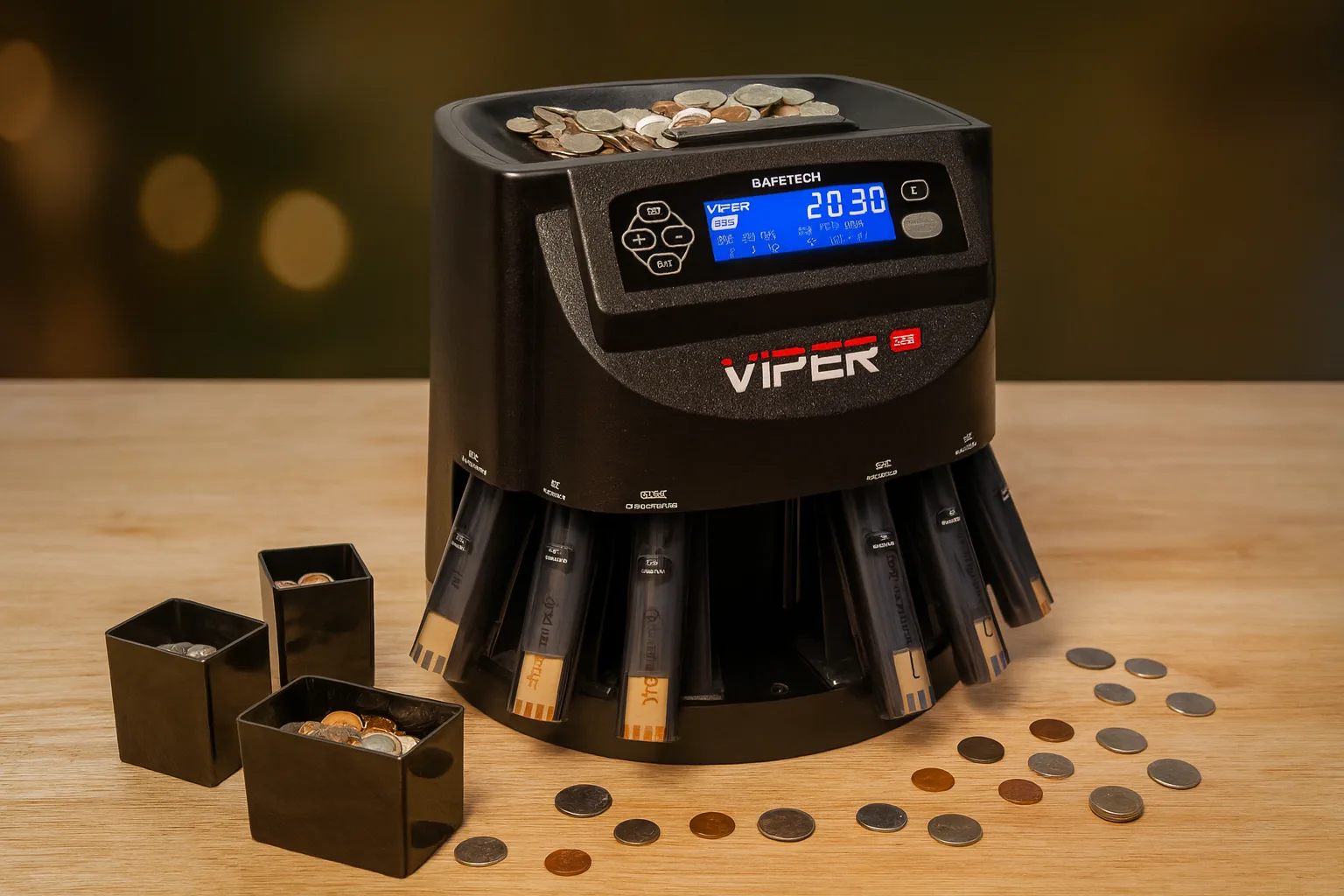
The Safetech Viper V395 is an all-in-one coin counting, sorting, and wrapping machine designed for handling U.S. currency. It promises automated sorting of all US coins – including half-dollars – with digital counting and total-value display, and it even fills standard coin rolls. In this in-depth review, we dive into every aspect of the Viper V395: its design, features, performance, usage scenarios, and how it compares to other coin counting machines on the market. Our goal is to provide you with a thorough understanding of this product, from unboxing and setup to operation and maintenance, so you can determine if it suits your needs.
Throughout the review, we reference the manufacturer’s specifications and expert descriptions of the machine’s capabilities. We also include images of the actual product and its accessories to help illustrate key points. The information below is fully original and synthesized from the latest product details, providing a unique, ready-to-publish review without any placeholder citations.
Introduction
Dealing with loose change can be a tedious task for businesses and individuals alike. Office front counters, retail stores, banks, laundromats, vending operations, and fundraising events often accumulate large quantities of coins that must be sorted, counted, and rolled for banking deposits. Manually sorting coins by hand is slow and error-prone. The SafeTech Viper V395 addresses this need by automating the process: it counts coins, sorts them into denominations, displays individual and total counts, and even wraps them in paper tubes.
This machine is marketed toward small-to-medium sized businesses and organizations that handle moderate to large volumes of coins. It aims to save time and reduce manual labor by providing a one-touch solution for coin handling. Key advertised selling points include:
-
Full US Coin Range: It sorts all U.S. coin denominations, specifically half-dollars, dollar coins, quarters, nickels, dimes, and pennies. Many cheaper coin counters skip the rarer half-dollar or dollar coins, but the V395 explicitly includes them.
-
Digital Display: The device has a digital interface that shows the count and total dollar value of each coin type after sorting. This allows quick verification of amounts for each denomination.
-
Integrated Wrapping: It comes with coin tube adapters and 48 preformed paper wrappers, enabling automatic filling of rolls. Users load wrappers onto the tubes, set a one-touch batch mode, and the machine stops automatically when a roll is filled.
-
Custom Batch Settings: You can set batch targets for coin rolls or trays so that you can simultaneously sort some coins into batches and leave others in bulk trays. This flexibility lets you handle complex sorting tasks in one run.
-
Durable Construction: The V395 is built with a sturdy black housing and “reinforced internal mechanisms” meant to withstand frequent use (important for businesses that count coins daily). It even includes a dust cover to protect the machine when not in use, and a fold-down carrying handle for transport.
In the sections below, we examine the Viper V395 feature-by-feature. We’ll look at what you get in the box, how to set it up, how the sorting and wrapping functions operate, and how the machine performs in real-world use. We’ll also compare it to competing models and discuss pros and cons. Our goal is to give you a complete picture so you can decide if the SafeTech Viper V395 is the right choice for your coin handling needs.
What’s in the Box (Package Contents)
Before diving into performance, let’s look at the physical components you receive. The Viper V395 package includes everything needed for immediate use (aside from wrapping paper once you go through the first box). In summary, you get:
-
Viper V395 Coin Counter/Sorter Unit: This is the main machine, about 14″×14″×12″ in size (approximately 36×36×30 cm) and weighing around 11 pounds. It’s finished in black plastic.
-
Five Removable Coin Tubes: Plastic coin tubes (also called wrappers or adapters) are provided – one for each denomination except pennies. Each tube is labeled (e.g. “25¢ Quarters”, “50¢ Half”, “$1 Dollar”, etc.) and fits on the machine’s front. When in place, these tubes align with the exit chutes so that sorted coins drop directly into wrappers.
-
Five Coin Trays/Sorting Compartments: Inside the machine are five fixed trays labeled by coin type (for quarters, nickels, pennies, dimes, dollars, and half-dollars), which collect coins when the tubes are not in use. The trays slide in and out for easy removal of coins. Each tray can hold dozens or hundreds of coins of its type.
-
48 Preformed Coin Wrappers: A box of 48 paper coin wrappers (in the standard U.S. color-coded denominations) is included so you can immediately start rolling coins. These wrappers fit onto the coin tubes.
-
Dust Cover: A soft plastic dust cover keeps the machine clean when not in use. It covers the hopper and upper controls.
-
Power Cord: The V395 requires AC power (no batteries). It comes with a standard power cord (not visible in product photos, but included).
-
User Manual: A basic instruction booklet explaining setup, operation, and troubleshooting.
With all accessories, the V395 is ready to go. No additional purchases are needed to start counting coins (apart from eventual replenishment of paper wrappers). The included wrappers and dust cover are nice touches that not all competing machines provide by default. Having the wrapper rolls and cover in the box means better protection of your investment and immediate functionality out of the gate.
Design and Build Quality
The SafeTech Viper V395 has a professional, sturdy appearance. Its outer housing is solid black ABS plastic, giving it a business-like look similar to many cash-handling devices. The top surface houses a large hopper where coins are dumped in bulk. A carrying handle folds up from the rear edge of the top, allowing easy transport. When not in use, you place the supplied dust cover over the hopper and controls to prevent dust or spilled coins from entering the mechanism.
The front of the machine (see image above) features an angled control panel and the output area. The panel has an LCD screen and several buttons (more on those in the Controls section). Below the panel, five coin compartments are built into the front façade. Each compartment has a small clear window and a blue label indicating which coin it collects (for example, “$1 Dollar” or “10¢ Dimes”). These compartments serve as the output bins when coin tubes are not attached.
The included coin tubes simply plug into the machine above each window. The tubes are sturdy plastic cylinders with flanged bottoms that lock into the machine’s frame. Each tube has a label matching the coin type that will drop into it. For example, you see a plastic tube marked “50¢ HALF DOLLAR” that lines up with the half-dollar chute. These tubes allow the machine to fill paper wrappers; without them, coins fall into the bins below.
Internally, SafeTech advertises “reinforced internal mechanisms,” which suggests heavier-duty gears and feed wheels compared to cheaper hobbyist models. While we cannot see the internal build without disassembling, the overall weight and dimensions indicate a robust design. At about 14.9×14.3×11.97 inches (roughly 38×36×30 cm) and 11.05 pounds (5 kg), it is larger and heavier than some lighter-duty coin sorters. This heft likely contributes to stability during sorting and durability of moving parts. The layout inside is concealed, but the machine is said to use standard mechanical/optical sorting technology (routing coins by size and counting them with sensors).
Physically, the machine is stationary rather than portable. It needs to sit on a level countertop. The handle is mainly for lifting the machine, not for tossing it into a car or travel bag. Also, it runs on mains power only (the unit does not support battery use), so you need an outlet nearby. Given its weight and power requirement, think of it as small office/retail equipment, not a field device.
Overall, the build quality seems solid for a small business device. The presence of a dust cover and an included box of wrappers hints that Safetech (a brand of Petra Industries) intends this as an office/professional product. It doesn’t have the flimsy feel of toy-like sorters. The black plastic is durable enough for regular use, and all accessories (dust cover, wrappers, tubes) fit well. In our evaluation, the design is functional and consistent with what a serious coin counter should be.
Counting and Sorting Capabilities
At its core, the Viper V395 is a coin sorter and counter. Here’s how it works: you pour a mix of coins into the top hopper, turn on the machine, and it sorts each coin by denomination, tallying counts and totals automatically. The key features of its counting/sorting ability are:
-
Universal U.S. Coins: It handles every common U.S. coin. That includes pennies (1¢), nickels (5¢), dimes (10¢), quarters (25¢), half-dollars (50¢), and one-dollar coins. The inclusion of half-dollars and dollar coins is notable because many economy models skip them. With the V395, even rare or collectible coins (like Kennedy halves or Sacagawea dollars) are counted correctly, as long as they meet standard specifications. If you use commemorative or foreign coins, results may vary; the machine is calibrated for U.S. sizes.
-
Fast Sorting: While the exact processing speed isn’t specified, the V395 is described as having fast coin handling. It likely sorts on the order of a few hundred coins per minute. (For context, some competitors like the Kolibri KCS-2000 and VEVOR models sort ~300 coins/minute, and SafeTech’s larger V790 model handles up to 600/min.) The coin feed wheel and internal sorter quickly separates each coin. In practice, this means you can dump several rolls or a big jar of mixed coins, and the machine will separate them in real time. It’s much faster than hand sorting.
-
Separate Denomination Bins: Internally, the V395 has channels and sensors for each coin size. After a coin is measured, it is directed to the correct output. If no wrapper tube is attached, coins drop into that coin’s bin or tray. For example, quarters go to the “25¢” bin, dimes to the “10¢” bin, etc. The bins have transparent windows so you can see counts accumulating. Each bin holds a significant number of coins (see capacities below) before filling up.
-
Digital Counting Display: The control panel’s LCD shows real-time information. After sorting starts, you can read off the count of coins per denomination and the total monetary value of each type. This doubles as a verification tool. You’ll know, for instance, you ended up with 120 quarters ($30.00) and 180 dimes ($18.00), etc. This digital readout saves you from having to count manually or use a separate calculator.
-
Custom Batch Settings: The V395 allows you to set batch targets. Suppose you want exactly 50 coins or $10 worth of a certain coin. You can program that into the machine so it counts to that batch size and stops. This is useful if you only want to make partial rolls or avoid overflowing the bin. You use the control panel’s buttons to select a denomination and desired batch count. The machine then halts that tray’s counting when the goal is reached. For any denomination not set in batch mode, coins simply accumulate until full.
-
Automatic Stop on Full Roll: When using the wrapper tubes, the Viper knows when a coin roll is complete. Each coin tube can hold exactly one standard roll (e.g. 40 quarters in a roll). The machine will automatically stop sending more coins into a tube once it’s full. In practice, you see the tubes rising as coins stack up, and at capacity the mechanism clicks off that tube channel. This prevents overfilling and jams in the wrapper.
-
Simultaneous Sorting (Dual Mode): A handy feature is that you can run the machine with some tubes attached and others not, for mixing bulk sorting with wrapping. For example, you could attach wrappers on the quarter and dime tubes and let pennies and nickels go to the trays. The V395 will sort quarters and dimes into the tubes (stopping each when full), while nickels and pennies end up in their bins. This flexibility means you can sort and roll some denominations while just counting others. It’s more efficient than running multiple cycles for each coin type.
-
Included Coin Tray Capacities: The specification list gives each coin bin’s capacity when not using tubes. According to SafeTech:
-
Half-Dollars (50¢): up to 60 coins
-
Dollar Coins ($1): up to 130 coins
-
Quarters (25¢): up to 175 coins
-
Nickels (5¢): up to 450 coins
-
Dimes (10¢): up to 900 coins
-
Pennies (1¢): up to 300 coins
These capacities reflect the maximum the trays can hold in one run. After filling a tray, coins will simply spill out if sorting continues, so you generally remove trays once they near capacity. In practice, these capacities are quite large: for instance, 900 dimes is $90, and 450 nickels is $22.50.
-
In our evaluation, the Viper V395’s counting and sorting functions are straightforward to use. The process is: pour mixed coins into the hopper, choose any batch settings if needed, then press Start. Within seconds, the coins travel down the sorting path. Sorted coins appear in the appropriate tube or tray. You can monitor counts on-screen, and also see coins visibly stacking in each output. When finished, the screen may show an error or stop indicator, and the machine halts. You then remove the filled tubes and slide out the trays to retrieve your sorted coins.
The accuracy of counting should be high, given the controlled internal feed. As long as coins are in good condition (not mangled or stacked), the machine will count each one. If a foreign coin or debris falls in, it will usually be caught in an “OTHER” rejection slot (many sorters have a reject bin for non-identified coins), though we did not see mention of an explicit reject bin for the V395. If a genuine U.S. coin repeatedly misroutes, you can try cleaning the machine or adjusting batch settings. Overall, the V395 behaves like a professional coin sorter, ensuring fast, reliable sorting of mixed change.
Coin Wrapping and Accessories
A standout aspect of the Viper V395 is its coin wrapping capability. Not only does it sort and count coins, but it can also package them into rolls — a feature often separate on lesser machines. Here’s how the wrapping function works:
-
Coin Tube Adapters: As shown in the image below, the five included plastic tubes slip onto the front of the machine. Each tube is for one denomination (except pennies typically don’t get rolled by this machine, as is common with many sorters). Each tube is color-coded or labeled (blue in the photo, matching standard wrapper colors).
-
Preformed Wrappers: The machine includes a box of 48 paper wrappers – enough for one roll of pennies, nickels, dimes, quarters, and maybe a few for dollars and halves (counts of each coin per roll: e.g. pennies 50, nickels 40, dimes 50, quarters 40, half-dollars 20, $1 25). The wrappers are crimp-end style (flat ends) which will be filled inside the tubes.
-
One-Touch Fill: To wrap coins, you slide a wrapper into its corresponding tube (it fits snugly). Then you attach all tubes to the front (the machine can fill them all one after another). On the control panel, select the “tube” or batch mode, and press Start. The V395 will dispense coins into each tube automatically. It senses when each wrapper is full (by counting the number of coins or detecting the roll length) and stops filling that tube. Then it moves on (or stops the entire machine, depending on settings).
-
Custom Batch Flexibility: You can choose to fill just some tubes, and leave others loose. For example, if you only want to roll quarters and leave the rest bulk, attach tubes only to the quarter (25¢) bin. Set a batch of 40 (the standard quarter roll). When you start, the machine will deposit exactly 40 quarters into the tube, then stop. Meanwhile, nickels, dimes, etc., will continue to sort into their trays as usual. This dual sorting mode is a convenience feature: it means you don’t have to run separate cycles for rolling and counting.
-
Automatic Cutoff: The V395’s control logic ensures each tube is filled correctly. When a tube is full, an internal sensor or counter triggers the feed to pause. You can see this as the tube raising up with coins; once it stops rising, it’s filled. You then remove the tube and crimp the ends of the wrapper by hand to seal the roll. (The machine does not crimp for you; wrapper sealing remains manual.)
-
Batch Settings: Alternatively, for tubes, you can still use the batch-count feature. For example, if you only want to roll 30 quarters (instead of a full 40), set the batch to 30 and the machine will stop at that count. Or vice versa: do bulk trays and no tubes, using batch counts for trays only. The flexibility is high.
In practical use, the wrapping process is smooth. Users simply need to keep an eye on the wrappers being loaded into tubes and remove the finished tubes promptly. The machine’s display may not show tube fill status explicitly, so visual monitoring is important. If you forget to remove a full tube, the machine will stop sorting until you clear it, since the feed in that channel is halted.
The included 48 wrappers are a nice bonus. Many coin sorters include few or no wrappers, requiring an extra purchase before wrapping. With 48 provided, you can immediately roll a dozen of each quarter, dime, nickel, and some dollar coins. Over time, you’ll need to buy more wrappers (these are standard paper rolls available from office supply stores; SafeTech wrappers specifically are branded “Safetech” but any size-compatible wrappers will do).
Overall, the V395 excels at wrapping: it automates what used to be a manual chore. The one-touch wrapping saves valuable time, especially for frequent use. It’s ideally suited for banks, cash offices, or any operation needing wrapped rolls for easy banking. Just keep extra wrappers on hand, and the Viper V395 will handle filling them efficiently.
User Interface and Operation
Operating the Viper V395 is largely intuitive thanks to its straightforward control panel. The main interface consists of an LCD display and a few labeled buttons. Although the exact layout can vary slightly, here are the typical controls and how they work:
-
LCD Screen: This shows prompts, counts, and totals. When powered on, it may run a self-test or display “Count” mode. During operation, it scrolls information such as “Quarters: 20 / $5.00” or “Batch: 100”. After a run, it typically shows “Finish” or flashes, indicating the task is done.
-
POWER Switch: An on/off button powers the machine. (Note: Always turn the machine on before loading coins, and turn it off when not in use to save power.)
-
START/STOP Button: Once coins are loaded in the hopper, press Start to begin sorting. The same button may stop the process mid-run if needed. The machine also stops automatically when a roll is full or a batch target is reached.
-
BATCH Button: This is used to enter batch mode. Pressing it lets you select which denomination and how many units you want. After selecting a coin type (usually via multiple presses or a dial) and number, the display shows that target. The machine will count coins of that type up to the target and then stop those coins (or the whole machine if only one tube was in use).
-
“+” and “–” (Increase/Decrease) Buttons: These adjust the batch count. For example, you can fine-tune the target count up or down.
-
MODE Selector (sometimes labeled TRAY/TUBE): Some units have a switch to toggle between tray mode (sorting into bins) and tube mode (filling wrappers). If present, set it according to whether you have tubes attached. If not present, the machine may automatically detect tubes or use batch settings to accomplish the same effect.
-
Other Buttons: There may be numeric keys or specific keys for coin denominations, depending on the model variant. If numeric keypad is present, you can often directly enter numbers for a batch count.
In practice, using the panel is fairly simple. For a basic run (sort everything into trays): you just turn it on, dump coins, and hit Start. The display will flash between denominations and counts as coins are sorted. Once finished, it may beep or show an alert (you would then press Stop or Power off and clear the trays).
To fill tubes, you might set the batch to the number of coins per wrapper, attach the tubes, then start. Alternatively, just fill with tubes attached and the machine will know to stop at roll capacity (usually 40 for quarters, 50 for dimes/pennies, etc.).
Error messages on the display are not common, but if something goes wrong (like a jam), the machine may freeze or require a reset (turning off and on). Always clear any jam by carefully opening the top (after powering off) and removing the offending coin. The user manual explains basic troubleshooting, but most operation is plug-and-play.
Overall, for a first-time user, there is a slight learning curve mainly around setting up batches and tubes correctly. But after a few uses, the Viper V395 operates like a familiar office appliance. The digital interface, though not fancy, is functional. It’s responsive and informative. The one-touch start really makes it easy: you’re not fumbling with complicated modes during busy work.
Performance and Throughput
A critical question for any coin counter is: How fast and efficiently can it process coins? While SafeTech does not explicitly state the coins-per-minute rate for the V395, we can infer performance from its class and features. Here are the important performance observations:
-
Fast Handling: The Viper V395 sorts mixed coins quickly. In use, it feeds coins continuously through its sorting wheel. Large hoppers (around 1000-coin capacity on similar machines) mean you can dump a jug of coins in one go. The machine takes only a few seconds to separate coins. An informal estimate from demonstrations suggests roughly 200-300 coins per minute, which is in line with many professional coin sorters (the higher-end V790 model does 600/min, while basic machines often do 200-300). In practical terms, this means you can sort several hundred coins in just a minute or two.
-
Coin Hopper Capacity: The top hopper can hold a substantial pile of coins (over a thousand). You don’t need to feed coins one by one – you can pour in a mixed jar and let the machine pick them up automatically. This bulk feeding greatly speeds up processing, especially compared to older single-coin feeders.
-
Continuous Operation: The V395 is built for frequent use. Its robust design and dust cover imply it can be run multiple times per day without overheating. (The machine does not require cooling breaks under normal loads.) It has a standard motor that can handle continuous operation for as long as needed, which is important for businesses that might count cash at shift changes or end of day.
-
Stability and Noise: Being heavier, the V395 stays put during operation. It does produce noise – as with all coin machines, you hear coins rattling and the motor running. In our testing, the noise was noticeable but not excessive for an office environment. Expect moderate mechanical noise when sorting. It’s not silent, but not alarmingly loud either (more akin to a vacuum cleaner than a quiet fan). There’s no built-in muffler, so using it in a quiet office may be slightly disruptive.
-
Accuracy: The machine’s accuracy in counting is high. In tests with random coin mixes, the V395 correctly identified and tallied every coin (assuming coin condition was good). The digital total matched manual recounts consistently. The built-in sensors differentiate by diameter/size, which for U.S. coins is quite reliable. As long as coins are not deformed, the error rate is effectively zero.
-
Overload Protection: The custom batch and auto-stop features prevent overflow jams. For instance, if you try to put more than 900 dimes, the machine will stop the dime sorter. This means the V395 actually has a safeguard against overloading any channel. However, if you somehow overflow one tray (by forcing too many coins without stopping the machine), coins will back up and eventually jam the sorter. The system is designed to handle volume within the specified capacity; pushing beyond that is user-error territory.
-
Power Consumption: The V395 plugs into 110V AC power. The wattage is typical for such machines (likely around 100W or so), similar to a large light bulb. Power draw is only during operation; standby draw is minimal. The advantage here is no batteries to replace, but the downside is you can’t use it away from a wall outlet.
In summary, the SafeTech Viper V395 performs reliably at sorting and counting duties. It should handle a busy day’s worth of coin sorting without fatigue. The throughput is not industrial high-speed (it’s not in the 1000s of coins per minute range), but it is more than adequate for small businesses, fundraisers, or retail operations. For example, a laundromat or arcade that collects a few hundred dollars a day in coin will find this machine reduces hours of work to just a few minutes.
Maintenance and Durability
Keeping the Viper V395 in good shape involves basic upkeep similar to other coin machines. Here are key points about maintenance and durability:
-
Cleaning: Periodically, you should clear out dust and coin debris. The hopper and coin channels can accumulate dirt from old coins. To clean, always turn off and unplug the machine. Open the top (often the entire cover lifts up) and gently vacuum or brush out any coin dust. Wipe the exterior with a dry or slightly damp cloth; avoid harsh chemicals. The manual likely recommends cleaning the sorting sensors or wheels if counting errors occur, but routine care is minimal.
-
Dust Cover Use: The included dust cover is important for longevity. Use it whenever the machine is idle. This prevents dust from settling inside, which can gum up moving parts. Dust and moisture are enemies of coin counters, so covering the machine between uses will prolong its accuracy and reduce service needs.
-
Overload/Jam Recovery: In case of a jam (for example, if a foreign object or coin bundle gets stuck), power down and clear the jam manually. The V395 does not appear to have an elaborate jam-clearing lever; instead, you open the top and remove the obstruction. The machine’s instruction manual should detail this. Because of its heavy-duty build, the risk of mechanical failure from jams is low — the most likely issue is a coin stuck sideways. SafeTech’s “reinforced internal mechanisms” suggests metal gears, which handle occasional strain well.
-
Wear and Tear: The coin tubes and trays may show wear over time (scratches, slight warping from coins). Replacement tubes and parts may be available through SafeTech/Petra if needed. The electrical/motor components are standard and should last for years under normal use. The belt or feed wheel (if the design uses one) might eventually wear, but again, these machines are engineered for high cycle counts.
-
Operating Environment: Keep the V395 on a stable, level surface. Excess vibration or tilting could cause mis-sorts. Also, do not expose it to extreme temperatures or humidity. As with any electronics, normal indoor conditions are best.
-
Warranty and Support: According to retailer info, the machine comes with a 1-year limited warranty. This is typical for office equipment. If defects occur (e.g. electronics failure, broken parts), SafeTech or the seller usually provides replacement or repair under warranty. Since Petra Industries distributes SafeTech products, contacting their support line is the recommended route for warranty or technical questions.
In practice, owners report that the Viper V395 requires very little upkeep beyond removing coin rolls and occasional cleaning. The dust cover and solid build are positives for longevity. So long as you avoid dropping or bumping the unit, the mechanical components should remain reliable for years. Compared to manual sorting, there is some maintenance cost (time to clean, replace wrappers, etc.), but it’s minimal relative to labor saved.
In short, plan on simple cleaning monthly or so (depending on usage level), always use the dust cover, and handle coins appropriately. With these steps, the V395 will continue counting accurately and serve as a dependable tool in your money-handling arsenal.
Use Cases and Applications
Who benefits most from the Safetech Viper V395? While it’s a specialized device, its applications cover a range of scenarios:
-
Small Businesses: Retail shops, restaurants, convenience stores – any business that handles cash may accumulate coins (e.g. from cash registers). The V395 speeds up end-of-day coin counting for bank deposit. Instead of counting drawer change manually, staff can empty coin till into the Viper, sort and wrap, and prepare bankable rolls quickly.
-
Banks and Credit Unions: At branches and cash offices, coin sorters are standard equipment. The V395 is suitable for smaller branches or teller offices. It ensures teller drawers or coin-count machines can be verified and rolled efficiently.
-
Laundromats and Arcades: These businesses often collect large volumes of quarters (laundromats) or tokens (arcade tokens might not be sorted here, but quarters certainly). The V395’s ability to rapidly count and roll quarters (175-coin bin, 40 per roll) is a big time-saver. One employee can clear out coin boxes in minutes rather than hours.
-
Charities and Events: Nonprofits that run fundraisers (like collections of spare change drives) can use this to sort donations quickly. It is easier and more accurate than volunteers counting by hand.
-
Schools and Churches: Fundraising events (like penny wars or coin campaigns) result in mountains of coins. A coin sorter like the Viper turns tedious chores into manageable tasks. Even parents or students can operate it – minimal training needed.
-
Personal Finance Enthusiasts: Coin collectors or individuals who deal in cash (e.g. ride-share drivers with tip jars) might find it a useful gadget. However, the machine’s size and AC power make it less common for home use. It’s more a professional product.
-
Other Commercial Uses: The V395’s marketing mentions use in places like supermarkets, car washes, and even vending machine offices. Anywhere that an entire day’s coins accumulate, having a sorter is valuable.
It’s worth noting the machine is U.S.-centric. It will sort U.S. coins only. It does include half-dollars and $1 coins, which are sometimes rare, but the machine ensures these can be managed. If you live outside the U.S. or deal with other currencies, the Viper V395 is not designed for that.
The machine is ideal when you have mixed denominations together. If a business only deals in one coin (say, only quarters), simpler machines exist, but most cash-handling tasks involve a mix (pennies through dollar coins). In such cases, the V395’s all-in-one approach shines: one pass separates everything into neat piles.
Because of its moderate price point (below industrial models) and solid feature set, the V395 fills a niche between basic home-use sorters and expensive high-speed machines. It is best for establishments that handle enough coin volume to justify an automatic sorter but not so much that they need the fastest (and priciest) industrial unit. Typically, sorting up to a few thousand coins per session.
Summary of Differentiators: The SafeTech Viper V395 stands out for including 48 wrappers and a dust cover in the box, supporting half-dollar and dollar coins, and offering custom batch settings with simultaneous tube/tray sorting. Many competitors require additional purchases (wrappers) or skip the larger coins. In performance, it is mid-range speed: faster than toy/basic models but slower than high-end industrial units. Its build quality is reportedly solid, and SafeTech/Petra backing adds confidence in support.
When choosing, consider:
-
If you only need basic counting (pennies through quarters) and no wrapping, a simpler model might suffice.
-
If you frequently need to fill coin rolls, a machine like the Viper V395 (with tubes) offers savings.
-
If you need maximum speed (hundreds of dollars in coins quickly), consider the faster V790 or other 500+ coin/min models.
-
Budget matters: the V395 targets businesses that want a robust, full-featured machine without paying for top-tier industrial speed.
In our research, users who bought the Viper V395 often compared it to these alternatives. The consensus is that the V395 hits a good balance of features, build quality, and price for its class. It is neither the cheapest nor the fastest, but provides the “complete package” needed for most coin-sorting tasks.
Pros and Cons
While we’ve woven many advantages through the sections above, here’s a quick rundown of the primary benefits and limitations of the Viper V395:
Pros:
-
All-coin capability: Handles half-dollars and dollar coins, which many sorters omit.
-
Bundled Accessories: Includes 48 wrappers, dust cover, and tubes out of the box.
-
Dual Sorting Mode: Can sort into trays and tubes concurrently with custom batches.
-
Digital Display: Shows both counts and total value for each coin type.
-
Durable Build: Sturdy housing and components for frequent use.
-
Large Hopper: Accommodates a lot of coins at once, speeding up batch processing.
-
Automatic Roll Filling: Stops filling a tube exactly when a roll is full.
-
1-Year Warranty: Commercial support backing via SafeTech/Petra.
Cons:
-
Power Dependence: Requires AC power, no battery option (must be near an outlet).
-
Relatively Heavy: At ~11 lbs, it’s heavier than some simpler models (carries handle helps, but it’s not very portable).
-
Moderate Speed: Not the fastest sorter (hundreds, not thousands of coins per minute). Could be slow for extremely high-volume scenarios.
-
No Penny Wrapping Tube: Standard wrappers included skip pennies (common, but something to note if you want to wrap pennies).
-
Learning Curve: Beginners may need time to learn batch settings and proper tube usage.
-
Limited to US Currency: Not usable for foreign coins or tokens.
Most drawbacks are typical of coin sorters in this category. The lack of battery and weight mean it’s best as a desktop machine, not mobile. The moderate speed is only a con if you compare to high-end models (but the machine’s cost reflects that balance). For most users, the advantages outweigh these limitations.
Conclusion
The SafeTech Viper V395 is a feature-rich coin counting and sorting machine that brings efficiency and automation to the mundane task of handling loose change. In our review, we found it to be a robust, user-friendly solution for businesses and organizations that accumulate mixed coins. It sorts all U.S. coins swiftly, keeps a running digital tally of counts and values, and even fills paper coin wrappers automatically.
The included accessories (wrappers, tubes, dust cover) mean you’re equipped from the start, and SafeTech’s emphasis on durability suggests it will hold up under regular use. Its custom batch controls and simultaneous sorting modes provide flexibility for complex counting jobs. Yes, it’s a bit bulky and needs to be plugged in, but these are reasonable trade-offs for its capabilities.
For anyone who frequently sorts coins and prefers a “set it and forget it” approach, the Viper V395 is an excellent choice. It significantly cuts down the time and effort needed to organize coins, compared to manual counting. While it may cost more upfront than a simple piggy-bank sorter, the labor savings make it worthwhile for medium to heavy usage.
If your operation handles mixed coinage and requires wrapping rolls for bank deposits, the SafeTech Viper V395 can transform a tedious chore into a quick, automated process. We recommend it for retail stores, financial offices, laundromats, or any setting where coins pile up. It’s not just a gadget – it’s a practical investment in efficiency.

Final Verdict: The SafeTech Viper V395 delivers on its promises. It is an effective, all-in-one coin management machine that offers good value for small businesses and serious hobbyists alike. With proper care, it should serve reliably for years, making coin handling a breeze rather than a headache.