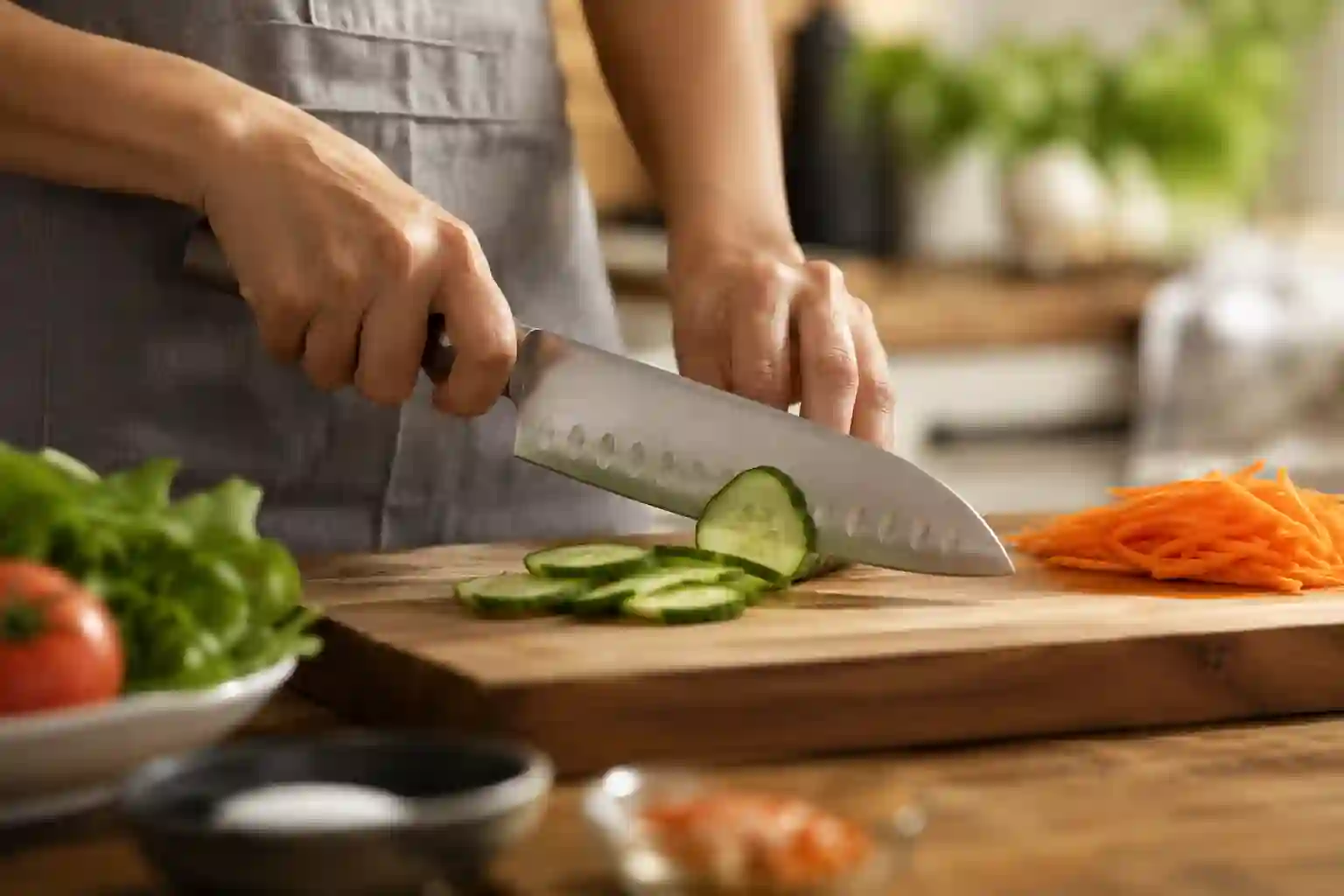
There is something deeply satisfying about turning a bag of carrots and a head of cabbage into perfectly uniform slices that cook evenly and look impressive on the plate. For vegetable-focused cooks, a Santoku knife hits the sweet spot: a shorter, flatter blade that encourages a controlled rocking or chopping motion, less bounce on cutting boards, and often a Granton or hollow edge to stop sticky vegetables from clinging to the blade. People buy a Santoku for vegetables because it simplifies prep, protects fingers, and reduces fatigue during big salad or stir-fry sessions.
Buyers often make the same mistakes: choosing the flashiest finish over blade steel, grabbing a one-size-fits-all 8-inch chef when a 6 to 7-inch Santoku would be faster for weekday veg prep, or ignoring handle fit. What matters most is edge geometry, blade finish, and balance between blade and handle. Some cooks want a razor-thin Japanese grind for delicate slicing. Others prefer a tougher German-style steel that tolerates a little rough use and keeps an edge with simpler maintenance. Your ideal knife depends on how you prep, how often you sharpen, and whether you prioritize absolute paper-thin slices or rugged everyday reliability.
If you want a quick recommendation, the imarku 7-inch Santoku lands at the top for vegetable work because of its thin, hollow-edge blade and balanced pakkawood handle that keeps slices clean and even. Below is a quick comparison table to help you scan the top picks fast.
If you are short on time, the table below gives a fast snapshot of features and which knife suits different veggie tasks. Click any product name to jump to its full review further down.
Best Santoku Knives For Vegetables Comparison Table
| Product | Best For | Main Strength | Blade Material |
|---|---|---|---|
| imarku 7″ Santoku | All-round vegetable prep | Hollow edge reduces sticking | High-carbon stainless |
| Home Hero 2-Piece Santoku | Budget shoppers, beginners | Protective sheath included | 3Cr13 stainless |
| Cutluxe 7″ Santoku | Durability and edge retention | Forged German steel, 56+ HRC | High-carbon German steel |
| Cutluxe 5″ Santoku | Small hands, precise cuts | Compact control and grooves | High-carbon German steel |
| DDF iohEF 7″ Santoku | Balanced feel for long sessions | Well balanced, 58 HRC | Japanese stainless 5Cr15Mov |
| HENCKELS Solution 2-pc Set | Trusted brand, set buyers | Reliable stamped construction | Stainless steel |
| imarku 5″ Santoku | Maneuverability and fine slicing | Short blade for accuracy | Japanese high-carbon |
| MOSFiATA 7″ Santoku | Starter to mid-level cooks | Full tang and extras kit | EN.4116 German steel |
| Babish 6.5″ Santoku | Balanced daily veggie work | Granton edge for reduced drag | 1.4116 German steel |
The reviews below dig into each knife, how it performs with vegetables, who it suits, and realistic tradeoffs so you can pick the one that fits your kitchen style.
1. Best Overall: imarku Chef Knife 7 Inch Santoku

One reason this imarku 7-inch Santoku stands out is the hollow-edge blade and the hand-polished 15-18 degree edge. In real kitchens, that means cucumber slices fall away cleanly instead of sticking to the blade. Picture yourself prepping a big summer salad: cherry tomatoes, peppers, and zucchini get through the lineup fast with less wiping between cuts. Another scene is a weekday stir-fry where thin, even carrot ribbons and onions need to cook consistently; the blade geometry here helps you hit uniform thickness every time.
The pakkawood handle is ergonomically shaped to reduce wrist tension during long prep. For home cooks who go through a weekend farmer’s market haul or who entertain often, that handle and the blade thickness around 2.5mm deliver a satisfying balance of control and slicing speed. The steel is marketed as high-carbon stainless, giving reasonable edge retention while still resisting corrosion for those who prefer lower-maintenance blades.
Pros
- Hollow-edge design minimizes food sticking, great for wet vegetables.
- Comfortable pakkawood handle reduces wrist fatigue in longer prep sessions.
- Sharp factory edge capable of thin vegetable slices right out of the box.
- Well-balanced for both push-cut and rocking styles.
- Comes in a gift box, making it a solid present for cooks.
Cons
- Blade is thin enough that rough cutting on ceramic boards may nick it.
- Pakkawood handle, while stable, needs proper drying to maintain finish.
For cooks who prep a lot of vegetables and want a workhorse that feels lively in the hand, this imarku is a versatile pick. It mixes a Japanese-style edge with features that reduce sticky produce problems, making it particularly good for tomatoes and potatoes, where sticking is common. If you are looking for a heavier, more hammer-like blade for root vegetables, you might prefer a thicker German-style santoku. This imarku is best for those who value control and clean slicing in salad and stir-fry prep.
To buy this product, click here.
2. Best Budget: Home Hero 2 Pcs Santoku Knife with Sheath
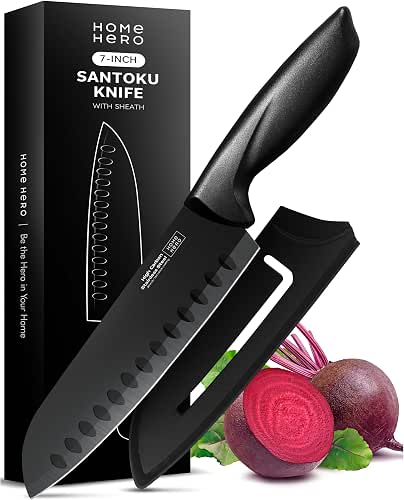
If you are learning knife skills or equipping a small apartment kitchen, inexpensive knives that still do a real job can be liberating. The Home Hero two-pack gives you that freedom with protective sheaths so the blades survive being tossed in a drawer. Imagine packing a picnic where you want a reliable vegetable-slicing blade without adding a bulky block to your counter. Another scenario is gifting a new renter who needs basics: these knives cover most veg prep tasks and come boxed attractively.
The stainless steel used here is 3Cr13, a budget-friendly grade that is workable and holds an edge well enough for casual cooks. The non-stick coated blade helps with sticky items like avocado or grated potato, and the ergonomic plastic handles are simple to grip for short sessions. For routine weekday chopping, these knives deliver a lot of value for the price and clean up quickly.
Pros
- Very affordable way to add Santoku capability to a kitchen.
- A protective sheath is included for safe storage and transport.
- Non-stick blade coating reduces sticking on wet vegetables.
- Comfortable ergonomic handle for quick prep.
- Comes as a two-piece bundle for extra value.
Cons
- Steel is softer than premium options, so the edge will require more frequent touch-ups.
- Coating can wear over time with heavy use or improper cleaning.
This Home Hero set is aimed at beginners, students, or anyone who needs a decent Santoku without a big commitment. It performs best in light to medium prep: slicing peppers, cutting herbs, and segmenting citrus. If you plan extended daily vegetable processing or you prefer professional edge retention, consider stepping up to a forged steel option. For casual cooks who want safety and value, these are very practical.
To buy this product, click here.
3. Best Value: Cutluxe Santoku Knife 7″

For cooks who want a long-lasting edge without spending into premium brands, the Cutluxe 7-inch Santoku blends forged German steel with an ergonomic pakkawood handle. Visualize prepping a winter root vegetable roast where you rough-chop sweet potatoes and parsnips for hours. The 56+ Rockwell hardness helps the blade keep its edge over many sessions, saving you time sharpening. Another real-world moment is slicing through dense butternut squash, where a sturdy, full-tang construction gives confidence and stability.
The hand-sharpened 14-16 degree edge strikes a balance between sharpness and durability, so you can make fine slices yet handle tougher produce when needed. The included sheath protects the blade, and the triple-riveted pakkawood handle provides a secure grip even when your hands are wet from rinsing veggies. The lifetime warranty is a practical reassurance for buyers who expect daily use.
Pros
- Forged German steel offers solid edge retention and toughness.
- Full tang and triple-riveted handle for long-term durability.
- Hand-sharpened edge gives precise slicing for thin vegetable cuts.
- Lifetime warranty supports long-term ownership.
- Sheath included for storage and travel.
Cons
- Slightly heavier than thin Japanese blades, which may fatigue small hands.
- Pakkawood needs care to keep its finish over time.
This Cutluxe is for cooks who want a durable, all-purpose Santoku that will tolerate heavy use while still delivering nice slices. It is an excellent kitchen workhorse for roasting prep, chopping fennel, or trimming winter squashes. Those who want the absolute thinnest possible edge for sashimi-style slicing should look at dedicated Japanese blades, but for everyday vegetable work this is a hard-to-beat value.
To buy this product, click here.
4. Best For Small Hands: Cutluxe Santoku Knife 5″
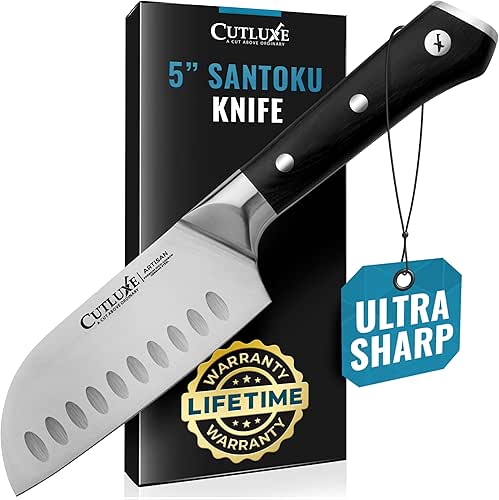
For many home cooks, a full-size 7-inch Santoku can feel unwieldy. The Cutluxe 5-inch version solves that by bringing a compact footprint and precise control. Picture a mid-week snack prep where you are trimming asparagus and peeling small shallots. The shorter blade converges cutting force toward the tip, which helps with fine trimming work. Another scenario is teaching a teenager to chop safely; the 5-inch blade is friendlier for smaller hands and reduces the intimidation factor at the board.
The grooved sides help release veg slices, which is useful for sticky items like peeled apples or sticky rice cakes. Cutluxe keeps the same German high-carbon steel and hand-honed edge as their larger knives, so you get the performance of the brand in a more maneuverable format. This model is especially handy when you want control for paper-thin slices without swapping to a paring knife.
Pros
- Short blade offers superior control for small hands and precision cuts.
- Grooved sides reduce sticking for wet vegetables.
- High-carbon German steel maintains a strong edge.
- Triple-riveted pakkawood handle feels secure and balanced.
- A lifetime warranty adds confidence for long-term use.
Cons
- Less reach for large veg like melons or whole squash.
- A smaller size may require two-handed work for big batches.
This compact Cutluxe is a smart choice for cooks who value precision or who have smaller hands. It performs best with herbs, shallots, peppers, and radishes where accuracy matters. If you routinely cut large heads of cabbage or prep big roasting vegetables, you may want a larger blade in addition, but many cooks find the 5-inch santoku becomes their go-to for everyday slicing.
To buy this product, click here.
5. Best Balanced Option: DDF iohEF Kitchen Knife 7″

If your kitchen sessions are long and you want a knife that stays comfortable from prep to plating, the DDF iohEF 7-inch santoku emphasizes balance and ergonomics. Imagine prepping a giant ratatouille where you slice dozens of zucchini and eggplant. The balanced weight of the blade and stainless steel handle reduces wrist strain, so you maintain control through the last slice. Another scene is a weekend meal where left- and right-handed family members both reach for the same knife; the double-edged design suits both.
The blade’s claimed hardness near 58 HRC gives a good compromise between edge retention and ease of sharpening. The full stainless handle creates a clean, sanitary interface that many cooks appreciate for wet vegetable work, though it lacks the warm feel of wood. With a fine 15-degree edge per side, the knife performs well for thin slicing, julienne cuts, and general chopping.
Pros
- Well-balanced for long prep sessions and repetitive chopping.
- Double-edged blade suits left- and right-handed users.
- Higher hardness rating helps edge retention for frequent use.
- Stainless steel handle is easy to clean and hygienic.
Cons
- The full-metal handle is less forgiving on the hands during extended wet prep.
- Heavier overall feel may not suit those who prefer lightweight blades.
This DDF santoku is for cooks who prioritize balance and a universal grip. It thrives in scenarios with heavy vegetable throughput like family dinners or meal-prep sessions. If hand comfort and a warm grip matter more than hygienic metal surfaces, look at pakkawood-handled models. For those who share knives between left- and right-handed users, the symmetric edge is a genuine plus.
To buy this product, click here.
6. Best Trusted Brand: HENCKELS Solution Razor-Sharp 2-pc Knife Set
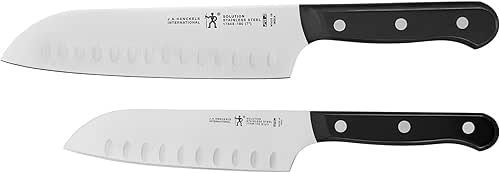
Heritage and consistency matter when you are investing in a tool you use every day. The HENCKELS Solution set gives you both a 5.5-inch and a 7-inch santoku from a brand with a long track record. Picture prepping for a dinner party where the 7-inch handles larger salads, and the 5.5-inch is perfect for smaller tasks like mincing garlic or trimming green beans. Another common use is gifting to a newly independent adult who needs reliable knives that behave predictably.
These precision-stamped blades are thin and start out razor sharp. While they are not forged, their stamped construction keeps weight low and handling nimble. The satin finish resists staining, and the factory edge holds up well for routine household use. For cooks who prefer low-fuss knives that still provide consistent results, this set is a comfortable middle ground between budget and artisan forged blades.
Pros
- Trusted brand with long-term reputation for consistent quality.
- Lightweight stamped blades are easy to handle for fine vegetable work.
- Set includes two useful sizes for different kitchen tasks.
- Low-maintenance finish and easy cleanup.
Cons
- Stamped blades are less robust than forged alternatives for heavy-duty use.
- Edge retention is solid but not exceptional versus premium steels.
Choose the HENCKELS pair if you want predictable performance from a known maker. The set covers daily vegetable needs and makes the transition to sharper techniques simpler because the blades are easy to control. If you prefer a heavier, forged feel or want a boutique hand-finished edge, consider a different model, but for reliable everyday prep, this set is an excellent choice.
To buy this product, click here.
7. Best for Maneuverability: imarku Santoku Knife 5 Inch
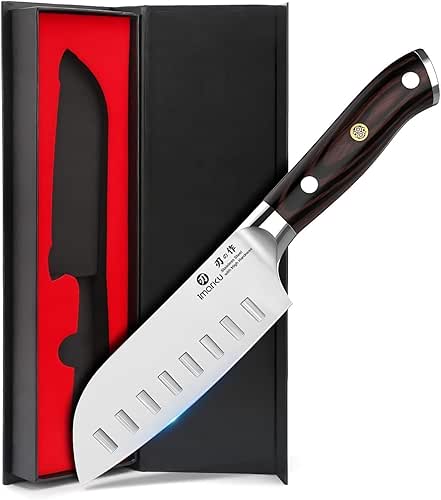
Smaller blades reward cooks who want pinpoint accuracy. The imarku 5-inch santoku is designed to bring cutting force to the tip, which helps with ultra-thin slices and delicate micro-prep tasks. Visualize slicing radishes paper-thin for pickling or peeling ginger with a small controlled motion. Another scenario is snack prep: trimming strawberries and segmenting citrus for a fruit plate, where a smaller blade feels nimble and safe.
The professional hand-polished edge and anti-stick blade texture make the 5-inch surprisingly capable for multi-course vegetable prep. The shorter blade also makes it easier to manipulate close to the cutting board, which is helpful when doing tasks that require a steady wrist. The pakkawood handle follows imarku’s ergonomic approach, so you get a comfortable grip without a bulky profile.
Pros
- Short blade gives excellent control for precision vegetable work.
- Anti-stick design reduces drag when slicing moist produce.
- Ergonomic handle fits smaller hands well and reduces fatigue.
- Hand-polished edge allows for thin, accurate cuts.
Cons
- Not ideal for large cutting tasks or long runs of prep.
- Smaller blade limits leverage for harder vegetables like winter squash.
The imarku 5-inch is a specialist everyday tool that shines on herbs, small fruits, and delicate veg slicing. It is a great companion to a larger santoku or chef’s knife rather than a solo kitchen blade. If you frequently chop heads of cabbage or large melons, you will need a larger blade in addition, but for controlled, precise work this small santoku is a joy to use.
To buy this product, click here.
8. Best Starter Kit: MOSFiATA Santoku Knife 7″
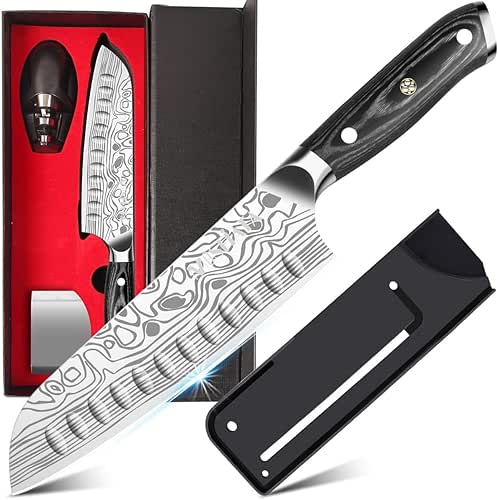
For cooks building a first proper kit, the MOSFiATA 7-inch santoku packages a lot of practical extras: sheath, finger guard, sharpener, and a handmade gift box. Imagine unboxing this before your first big meal prep and using the included sharpener to tune the edge. Another common scene is a household where multiple people share the knife; the full-tang construction and finger guard in the kit make it safe and versatile for communal use.
The forged EN.4116 German steel holds up well, and the micarta handle gives a secure grip even when hands are damp from rinsing vegetables. The set approach makes MOSFiATA an appealing first-step upgrade from supermarket knives because it offers both protection and maintenance tools so new owners can learn basic care right away.
Pros
- Comes with practical extras like a sharpener and sheath for safe storage.
- Forged German steel gives strength and decent edge retention.
- Micarta handle provides secure grip for wet vegetable prep.
- Attractive handmade gift box makes it easy to present.
Cons
- The included sharpener is basic; professional sharpening will still be required over time.
- Edge may need initial stropping to reach peak sharpness.
This MOSFiATA model is a strong pick for someone assembling a reliable kitchen kit who appreciates extras that simplify care and storage. It shines in multi-task vegetable prep where balance and safety accessories matter. If you already own a high-quality sharpener and storage solution, you may prefer a bare-bones blade without the extras.
To buy this product, click here.
9. Best For Reduced Stick: Babish 6.5 Inch Santoku
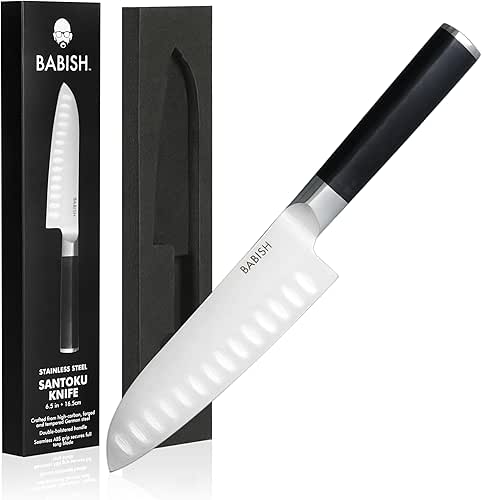
Sticky vegetables like grated potato or thinly sliced eggplant are where Granton or scalloped edges prove their worth. The Babish 6.5-inch santoku includes a Granton edge to create air pockets between the blade and food, so slices slide away cleanly. Imagine making latkes where you need crisp, even shreds; less sticking means faster throughput and fewer ragged edges. Another scenario is thinly slicing tomatoes for a tart where intact, tidy slices make a visual difference.
Forged from 1.4116 German steel and finished to a razor edge, this knife gives a responsive feel and balanced handling thanks to its full-tang construction. The blade length of 6.5 inches is a sweet middle ground for most vegetable tasks, giving reach without sacrificing control. If reduced drag and clean release are priorities, the Babish Santoku is engineered around those exact needs.
Pros
- Granton edge significantly reduces sticking on moist vegetables.
- Forged single-piece construction offers solid balance and durability.
- Comfortable full-tang handle for precise control.
- Good all-around size for most vegetable prep tasks.
Cons
- Granton edges can be slightly more difficult to sharpen uniformly at home.
- Not as light as some stamped blades for ultra-fast slicing.
Pick the Babish santoku if you are frequently slicing sticky or wet vegetables and you want clean, presentable pieces without stopping to scrape the blade. It handles both delicate and mid-weight tasks with composure. If you want a paper-thin Japanese slicer for sashimi work, look for a dedicated yanagiba or specialty slicer, but for vegetable-focused kitchens, this Babish knife is remarkably efficient.
To buy this product, click here.
Best Santoku Knives For Vegetables FAQ
What blade length is best for vegetable prep?
For most home cooks, a 6 to 7-inch Santoku balances reach and control. A 5-inch model is excellent for precision and small hands, while a 7-inch gives more board coverage for larger vegetables. Consider what you cut most often: small herbs and shallots point toward a shorter blade, while big winter squashes benefit from a longer blade or a dedicated chef’s knife.
Should I choose a hollow/Granton edge for vegetables?
Yes, hollow or Granton edges help reduce sticking on wet or starchy vegetables like tomatoes and potatoes. They are particularly helpful when slicing thin rounds or making large batches. The tradeoff is that scalloped grinds can complicate DIY sharpening, so factor in sharpening habits before choosing.
How important is steel type for vegetable knives?
Steel determines edge retention and ease of sharpening. Harder steels keep a keen edge longer but need finer sharpening stones and more care. For vegetable-heavy kitchens, a steel that balances sharpness and toughness—such as mid-hardness German or Japanese stainless—is often the best daily compromise.
Can I use a Santoku for all vegetable tasks?
Yes, Santoku knives handle most vegetable tasks elegantly. They excel at slicing, dicing, and mincing. For very heavy-duty tasks like breaking down melons or dense squash, you may still prefer a heavier chef’s knife or a cleaver-style blade, but a Santoku covers the majority of everyday prep.
How often should I sharpen my Santoku?
Frequency depends on use. Light home use may need an edge tune every few months with a honing rod and a full sharpen once or twice a year. Professional or heavy home use may require weekly honing and monthly sharpening. Using a quality honing rod and learning basic sharpening extends blade life and keeps vegetable slices precise.
Are pakkawood handles better than synthetic ones for vegetable prep?
Pakkawood offers a wood-like feel with better moisture resistance than natural wood. It provides warmth and grip, which many cooks prefer during long prepping sessions. Synthetic handles are easier to sanitize and often more durable under dishwashing, but they can feel less comfortable for long cutting sessions.
Is a Santoku better than a nakiri for vegetables?
Both excel with vegetables. A nakiri has a straight edge and square tip optimized for push cuts and chopping, which makes it ideal for rapid vegetable chopping. A Santoku is more versatile, combining slicing and chopping with a slightly curved belly for slight rocking motions. Choose nakiri for heavy, repeated chopping and Santoku for more varied tasks.
What cutting board is best with Santoku knives?
Use a wooden or high-quality plastic board for knife-friendly surfaces. Hard surfaces like glass or stone blunt edges quickly. For fine vegetable slicing, end-grain wood boards provide the best balance of edge preservation and stability under the blade.
Final Verdict
For crisp, clean vegetable prep, the imarku 7-inch Santoku earns the top spot because it combines a sharp 15-18 degree edge with a hollow grind that prevents sticking, giving you speed and precision across salads, stir-fries, and delicate slicing. Its ergonomic handle supports longer sessions, which makes it a versatile primary vegetable knife for most kitchens.
Budget buyers who need safe, practical knives will find the Home Hero two-pack a smart entry point, while the Cutluxe 7-inch represents the best value for cooks who want forged construction and long-term edge retention. Smaller-handed cooks should consider the compact Cutluxe 5-inch or the imarku 5-inch for accuracy. Across the nine picks, match blade length, edge type, and handle comfort to your prep style and sharpening habits. Invest in a basic sharpening routine and a good cutting board and your Santoku will transform vegetable prep into a faster, quieter, and more satisfying part of daily cooking.
Leave a Reply