Homeowners usually start looking for the best air compressors for home use when a routine task suddenly becomes more annoying than it should be. Maybe it is tire inflation in the garage, a brad nailer on a trim project, a dust-blowing cleanup job, or a weekend paint touch-up. The right compressor can make those jobs quicker and cleaner, but the wrong one becomes a noisy, underpowered box that takes up space and never feels ready when you need it.
One common mistake is buying for headline pressure alone and ignoring the real work the compressor has to do. Tank size, airflow at a usable pressure, noise, portability, and maintenance all matter just as much. Some buyers want a compact inflator they can keep in the car or hall closet. Others need a small shop compressor that can handle finish tools without constantly cycling. A few are better served by a larger garage unit with enough reserve to support more demanding projects. The best choice depends on how often you use it, where it will live, and how much noise or upkeep you are willing to tolerate.
The most practical choice in this group is the Klutch 20-Gallon Air Compressor, which gives home users a more capable, longer-running setup than the small portable units while still staying within a reasonable footprint for a garage or workshop. It is not the right answer for everyone, but it is the kind of compressor that makes sense when you want real versatility without jumping all the way to a bulky shop machine.
If you are short on time, the comparison table below gives a fast snapshot of the best options for different kinds of home use.
Best Air Compressors For Home Use Comparison Table
| Product | Best For | Main Strength | Key Specs |
|---|---|---|---|
| Klutch 20-Gallon Air Compressor | Serious garage and workshop use | Strong capacity and steady recovery | 2 HP, 20-gallon class, 175 PSI |
| AstroAI Tire Inflator | Travel, tires, and inflatables | Dual power convenience | 12V DC and 120V AC, up to 150 PSI |
| Bostitch 6 Gallon Pancake Compressor | Finish work and light home projects | Balanced output and included accessory kit | 150 max PSI, 2.6 CFM @ 90 PSI |
| California Air Tools CAT-1P1060S | Indoor work and noise-sensitive spaces | Very quiet operation | 56 dBA, 1 gallon tank, 0.6 HP |
| VEVOR 6.3 Gallon Air Compressor | Mixed DIY and light tool use | Good airflow for the size | 2 HP, 3.35 CFM @ 90 PSI, oil-free |
| Ironton Oil-Free Pancake Air Compressor | Budget-minded homeowners | Simple, compact, easy to move | 3 gallons, 110 PSI, 0.3 HP |
| CARSUN AC/DC Tire Inflator | Basic roadside and home inflation | Low-cost dual-power portability | 110V AC and 12V DC, up to 150 PSI |
| CRAFTSMAN V20 Tire Inflator | Owners already in the CRAFTSMAN battery system | Three power options | Cordless, 120V, 12V adapter |
| CRAFTSMAN 2-Gallon Air Compressor | Portable home and garage use | Lightweight with useful accessories | 2 gallons, 125 PSI, 1/3 HP |
The reviews below explain how each model differs in real use, which ones make sense for different home projects, and where the tradeoffs begin to matter.
1. Best Overall: Klutch 20-Gallon Air Compressor

The Klutch 20-gallon compressor is the kind of machine that immediately makes sense for a homeowner who wants more than occasional inflation duty. Its 2 HP motor and larger tank capacity put it in a more useful category for garage projects, trim work, and light-to-moderate pneumatic tool use. That extra reserve matters. Instead of waiting constantly for recovery, you get a compressor that is better suited to longer sessions and more consistent output, which is exactly what many home users discover they need after trying a small inflator or a tiny pancake unit.
What stands out here is the balance between durability and practicality. The splash oil-lubricated cast iron twin-cylinder pump, thermal overload protection, and oil sight gauge suggest a compressor built for regular use rather than occasional emergencies. It is still a home machine, not a full commercial setup, but it is the one in this roundup that most closely bridges that gap. If you are working in a garage, doing auto maintenance, or using tools that benefit from better air reserve, this is the most complete choice in the group.
Pros
- Large tank capacity gives it more staying power for longer home projects.
- 2 HP motor and belt-driven design help support steadier recovery.
- Oil-lubricated cast iron pump is a strong sign of durability.
- Thermal overload protection adds a useful layer of peace of mind.
- Better suited than compact models for repeated garage and workshop use.
Cons
- It is more compressor than casual users need.
- Requires more space than a portable pancake or inflator-style model.
- Oil-based maintenance means a little more attention than an oil-free unit.
This is the pick for homeowners who want one compressor that can do a lot of different jobs without feeling underbuilt. It makes the most sense if you use air tools often enough to care about recovery time and tank reserve. Buyers who only need occasional tire top-offs or inflatables should look lower in the list, but anyone with a real garage toolkit will appreciate the extra capability. To buy this product, click here.
2. Best For Roadside Use: AstroAI Tire Inflator

The AstroAI Tire Inflator is not trying to be a shop compressor, and that is exactly why it belongs here. For many households, the real compressor needs are simple: keep tires at the right pressure, handle a bike now and then, and inflate a few sports or camping items. This model is tailored to that everyday reality with dual AC and DC power, which means it can work from a wall outlet at home or a car socket on the road. That flexibility is one of its biggest advantages.
AstroAI also gives this unit a more polished feel than many bargain inflators. The digital display, preset shutoff, LED light, and memory function make it easy to use without guesswork. The dual metal motors and metal cylinder are reassuring for a compact inflator, especially because many buyers worry about overheating or short runtimes in this category. It is still limited by its size, and the fine print about cooldowns is worth respecting, but for households that value convenience over raw power, this is a smart little utility tool.
Pros
- Dual AC and DC power make it useful at home and in the car.
- Auto shutoff helps prevent overinflation.
- Digital readout is easy to follow in dim light or when you are in a hurry.
- Useful for cars, bikes, small inflatables, and sports gear.
- Compact storage makes it easy to keep in a garage or trunk.
Cons
- Not designed for heavy-duty truck tires.
- Runtime limits mean it is better for short inflation jobs than long sessions.
- Can require cooldown time if used repeatedly.
This is a good fit for drivers, families, and casual users who want one compact inflator for several simple jobs. It is not the answer for power tool work, but it does exactly what a lot of home users need and does it with less hassle than a larger compressor. To buy this product, click here.
3. Best For Finish Work: Bostitch 6 Gallon Pancake Air Compressor

The Bostitch 6-gallon pancake compressor lands in a sweet spot for many home workshops. It is compact enough to move around easily, but it offers enough output to support common finish tasks that small inflators simply cannot handle. With 150 max PSI and 2.6 CFM at 90 PSI, it is aimed squarely at the homeowner who needs a dependable compressor for nailers, trim work, and general light-duty tool use. That makes it more versatile than a tire-only pump, yet much easier to live with than a large garage compressor.
The included 13-piece accessory kit also makes it more appealing to a first-time buyer. You are not just getting the compressor itself, but a hose and a useful set of inflation and blow-off accessories that reduce the need for immediate add-ons. The maintenance-free, oil-free pump is another practical advantage for home users who would rather spend time on projects than on compressor upkeep. It is not the quietest or the most powerful unit in the category, but it is well matched to the kind of light carpentry and household work many people actually do.
Pros
- Good fit for finish nailers and other light home workshop tools.
- Oil-free pump keeps maintenance simple.
- Compact pancake shape is easy to store and move.
- Accessory kit adds immediate usefulness out of the box.
- Two couplers make shared use more practical.
Cons
- Not the best choice for long runtimes with larger tools.
- More limited than bigger tank compressors for sustained work.
- Accessory bundle is helpful, but it does not change the compressor’s core capacity.
Choose this one if your home projects lean toward trim, cabinetry, occasional fastening, and general garage tasks. It is a smart middle ground for buyers who want a real compressor without overspending on a more industrial unit. To buy this product, click here.
4. Best Quiet Option: California Air Tools CAT-1P1060S

If noise is your biggest complaint about compressors, the California Air Tools CAT-1P1060S is the obvious standout. At 56 dBA, it is built for buyers who need air power in a space where a loud compressor would be genuinely annoying, such as a basement shop, shared garage, apartment storage room, or indoor craft area. That quiet profile gives it a very different personality from most compressors in this roundup. It feels more like a specialist tool than an all-purpose workhorse, but in the right setting, that specialization is exactly what makes it attractive.
Its 1-gallon tank and modest airflow mean it is not trying to run demanding pneumatic tools for long stretches. Instead, it is best for brad nailers, staplers, airbrush work, light inflation, and cleanup tasks. The oil-free pump is a welcome convenience, and the low operating speed helps support its reputation for long service life. For people who put a premium on comfort and a calmer workspace, this is one of the easiest compressors to recommend. The tradeoff is simple: you are giving up capacity and punch in exchange for a much more civilized experience.
Pros
- Exceptionally quiet compared with most home compressors.
- Lightweight and easy to move around the house or garage.
- Oil-free design reduces routine maintenance.
- Well suited to airbrushing and light finish work.
- Works well where noise matters more than high output.
Cons
- Small tank limits extended tool use.
- Not intended for more demanding air tools.
- Less versatile than larger compressors for general garage work.
This is the right call for buyers who value a quiet workspace and only need light-duty compressed air. If you want to work indoors without turning the room into a racket, it is hard to ignore. If you need more reserve or plan to run several tools, move on. To buy this product, click here.
5. Best Value For Light Garage Use: VEVOR 6.3 Gallon Air Compressor

The VEVOR 6.3-gallon compressor looks aimed at homeowners who want more capability than a tiny inflator but do not want to jump to the size or cost of a larger garage unit. Its 2 HP motor and 3.35 CFM at 90 PSI give it decent working range for tasks like inflation, spray work, light nailing, and general auto repair chores. That makes it one of the more capable mid-size entries here, especially for buyers who want a bit of everything rather than a single narrow use case.
VEVOR has also paid attention to heat management and noise control, both of which matter in home use. The dual silencers, cooling fans, and overheating protection are reassuring details for people who expect a compressor to run often enough to be worth keeping around. It is oil-free, which simplifies maintenance, and the structural steel tank design suggests the company is thinking about durability rather than just list price. The main thing to remember is that this unit still lives in the light-to-moderate category. It is a good home utility compressor, not a substitute for a serious shop machine.
Pros
- Strikes a useful balance between size and capability.
- Oil-free design keeps upkeep straightforward.
- Better airflow than many compact home compressors.
- Noise reduction and cooling features improve everyday usability.
- Versatile enough for inflation, light spray work, and nailing.
Cons
- Still not ideal for heavy, continuous tool demands.
- Less refined brand reputation than some legacy names.
- May be more compressor than a casual tire user needs.
This is a strong option for shoppers who want a practical home compressor with real versatility and do not mind choosing a less familiar brand to get that value. It makes the most sense for a garage that sees regular but not professional-grade use. To buy this product, click here.
6. Best Budget Compressor: Ironton Oil-Free Pancake Air Compressor

The Ironton 3-gallon pancake compressor is the kind of compact, no-frills machine that appeals to practical shoppers. It keeps the design simple, the footprint small, and the maintenance burden low. For a homeowner who wants a basic compressor for nail guns, inflation, and cleanup tasks, that simplicity is valuable. The fold-down handle and cord storage also make it easier to stash in a garage cabinet or carry from one project to another without feeling bulky.
Its biggest limitation is also the reason it lands in the budget spot. The 0.3 HP motor and 110 PSI maximum pressure tell you this is not meant for demanding air tools or long duty cycles. That is fine if your needs are modest. The wide base and pancake form factor should help with stability, and the oil-free pump means there is less to think about over time. If you are shopping strictly for the lowest-cost path into compressed air and you know your projects are light, this is a sensible compromise.
Pros
- Low-maintenance oil-free design is easy for beginners.
- Compact and portable for small garages or storage areas.
- Stable pancake base helps keep it planted during use.
- Useful for inflation, stapling, nailing, and cleanup.
- Simple controls make it approachable for first-time buyers.
Cons
- Not intended for high-demand pneumatic work.
- Limited power compared with 6-gallon and larger units.
- More of a light-duty helper than a do-it-all compressor.
Buy this if your priorities are price, simplicity, and portability, and you are not expecting it to do the work of a much larger compressor. It is a sensible starter option for basic household and garage tasks. To buy this product, click here.
7. Best Compact Dual-Power Inflator: CARSUN AC/DC Tire Inflator

The CARSUN AC/DC inflator is best understood as a convenience tool, not a full compressor. That distinction matters. For homeowners who want something inexpensive and easy to keep around for car tires, bicycle tires, sports equipment, and occasional inflatables, it offers a sensible mix of features. Dual power is the headline here. Being able to use it from a wall outlet or a vehicle socket gives it more flexibility than a lot of ultra-compact inflators in this price range.
The digital display, preset modes, and auto shutoff make it user-friendly, especially for people who do not want to monitor pressure continuously. Its portability is another plus. You can keep it in the house, the garage, or the car without needing a dedicated shelf. The downside is that it is not built for anything beyond light inflation. CARSUN is also upfront that it is not for truck or tractor tires, which is the kind of limitation shoppers should respect. For everyday household inflation needs, though, it is an easy recommendation.
Pros
- Useful dual power setup for home and vehicle use.
- Auto shutoff simplifies inflation and helps prevent mistakes.
- Digital display is easy to read in different lighting conditions.
- Small enough to store almost anywhere.
- Good for tires, balls, and other light inflatables.
Cons
- Not suitable for heavy-duty truck or tractor tires.
- Limited duty cycle makes it a light-use tool only.
- Not a replacement for a real compressor if you need air tools.
Choose this if you want a simple, inexpensive inflation tool for everyday household use and you do not need workshop-level performance. It is especially useful as a backup or emergency inflator. To buy this product, click here.
8. Best Cordless-Friendly Inflator: CRAFTSMAN V20 Tire Inflator

The CRAFTSMAN V20 Tire Inflator earns its place by offering a rare amount of power-source flexibility. If you already own CRAFTSMAN V20 batteries, this can be an especially attractive add-on because it can run cordless, from a wall outlet, or from a 12V car adapter. That kind of versatility is useful in the real world, where inflation jobs do not always happen in one place. You might use it in the driveway one day and in the garage the next.
What it does best is keep tire and low-volume inflation simple. The automatic shutoff and digital gauge are the features most shoppers will appreciate because they reduce guesswork and make the tool feel more polished. The catch is that the battery and charger are sold separately, so the true value depends on whether you already live in that cordless ecosystem. If you do, this is a convenient and logically designed inflator. If not, the total cost is less appealing than it first appears.
Pros
- Three power options make it unusually flexible.
- Works well for car tires and other low-volume inflation tasks.
- Automatic shutoff adds convenience and confidence.
- Digital PSI gauge is easy to monitor.
- Good choice for existing CRAFTSMAN battery owners.
Cons
- Battery and charger are not included.
- Not meant for serious compressor-style tool use.
- Best value depends heavily on system ownership.
This is the right pick for CRAFTSMAN tool users and anyone who wants a flexible inflator they can take from house to car without much thought. It is not a general-purpose air compressor, but it is a practical portable solution. To buy this product, click here.
9. Best Portable All-Rounder: CRAFTSMAN 2-Gallon Air Compressor
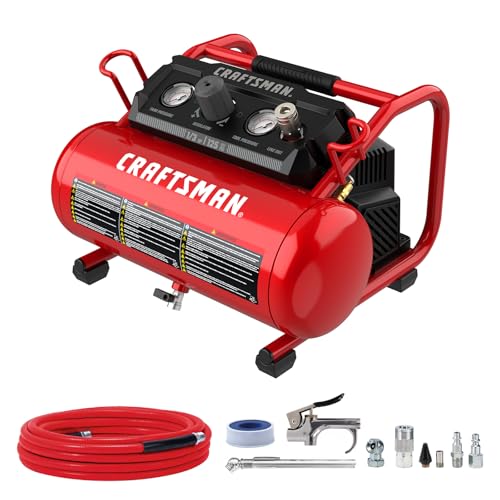
The CRAFTSMAN 2-gallon compressor is a practical middle ground for homeowners who want something more useful than a pure inflator but more compact than a larger garage unit. At 19 pounds, it is easy to move and store, and the included accessory kit gives it immediate utility for a range of home tasks. That matters because many people buying their first compressor do not want to spend another afternoon assembling a pile of extras before they can do anything with it.
With a 1/3 HP motor, 125 PSI maximum pressure, and oil-free maintenance-free pump, this unit is clearly geared toward simple reliability over brute force. It is suitable for inflation, light nailing, and small workshop jobs, but it is not the compressor for big run times or demanding pneumatic tools. That said, the combination of portability, accessory bundle, and brand familiarity makes it a good candidate for homeowners who value convenience and modest all-around usefulness. It is the sort of compressor you actually keep accessible rather than buried in a back corner.
Pros
- Lightweight enough for easy carrying and storage.
- Accessory kit adds useful parts right away.
- Oil-free pump reduces maintenance demands.
- Good for light home, garage, and inflation tasks.
- Two quick couplings add some everyday flexibility.
Cons
- Not powerful enough for larger or continuous air-tool jobs.
- Smaller tank means shorter usable sessions.
- Better as a compact helper than a primary workshop compressor.
This is a strong choice for homeowners who want a portable compressor that can cover the basics without becoming cumbersome. It is especially appealing if you need a compact unit for intermittent use and appreciate having accessories included. To buy this product, click here.
How We Chose
To narrow the field, the focus stayed on practical home use rather than raw specification chasing. That meant weighing tank size, airflow, pressure, noise, portability, and maintenance burden against the kinds of jobs homeowners actually do. A compressor that looks impressive on paper but is awkward in a garage or too loud for indoor use is not a good home pick, no matter how high the pressure rating appears.
Preference also went to products that solve distinct problems. Some buyers need a quiet machine for finish work. Others need a compact inflator for tires and travel. Still others want a bigger garage compressor that can run longer and recover faster. By separating those use cases, the roundup aims to be more useful than a generic list. Each recommendation reflects a different kind of household need, which is how real buying decisions are usually made.
Buying Guide
Choosing among the best air compressors for home use starts with a simple question: what will you actually do with it? If the answer is mostly tires, sports gear, and air mattresses, a compact inflator is the most sensible and least expensive route. If you plan to run brad nailers, staplers, or other light pneumatic tools, you should look at pancake or small tank compressors. If you expect more frequent garage work, longer sessions, or broader utility, a larger tank model becomes worth the extra size and cost.
Tank size matters because it determines how long you can work before the compressor has to recover. Larger tanks are not always better, but they are helpful when you want steadier delivery. Airflow, usually expressed in CFM at a given PSI, matters just as much because tools need usable air, not just pressure numbers. A compressor with a high max PSI but weak airflow can disappoint quickly. For home buyers, the sweet spot is often a unit that balances both instead of excelling in only one area.
Noise is another decision point that gets overlooked. If your compressor will live in a basement, attached garage, or shared space, a quieter model can genuinely improve the experience. Similarly, maintenance should not be ignored. Oil-free designs are easier to live with, while oil-lubricated machines may offer durability advantages but ask for more care. Neither is universally better. It depends on whether convenience or long-term serviceability matters more to you.
Portability also deserves real attention. A small compressor that is easy to grab will get used more often than a better one that is miserable to move. That is why compact inflators and light pancake units remain popular for home use. In the end, the best choice is usually the one that fits your space, matches your projects, and feels easy enough to keep ready.
Best Air Compressors For Home Use FAQ
What Size Air Compressor Is Best For Home Use?
For basic tire inflation and small inflatables, a compact inflator is usually enough. For brad nailers, staplers, and occasional garage work, a 3 to 6-gallon compressor is often the sweet spot. If you want a more capable all-around garage machine, a larger tank such as the Klutch 20-gallon model is a better fit.
Is An Oil-Free Air Compressor Better For Homeowners?
Oil-free compressors are often easier for homeowners because they need less routine maintenance. They are a good choice if you want something simple and low-fuss. Oil-lubricated models can be more appealing for heavier use, but they usually require more attention and are not always necessary for home projects.
How Much PSI Do I Need For Home Projects?
Many home inflation and finish-tool jobs are well served by compressors in the 110 to 150 PSI range. For a lot of users, the more important number is airflow at working pressure. A higher PSI rating is useful, but it should not distract you from the compressor’s actual ability to keep tools running.
Can I Use A Small Compressor For Painting?
Small compressors can handle very light paint touch-up or airbrush tasks, but they are usually not ideal for larger painting jobs. Spray painting needs consistent airflow, and smaller tanks can run out of reserve quickly. If painting is a major part of your plan, look for better airflow and a larger tank.
Are Quiet Compressors Worth Paying More For?
Yes, if the compressor will be used in a garage, basement, or shared space where noise matters. Quiet models are especially appealing for homeowners who work early, live close to others, or simply dislike the usual compressor racket. If the unit will live in a detached shop, noise may matter less.
Should I Buy A Tire Inflator Or A Full Compressor?
If all you need is tire and inflatable maintenance, buy a tire inflator. If you plan to use air tools, even occasionally, choose a true compressor. That one decision usually saves money and frustration because inflators are built for a narrow job, while compressors are built for broader utility.
What Is The Most Important Feature For A First-Time Buyer?
Ease of use is usually the best starting point. Look for clear controls, manageable size, and a design that matches your projects. A compressor is only useful if you are willing to keep it accessible and use it often. For many first-time buyers, that means choosing a unit that is not bigger or louder than they will tolerate.
Final Verdict
The Klutch 20-Gallon Air Compressor is the strongest overall pick in this roundup because it offers the most convincing mix of capacity, durability, and usefulness for real home garage work. It is the machine for buyers who know they will use compressed air often enough to justify a larger and more capable setup. It is not the smallest, cheapest, or quietest option here, but it is the one that feels most ready for regular ownership rather than occasional novelty use.
For budget-minded shoppers, the Ironton Oil-Free Pancake Air Compressor is a sensible entry point, while the California Air Tools CAT-1P1060S is the best fit for quiet, indoor-friendly use. The right decision comes down to your space, your projects, and how often you want to rely on the compressor. If you mostly inflate tires, a compact inflator will make more sense. If you expect to use nailers, cleanup tools, or other air-driven gear, step up to a real tank compressor. Match the machine to the job, and you are far more likely to be satisfied with it long after the purchase is over.
Leave a Reply