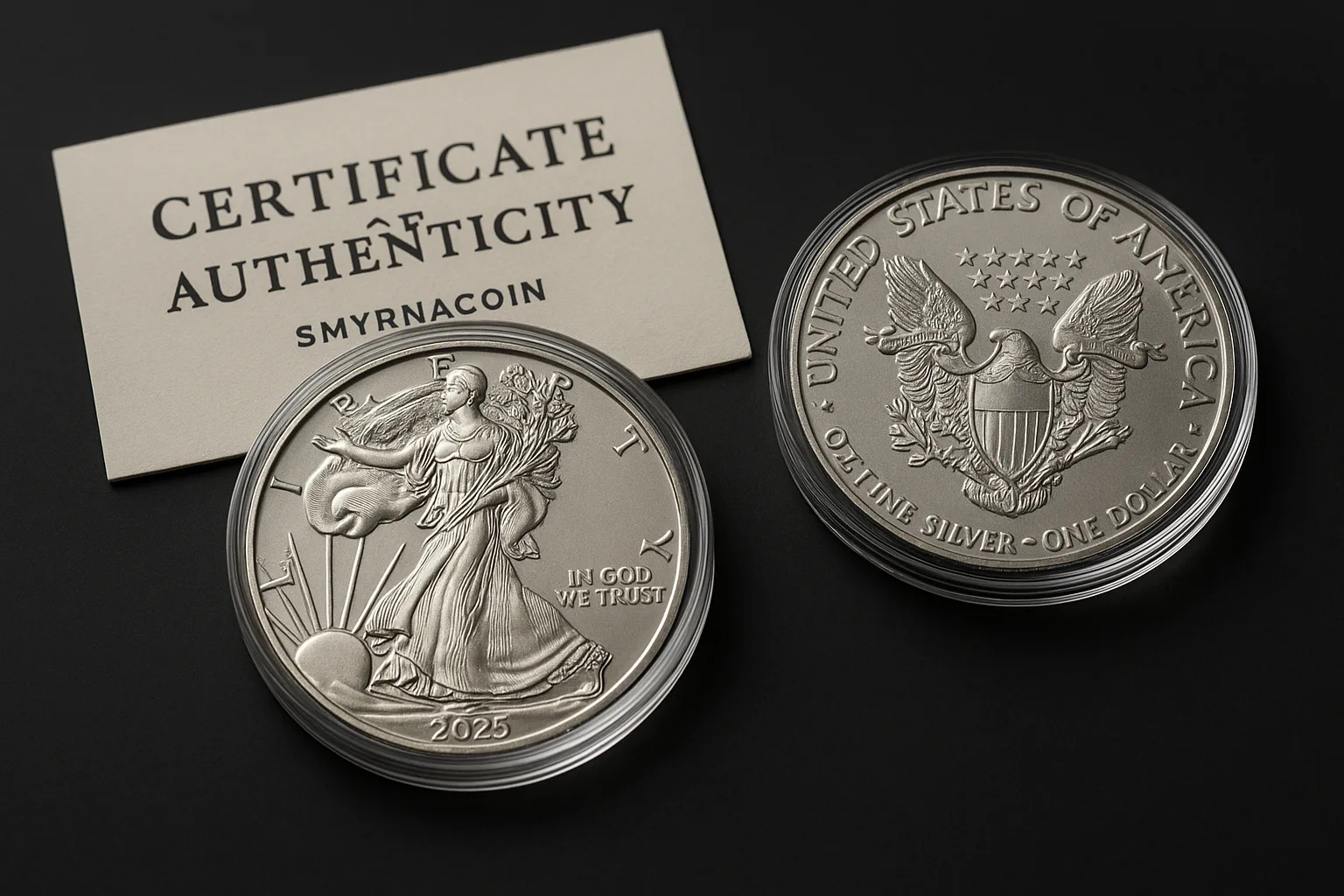
The American Silver Eagle stands as a cornerstone of modern coin collecting and precious metal investing. The newly released 2025 American Silver Eagle – a $1 U.S. legal tender coin containing one troy ounce of 99.9% pure silver – continues the proud legacy of this iconic series. As the official silver bullion coin of the United States, it is renowned worldwide for its stunning design and reliable silver content, making it both a beautiful collector’s item and a solid investment piece.
Renowned for its breathtaking Walking Liberty obverse design and the majestic bald eagle on its reverse, the Silver Eagle series has been a symbol of American pride and artistry for nearly four decades. Each annual release draws strong interest from collectors and investors alike. Every Silver Eagle is backed by the U.S. government for its weight and purity, meaning you are guaranteed a full troy ounce of fine silver in every coin. The 2025 edition is no exception – it offers a Gem Brilliant Uncirculated coin that showcases sharp detail, radiant mint luster, and all the hallmarks of quality that the series is known for.
What sets this particular offering apart is the inclusion of a SmyrnaCoin Certificate of Authenticity, which accompanies the coin to verify its genuineness and specifications. This added layer of assurance is especially welcome for new collectors or those giving the coin as a gift. It’s also worth noting that the 2025 Silver Eagle has quickly become a top seller in the coin market – even achieving a #1 best-seller rank among collectible coins online, with hundreds of coins snapped up within weeks of release. In this in-depth review, we’ll explore the design, features, history, and value of the 2025 American Silver Eagle, and explain why it’s a must-have addition to your collection or portfolio.
Overview of the 2025 American Silver Eagle
In summary, here are the key features and specifications of the 2025 American Silver Eagle at a glance:
-
Composition & Weight: One troy ounce of 99.9% fine silver (pure silver content, with trace copper for hardness).
-
Denomination: $1 USD face value (legal tender, though its precious metal content far exceeds this value).
-
Year & Mint: 2025 issue, struck by the United States Mint (primarily at the West Point Mint for bullion coins, no mint mark on the coin).
-
Condition: Gem Brilliant Uncirculated (BU) – a mint-fresh, uncirculated coin with full original luster and no wear (comparable to a high Mint State grade).
-
Design: Obverse – Walking Liberty by Adolph A. Weinman (Lady Liberty striding toward the sunrise, draped in the U.S. flag, with laurel and oak branches in hand). Reverse – Eagle Landing by Emily Damstra (a bald eagle descending with an oak branch in its talons; the “Type 2” design introduced in 2021).
-
Edge: Reeded edge (with a subtle interrupted reeded security gap as an anti-counterfeiting feature introduced in 2021).
-
Authenticity Certificate: SmyrnaCoin Certificate of Authenticity included – a printed certificate from the seller verifying the coin’s year, purity (.999 fine silver), weight (1 oz), and authenticity.
-
Dimensions: Approximately 40.6 mm in diameter and 2.98 mm thick (a sizable silver dollar coin).
-
Guarantee: Weight, content, and purity guaranteed by the U.S. government – each coin’s metal content is officially certified by the U.S. Mint, adding a high level of trust and credibility.
With these basics in mind, let’s dive deeper into the coin’s design details and what makes the 2025 Silver Eagle such a special piece.
Design and Features
One of the biggest draws of the American Silver Eagle is its gorgeous and meaningful artwork. Both sides of the coin carry designs rich with history and symbolism. Here we break down the obverse and reverse designs, as well as a note on the coin’s edge and security features.
Obverse: “Walking Liberty” by Adolph A. Weinman
The obverse (heads side) of the 2025 Silver Eagle features the Walking Liberty design – widely regarded as one of the most beautiful coin designs ever created. Originally crafted by sculptor Adolph A. Weinman for the half-dollar coin in 1916, this image depicts Lady Liberty striding confidently toward a rising sun. She is draped in the billowing folds of the American flag, and her right arm is outstretched in a gesture of forward progress and freedom. In her left arm, Liberty carries branches of laurel and oak – symbols of civil glory (laurel) and strength (oak). The scene is encircled by the word “LIBERTY” overhead, while the motto “IN GOD WE TRUST” appears to Liberty’s right. The year “2025” is inscribed at the bottom. The entire composition evokes a sense of hope, patriotism, and the dawning of a new day, which is why it has been so beloved by Americans for generations.
Notably, in 2021 the U.S. Mint refreshed the obverse design to more closely match Weinman’s original vision. Using historical assets and modern technology, they enhanced the details of Liberty’s figure and the flag’s folds. They also added Weinman’s initials “AW” (a small artist’s mark) on the obverse, which had not appeared on earlier Silver Eagles. On the 2025 coin, you can find this tiny intertwined “AW” if you look carefully, proudly crediting the artist and connecting the coin to its classic 1916 origin. Overall, the obverse of the Silver Eagle is a timeless celebration of liberty and remains as stunning in 2025 as it was when first introduced.
Reverse: “Eagle Landing” by Emily Damstra
The reverse (tails side) of the 2025 American Silver Eagle showcases the new “Eagle Landing” design, created by graphic artist Emily Damstra and introduced in mid-2021. This dynamic design replaces the previous Heraldic Eagle motif that graced Silver Eagles from 1986 through early 2021. In the current reverse, a bold and lifelike bald eagle is depicted in mid-flight, descending with its wings spread wide. The eagle clutches a large oak branch in its talons, as if adding it to a nest. This imagery symbolizes the strength, resilience, and nurturing aspects of our national bird – the bald eagle is not only a symbol of American freedom, but here it also conveys the idea of building and sustaining home or community (the nest).
Emily Damstra’s eagle design has been lauded for its realism and sense of motion. The level of detail in the feathers and the powerful stance of the bird give the coin a modern, refreshed character while preserving a patriotic theme. Along the rim of the reverse are inscriptions typical to U.S. coinage: “UNITED STATES OF AMERICA” arcs along the top, affirming the issuing country. Flanking the eagle are the phrases “E PLURIBUS UNUM” (Latin for “Out of many, one”) and the coin’s weight and purity “1 OZ. FINE SILVER”. At the bottom, the denomination “ONE DOLLAR” is inscribed. Unlike the special proof or collector versions, the bullion Silver Eagle does not have a mint mark on the reverse, since bullion strikes are usually made in bulk at West Point (and sometimes other mints) without mint marks.
The Type 2 Eagle Landing design has quickly become a favorite for many, bringing a fresh look after 35 years of the previous design by John Mercanti. The 2025 Silver Eagle proudly carries this reverse, representing the continuing evolution of the series. It’s a design that balances modern artistry with national symbolism – a fitting tribute to the American eagle’s majesty.
Edge and Security Features
While much attention is given to the coin’s obverse and reverse, the edge of the 2025 Silver Eagle also has an important feature. The coin has a reeded edge (meaning it has a series of grooves around the circumference, like most U.S. quarters and half dollars). However, starting in 2021, the U.S. Mint introduced a subtle change to the Silver Eagle’s edge as a security enhancement: there is a small gap or variation in the reeding. In other words, one tiny section of the otherwise serrated edge is missing or smooth. This interrupted reed serves as an anti-counterfeiting measure, making it more difficult for counterfeiters to produce convincing fakes and also helping to identify genuine coins.
On the 2025 Silver Eagle, you will find this security gap on the edge if you inspect closely. It’s not immediately obvious unless you look for it, but it’s an intentional feature. The presence of this gap can help verify that a coin is an authentic recent Silver Eagle (since older pre-2021 Eagles have fully uniform reeded edges with no breaks). While this is a minor detail, it underscores the Mint’s commitment to protecting the integrity of its bullion coins. Aside from the gap, the edge still functions like a normal reeded edge – it deters clipping of the coin’s metal and provides a nice tactile grip.
In summary, the design and features of the 2025 American Silver Eagle combine the best of old and new. The Walking Liberty obverse connects us to a century-old artistic heritage, the Eagle Landing reverse infuses a modern spirit, and the updated edge and design details ensure the coin remains secure and true to its legacy. Simply put, the Silver Eagle is not just a lump of precious metal – it’s a work of art and a statement of national pride struck in silver.
Brilliant Uncirculated Condition and Quality
The 2025 Silver Eagle is offered in Brilliant Uncirculated (BU) condition, more specifically described as Gem Brilliant Uncirculated. For those unfamiliar with the term, a Brilliant Uncirculated coin is essentially a coin that has never been circulated in commerce and thus exhibits no wear or rubbing on its surfaces. It retains the full mint luster (that radiant shine from the coin’s original striking) and all of its design details are intact and crisp. The word “Brilliant” indicates that the coin has a bright, lustrous appearance, as opposed to a toned or dull finish. Gem BU takes it a step further – suggesting that the coin is not only uncirculated but also of particularly high quality for an ungraded coin, typically with very few contact marks or imperfections visible. In the traditional Sheldon coin grading scale (which ranges from MS60 up to MS70 for mint-state coins), a “Gem BU” coin often corresponds to roughly MS65 or higher. In simple terms, that means you can expect a handsome, near-flawless example of the Silver Eagle in the 2025 edition.
When you receive a 2025 American Silver Eagle, it should exhibit sharp strike detail and a brilliant silvery lusteracross all surfaces. You’ll notice the frosty sheen of Lady Liberty and the eagle, and how the light cartwheels around the fields (background) of the coin when you tilt it. This is the beauty of a fresh mint-state coin. Since these are bullion coins produced in large quantities, you might occasionally find the tiniest bag marks or minting marks – for instance, a slight nick or scuff that can occur when coins are ejected into bins or packaged in tubes at the Mint. However, any such marks are generally minor and do not detract from the overall appearance. The term “Gem BU” implies the coin was carefully handled after minting (often individually selected or packaged to avoid heavy marks). Many collectors find that Silver Eagles straight from U.S. Mint tubes are often in the MS67-MS69 range in quality, with some capable of grading a perfect MS70 if certified. In other words, the typical 2025 Silver Eagle you acquire should look virtually pristine to the naked eye.
It’s worth noting that modern silver coins, including Silver Eagles, can sometimes exhibit a phenomenon called “milk spots.” These are faint, milky-white spots that may appear on the surface of the silver over time, believed to result from trace amounts of minting detergents or processes that weren’t fully rinsed. Not every coin develops milk spots, but it is something collectors occasionally encounter on bullion coins from many mints (not just the U.S.). The presence of a milk spot is a cosmetic issue – it does not affect the silver content or value of the coin’s metal, though it might be aesthetically frustrating if you were aiming for a perfect specimen. The good news is that proper storage (low humidity, minimal direct contact with air and contaminants) can reduce the likelihood or severity of spotting, and the majority of Silver Eagles remain spot-free. If you happen to get a coin with a small spot, realize that this is fairly common in bullion and is one reason why third-party graders might not always designate bullion coins as perfect 70s. However, in a Gem BU 2025 Eagle, you will generally see a beautifully clean finish.
Overall, the quality control by the U.S. Mint for Silver Eagles is high, and the 2025 issue upholds that standard. Each coin is minted in brilliant finish (though not a mirror-proof finish, the brilliant uncirculated has its own appealing shine) and inspected to meet purity and weight specifications. Handling your BU coin: It’s recommended to handle the Silver Eagle by its edges and avoid touching the flat surfaces with bare fingers, as the oils from skin can dull the luster or cause toning over time. Many buyers use cotton gloves or simply keep the coin in its holder to preserve its pristine condition. With reasonable care, your 2025 Silver Eagle will remain as dazzling as the day it was struck, even years down the line.
If you are a collector who is very particular about perfection, you might consider having the coin graded by a service like PCGS or NGC, or purchasing one already graded. A perfect MS70 graded 2025 Silver Eagle will carry a premium for its certified flawless condition. But for most collectors and investors, an ungraded Gem BU coin straight from the Mint (like the one reviewed here) offers the same silver content and visual impact without the extra grading cost. In short, you can be confident that the 2025 Silver Eagle you receive will be a top-quality example, ready to be admired or added to your collection in mint-state glory.
SmyrnaCoin Certificate of Authenticity
A notable feature of this particular offering is that it comes with a SmyrnaCoin Certificate of Authenticity (COA). This certificate is a document or card accompanying the coin, provided by the seller (SmyrnaCoin), that confirms the coin’s authenticity and key specifications. Let’s break down what this means and why it can be valuable:
When you buy a raw bullion coin like a Silver Eagle, the U.S. Mint itself does not issue a certificate for the bullion version (official certificates are typically included only with the proof or burnished collector editions sold directly by the Mint). However, SmyrnaCoin – a reputable coin dealer – includes their own certificate to give buyers peace of mind. The Certificate of Authenticity will usually state the coin’s name and year (2025 American Silver Eagle), its metal content (1 troy ounce of .999 fine silver), its legal tender status ($1), and often some affirmation that the coin is genuine U.S. Mint product. It may bear a signature or seal from SmyrnaCoin and possibly a unique serial number or order number tying it to your purchase.
The presence of this COA provides an extra layer of assurance. For new collectors or gift-givers, it’s reassuring to have something in writing that verifies the coin’s authenticity. While counterfeit Silver Eagles are not extremely common (especially when you buy from a major seller), they do exist in the marketplace. Knowing that SmyrnaCoin stands behind the coin with a certificate means the coin has been vetted by them and they are willing to certify its genuineness. It’s somewhat analogous to getting a receipt or a guarantee – if there were any issue, you have documentation.
Additionally, the COA makes the overall presentation nicer, especially if the coin is intended as a gift or part of a collection display. You can keep the certificate alongside the coin, and it adds to the story and provenance of the item. Down the line, if you decide to sell or trade the coin, that certificate can be shown to the next party as part of the coin’s “paperwork,” which some buyers appreciate (though ultimately, any knowledgeable buyer will still verify the coin itself).
It’s important to clarify that the SmyrnaCoin COA is not an official government document – it’s issued by the dealer, not the U.S. Mint. However, SmyrnaCoin is a well-known retailer of coins (they’ve been selling coins online for years and have a strong presence on platforms like Amazon and eBay). Their name on the certificate indicates that a professional coin dealer has inspected and confirmed the coin’s specs. In the world of coin collecting, dealer COAs are quite common for items like this, and SmyrnaCoin’s inclusion of one is a nice bonus that not all vendors provide for bullion coins.
In summary, the SmyrnaCoin Certificate of Authenticity serves as a handy verification and record for your 2025 Silver Eagle. It doesn’t change the coin’s intrinsic value, but it adds confidence and convenience – especially for those who may not be experts in coin authentication. It’s one more reason you can feel secure and pleased with your purchase, knowing that the coin you have is exactly what it’s advertised to be. When you receive your coin, be sure to locate the COA in the package (it might be a small card or paper). Keep it in a safe place, ideally stored with the coin or in your coin documentation file. It’s part of the full package that SmyrnaCoin provides: a genuine Silver Eagle and official information validating it.
History and Legacy of the American Silver Eagle
The American Silver Eagle program has a rich history that adds depth to owning a 2025 coin. Understanding where this coin comes from and how it became so popular can enhance your appreciation for it.
The Silver Eagle was born out of the Liberty Coin Act of 1985, a law passed by Congress and signed by President Ronald Reagan. This law authorized the U.S. Treasury to strike a new silver bullion coin as a way to sell off excess silver from the national stockpiles and to provide the public with an investment-grade silver coin. The very first American Silver Eagles were released in 1986, and since then, the series has been produced every single year. It has truly become the flagship silver bullion coin of the United States, much as the Krugerrand is for South Africa or the Maple Leaf for Canada.
From its introduction, the Silver Eagle was destined for success: it combined beautiful design, convenient 1-ounce size, high purity, and government backing. Collectors and investors quickly embraced it. Over the past nearly 40 years, the U.S. Mint has struck Silver Eagles in enormous quantities to meet demand – in fact, cumulatively, hundreds of millionsof Silver Eagles have been minted. (To give a sense of scale, by the mid-2020s the total mintage since 1986 has well exceeded 600 million coins!) This makes the Silver Eagle one of the most widely collected and recognized silver coins in the world. Despite the large numbers, many Silver Eagles from earlier years have become sought after by collectors. The coin’s consistent quality and iconic imagery have built a loyal following.
For most of its history, the Silver Eagle’s design remained unchanged: Weinman’s Walking Liberty on the front and an American bald eagle with shield (the Heraldic Eagle designed by John Mercanti) on the back. This continuity lasted 35 years, from 1986 through 2020. In 2021, a major milestone was reached – the U.S. Mint introduced a new reverse design (the Eagle Landing by Emily Damstra) partway through the year, marking the first redesign in the program’s history. Thus, 2021 Silver Eagles actually came in two types: “Type 1” with the classic heraldic eagle reverse (for coins made in early 2021) and “Type 2” with the new eagle landing reverse (mid-2021 onward). This transition was partly to celebrate the 35th anniversary of the series and also to implement new security features. The 2025 Silver Eagle firmly falls in the Type 2 era, being the fifth year (including the partial 2021) featuring the Damstra eagle. The obverse design of Liberty was also slightly enhanced in 2021 as mentioned, but it remains true to the original artwork.
Over the decades, the Silver Eagle program expanded beyond just the bullion coins. The U.S. Mint also produces Proof Silver Eagles each year (coins with a mirror-like finish and frosted details, made in limited numbers for collectors) and occasionally Burnished Uncirculated Silver Eagles (also known as “W Uncirculated” coins, struck on special burnished blanks with a matte finish and bearing a “W” mint mark). These collector versions come with official U.S. Mint certificates and packaging. While the bullion Silver Eagle (like the 2025 coin we’re discussing) does not have a mint mark or fancy packaging from the Mint, it is essentially the same coin in terms of design and silver content. Bullion coins are sold through authorized distributors rather than directly to the public by the Mint – that’s why you buy them from dealers like SmyrnaCoin or other coin retailers. The Mint’s network of authorized purchasers buys the coins in bulk (often in “monster boxes” of 500 coins) and then resells them to dealers and the public. This system ensures wide availability and market-driven pricing for the bullion coins.
Throughout its history, the Silver Eagle has seen some interesting highlights that collectors still talk about. For example, 1996 was the lowest mintage year for the bullion Silver Eagle (around 3.6 million coins, which is low compared to tens of millions in other years), making the 1996 bullion coin a key date that commands higher premiums. On the other end, years like 2015 saw record-breaking mintages (over 47 million coins) due to huge investor demand for silver, demonstrating the coin’s role as a go-to investment in uncertain times. In 2009, high demand for bullion led the Mint to temporarily suspend proof Silver Eagle production (all silver went toward bullion strikes) – showing that in a pinch, the bullion investors come first.
The series also has a few famous rarities in its collector versions: the 1995-W Proof Silver Eagle (only 30,125 minted for a special set) is highly valuable, often selling for thousands of dollars today. More recently, the 2019-S Enhanced Reverse Proof (with just 30,000 minted) created a frenzy as it sold out immediately and shot up in secondary market value. These special issues underscore that while Silver Eagles are often common, certain releases can be true treasures.
By and large, the legacy of the Silver Eagle is that of a coin that brought silver investing to the masses in an accessible, beautiful form. It carries forward the ideals of liberty (through its design) and trust (through its guaranteed purity). Collectors often try to assemble year sets of Silver Eagles as a lifelong project, and new enthusiasts join the hobby every year by starting with the current date coin. The 2025 Silver Eagle, in particular, represents a continuing chapter in this story – it is one of the latest entries in a lineage that will soon reach its 40th year (the 2026 issue will mark the 40th anniversary of the series). This endurance speaks volumes: the Silver Eagle has never lost its appeal.
In short, owning a 2025 American Silver Eagle means owning a piece of modern U.S. coinage history. It’s the product of decades of tradition, growing from an idea in 1986 to a global standard for silver bullion. Whether you’re attracted by the historical design, the precious metal content, or the fact that millions of Americans and people worldwide recognize and trust this coin, the Silver Eagle’s legacy adds intangible value to every coin. When you hold that 2025 coin, you’re holding the result of a program that spans generations and has transcended its original purpose to become a cultural icon in numismatics.
The 2025 Release: What’s New?
You might be wondering: what distinguishes the 2025 Silver Eagle from prior years, and is there anything particularly special about this year’s release? The short answer is that the 2025 coin continues the Silver Eagle’s new design era with no major changes to the core specifications – but there are a few notable points and context to be aware of.
Firstly, the design and specifications of the standard 2025 Silver Eagle are the same as the 2022, 2023, and 2024 issues. It features the Type 2 Eagle Landing reverse (as will all Silver Eagles going forward, unless the Mint changes designs again in the distant future) and the refreshed Walking Liberty obverse. The metal content remains one ounce of .999 fine silver, and it’s issued in brilliant uncirculated form for investors and collectors. In essence, the 2025 coin is a continuation of the series, with the only routine change being the date on the coin. For collectors who purchase a Silver Eagle every year, 2025 is another must-have to keep their date set complete. For new buyers, 2025 offers the latest and shiny-new year on the market.
That said, 2025 has some interesting context. It comes just one year before 2026, which will be a milestone year (2026 not only marks the 40th anniversary of the Silver Eagle program but also the United States’ Semiquincentennial – 250 years since Independence). There is speculation that the U.S. Mint might do something special in 2026 to commemorate these events, possibly a one-year design tweak or privy mark, although nothing is confirmed yet. If any big changes or anniversary editions are planned, 2025 could be seen as the last “normal” issue before a special year. This adds a bit of anticipation around the series. Even without that, as the fourth full year of the new reverse design, the 2025 coin represents how the series has firmly transitioned into its modern look, and collectors who maybe paused after 2021 might be coming back to grab the latest installments.
One genuinely new development in 2025 is the introduction of a privy-marked Silver Eagle in the bullion range. For the first time, the U.S. Mint has issued a limited batch of bullion Silver Eagles with a small privy mark (a tiny additional symbol stamped on the coin) to create a collectible variant. Specifically, 2025 features an “Eagle Privy” Silver Eagle: a standard 2025-dated bullion coin but bearing a special privy mark of a privy-shaped eagle silhouette (the privy mark is located on the obverse side). This version was minted in limited quantity (reports indicate a mintage of only 500,000 coins) at the Philadelphia Mint, and it does not have a mint mark, but the privy itself distinguishes it. This marks the first time a privy mark has appeared on an American Silver Eagle bullion coin. It follows on the heels of a similar concept in 2024, when a limited “Heraldic Eagle” privy mark coin (with a little privy of the old eagle design) was released, but 2025’s eagle-head privy is notable because it’s explicitly an eagle design on an Eagle coin, almost a meta commemorative of the series itself.
What does this mean for you? Essentially, in addition to the regular 2025 Silver Eagle (the one we are reviewing in depth), there is a special edition 2025 Silver Eagle with an Eagle privy mark that some advanced collectors might pursue. That privy-marked coin was offered at a higher premium and, due to its low mintage, may carry numismatic value above and beyond the normal Eagle. If you’re a casual collector or silver stacker, the standard 2025 Silver Eagle (with no privy, which is the coin sold by SmyrnaCoin with the COA) is the primary coin to focus on – it’s readily available and priced near its silver content. However, it’s good to know that the year 2025 did introduce this wrinkle, as you might come across mentions of it or see graded examples labeled with a privy. Unless you’re specifically collecting every variety, the privy mark edition is not necessary to enjoy the Silver Eagle series, but it is a neat piece of trivia about the 2025 release year.
Additionally, the U.S. Mint produced a special proof Silver Eagle in 2025 to honor the 250th anniversary of the U.S. Navy, which includes a special privy mark of an anchor on the proof coin (minted at San Francisco with an “S” mint mark). That’s a separate collector coin, but it shows how 2025 is a year where the Mint is using privy marks to celebrate themes. While that doesn’t affect the bullion coin directly, it reflects an ongoing trend of adding variety to the Silver Eagle program.
In practical terms, for someone buying the 2025 Silver Eagle bullion coin, you can expect no surprises: it’s the same reliable coin with the same design as the last couple of years (aside from the updated date). This consistency is often appreciated – you know exactly what you’re getting. Each year’s coin is still unique by virtue of its date, and many people enjoy collecting the current year’s Eagle as a tradition, as well as gifting current year Eagles for events like birthdays or baby gifts (e.g., a child born in 2025 would find a 2025 Silver Eagle to be a meaningful keepsake of their birth year).
In summary, the 2025 Silver Eagle release itself isn’t a radical departure, but it sits at an interesting junction of the series – solidifying the new design standard and participating in some new Mint experiments like privy marks. It’s a coin that carries forward all the strengths of its predecessors. If you’ve been happy with Silver Eagles from 2021-2024, you’ll find the 2025 just as impressive. And if you’re new to Silver Eagles starting with 2025, you’re getting a coin that encapsulates the latest and greatest aspects of America’s bullion coin program. It’s a fresh strike of a timeless classic, ready to join your collection.
Collectibility and Investment Value
One of the big reasons people buy American Silver Eagles is that they serve a dual purpose: they are highly collectible coins and valuable silver investments at the same time. Let’s talk about the 2025 Silver Eagle from both these angles.
Investment Value (Silver Content and Market Worth): Each 2025 Silver Eagle contains one troy ounce of fine silver, which gives it a base value tied to the spot price of silver. When you buy the coin, you’ll typically pay a bit above the current market price of silver – this extra amount is known as the “premium.” The premium covers the cost of minting, distribution, and the dealer’s margin, but it also reflects the strong demand and trust associated with Silver Eagles. American Silver Eagles tend to have a higher premium than many other bullion coins or generic silver rounds. Why? Because they are widely recognized and easy to sell. If and when you decide to sell your 2025 Silver Eagle, you will likely get a good price for it relative to the silver spot price – often recovering much of that premium – since dealers and collectors are always eager to buy Silver Eagles. In essence, you pay a bit more upfront for the quality and reputation, but you often get it back on the resale end.
The value of your coin will fluctuate with the global silver market. Should silver’s price rise in the future, your Silver Eagle’s value in dollars will rise accordingly. Conversely, if silver prices dip, the coin’s bullion value does as well. Many buyers accumulate Silver Eagles as a form of wealth preservation and hedge against economic uncertainty, inflation, or currency fluctuation. The coin’s legal tender status and government guarantee provide an extra layer of confidence – you know the silver is genuine and of stated purity, which is something not always certain with lesser-known forms of silver. Furthermore, Silver Eagles are eligible for inclusion in many Precious Metals IRAs (Individual Retirement Accounts)in the U.S., due to meeting purity and authenticity requirements. This makes them an attractive choice for long-term investment holdings as well.
Collectibility (Numismatic Appeal and Series Popularity): Beyond the raw metal value, Silver Eagles have a huge collector following. Each year’s issue is eagerly anticipated, and many people aim to collect one from every year. The 2025 Silver Eagle, being part of the ongoing series, holds collectible value as the latest date. While recent years are not rare (the Mint produces enough to satisfy demand), collectors value them in gem condition or may seek special editions (like proof or privy mark versions) for their collections. Over time, if you keep your coin in pristine condition, it could gain some numismatic premium if, for instance, that year ends up having a lower mintage or if it becomes harder to find perfect specimens. For example, certain past bullion year Eagles that had lower production now sell for a bit more than common years purely because collectors want to fill that date and they’re slightly scarcer.
In general, modern bullion Silver Eagles like the 2025 won’t skyrocket in numismatic value because the mintages are ample. They primarily track the silver market. However, Silver Eagles are considered semi-numismatic: they do carry a bit of collector premium and historical interest that pure generic silver doesn’t. The beautiful design and the fact that each coin is an official U.S. Mint product give it a desirability beyond just its metal. Many owners take pride in the artistry, and building a date set can be a fun pursuit.
If you are interested in absolute perfection and graded coins, some collectors take 2025 Silver Eagles and send them to professional grading companies. A coin that grades MS69 or MS70 (near-perfect or perfect condition) might fetch a premium when sold to collectors who want top-graded registry sets. An MS70, being flawless as certified by a third-party, will often sell for more than the value of an ungraded coin because it’s special to have a perfect coin. That’s a niche collectible market – for the average buyer, an ungraded coin is satisfying enough. But it’s nice to know that if you happen to get a superb specimen, you could explore the grading route and potentially increase its collector value. For instance, a 2025 Silver Eagle in MS70 slab might be of interest to someone who wants the 2025 in perfect form for a complete set of MS70 Silver Eagles.
From a collector’s perspective, the American Silver Eagle series is approachable and deeply enjoyable. Unlike some coin series that have multiple designs per year or many denominations, the Silver Eagle is straightforward: one design (well, now two eras of design), one weight, one coin per year (plus the collector variants). This means assembling a collection is not overly complicated, and each coin stands on its own as a hefty piece of silver art. The 2025 coin will slide right into an album or display case alongside other years. Some collectors even like to collect multiple of the current year because they might want to give them out as gifts or save a tube as a date-marked investment (for example, “This is my tube of 2025 Eagles – I bought these the year my daughter was born,” etc.).
Liquidity and Longevity: One big advantage of Silver Eagles, including the 2025, is liquidity. These coins are recognized not just in the U.S. but internationally as well. If you ever need to sell, virtually any coin shop, bullion dealer, or online marketplace will readily buy Silver Eagles. They are often the first thing that comes to mind when people think of buying physical silver. This high liquidity means your investment in a 2025 Eagle is highly portable and easily convertible to cash if needed. Additionally, the U.S. government backing and long track record of the series mean you don’t have to explain what it is – a Silver Eagle sells itself by name. This contrasts with, say, generic silver rounds which might require an explanation or assaying.
Premium Considerations: At the time of purchase, you’ll notice the 2025 Silver Eagle carries a premium (as discussed). Sometimes investors ask, “Is the premium worth it compared to other silver options?” The answer depends on your priorities. If you want the most ounces of silver for your money, generic rounds or bars might give you a slight edge because they have lower premiums. However, the added benefits of Silver Eagles (guaranteed quality, easier resale at higher buyback prices, and collector interest) often justify the premium for many buyers. Historically, in times of high demand, Silver Eagles have maintained or even widened their premium because so many people specifically want Eagles. This means the premium you pay isn’t necessarily “lost” – it’s part of the coin’s market value which you may recover. In quieter times, the premium can shrink, but it generally never drops to zero because the coin will always be worth a bit more than a generic chunk of silver to most folks.
In conclusion, the 2025 American Silver Eagle offers a compelling mix of intrinsic and extrinsic value. Intrinsically, you have an ounce of pure silver, a tangible asset that has stood the test of time as a store of wealth. Extrinsically, you have a coin with a story, a following, and a beauty that plain bars don’t offer. Whether you buy it as a foundation of your silver stack or as a prized piece in your coin collection, you’re getting both a hard asset and a piece of numismatic art. Many purchasers of Silver Eagles find that over the years, they come to appreciate not just the metal, but the series itself – often leading them to collect more and gain enjoyment from owning something that is not only financially valuable but culturally significant. The 2025 Eagle will fit right in, fulfilling both roles admirably.
Comparing the Silver Eagle to Other Silver Coins
With so many options available in the silver market, it’s natural to wonder how the 2025 American Silver Eagle stacks up against other silver bullion coins and products. Below, we compare the Silver Eagle to some popular alternatives, highlighting the differences in purity, design, and overall appeal.
American Silver Eagle vs. Canadian Maple Leaf
The Canadian Silver Maple Leaf is often considered the Silver Eagle’s closest counterpart. Both are 1 oz silver bullion coins backed by a sovereign government, and both are immensely popular worldwide. There are, however, a few key differences:
-
Purity: Canadian Maple Leafs are struck in 99.99% pure silver (often advertised as “four-nines” fine), whereas American Silver Eagles are 99.9% pure (“three-nines” fine). In practical terms, this purity difference is very slight – the Maple Leaf has perhaps 0.09% less impurities, which is a fraction of a gram of difference in total silver content. Both coins are essentially pure silver, and for most investors this doesn’t create a meaningful distinction in value. It’s more of a bragging right for the Maple (having that extra 0.09% purity).
-
Design & Aesthetics: The Silver Eagle features classic American imagery – Walking Liberty on the obverse and the bald eagle on the reverse. The Maple Leaf, by contrast, has the profile of Queen Elizabeth II (soon to transition to King Charles III for future issues) on its obverse and a single, large maple leaf design on the reverse. The Maple’s design is simpler and has remained virtually unchanged since its introduction in 1988. The Maple’s appeal lies in the elegant simplicity of the iconic leaf and the brilliant, intricate radial line background that the Royal Canadian Mint has added in recent years. The Silver Eagle’s design is arguably more elaborate and steeped in historical symbolism. Which design is “better” comes down to personal preference: some prefer Lady Liberty and the eagle, finding it more meaningful, while others might appreciate the clean, natural beauty of the maple leaf and the brilliant finish of the Canadian coin.
-
Security Features: In recent years, the Royal Canadian Mint has been a leader in anti-counterfeiting technology. The Maple Leaf silver coin includes micro-engraved radial lines across the background that create a light-diffracting pattern, as well as a small laser-etched maple leaf privy mark that contains the year (visible under magnification). These features make Maple Leafs very hard to counterfeit. The American Silver Eagle, as discussed, introduced the missing reed edge variation as its anti-counterfeiting feature in 2021, but it’s a relatively subtle measure. The U.S. Mint does not yet use micro-engraving or holographic elements on Silver Eagles. Despite that, Silver Eagles haven’t been counterfeited at a rate causing widespread issues (especially if you buy from reputable sources), but in terms of technology, the Maple has an edge. The takeaway: both coins are quite secure, but Canada has packed more high-tech features in its bullion.
-
Price and Premium: Typically, Canadian Maple Leafs have a slightly lower premium over spot compared to Silver Eagles. If silver is, say, $25/oz on the market, a Maple Leaf might be a few percentage points cheaper than an Eagle at retail. This is partially due to differences in market demand and minting volume. In the United States, Silver Eagles have a huge local demand which keeps premiums high, whereas Maples (though popular) often are priced a bit more modestly. Internationally, both are respected, though in some markets Maples might even be preferred due to the higher purity. However, premium differences can fluctuate. During some periods (like late 2020 and 2021), premiums on both coins spiked high due to demand, and Eagles were especially high. In quieter times, you might save a dollar or two per coin by opting for Maples. When selling, Eagles might fetch a little more from U.S. dealers than Maples do, balancing out the equation.
-
Toning and Handling: Both coins, being high-purity silver, can develop toning (tarnish) if exposed to the right conditions. Some collectors note that older Maples were prone to milk-spotting, but the Royal Canadian Mint’s newer processes (such as “MintShield” introduced in 2018) aim to reduce that. The U.S. Mint’s Silver Eagles have also seen occasional milk spots, but not at an alarming rate. Both coins are best handled carefully to preserve their appearance.
In summary, the Silver Eagle vs Maple Leaf debate is like comparing two star athletes. The Silver Eagle wins in terms of U.S. market liquidity and patriotic design, whereas the Maple Leaf might win on purity and cutting-edge security features. Many investors actually hold both – there’s no rule you can’t enjoy what each offers. If you’re in the U.S., Silver Eagles might be slightly easier to sell/trade among local circles, and they carry the cachet of being the home team’s coin. If you’re looking for a tad more silver purity and possibly a lower premium, Maples are excellent as well. Importantly, both coins are highly trusted globally. A 2025 Silver Eagle and a 2025 Maple Leaf side by side make for a beautiful duo, each representing their nation’s pride.
(Note: The Canadian Mint sometimes issues special Maple Leaf variants with privy marks or colored designs, just as the U.S. Mint does special proofs. But comparing standard bullion to standard bullion, as above, is most fair.)
American Silver Eagle vs. Generic Silver Rounds and Bars
Another comparison to consider is between the 2025 Silver Eagle and generic, privately minted silver rounds or bars. Generic silver rounds/bars are products made by private mints (not government mints) and typically have no face value or legal tender status. They often contain 1 troy ounce of silver (or other weights like 5 oz, 10 oz, etc.) and come in various designs – sometimes imitating old coins, sometimes simple logos or patterns. The primary appeal of generic silver is to get the most silver for the lowest cost. Here’s how they differ from Silver Eagles:
-
Recognition and Trust: Silver Eagles are instantly recognized by almost anyone familiar with bullion. A generic round may require a bit more scrutiny – for example, a local dealer will still test or verify a generic round if they don’t know the brand, whereas they might not need to test a Silver Eagle (given the difficulty of faking one convincingly and the severe penalties for counterfeiting U.S. currency). That’s not to say generic rounds are untrustworthy; many come from well-known private mints (like Sunshine Mint, Silvertowne, etc.) and are stamped with purity and weight. But in terms of brand recognition, the Silver Eagle has the advantage. When it comes time to sell, a dealer might pay you a bit over spot for a Silver Eagle, but maybe only spot or slightly under for an unknown generic round because they will factor in the work of re-selling it.
-
Premium and Cost: Generic rounds and bars usually have lower premiums than Silver Eagles. For example, you might find a 1 oz generic round for, say, $2-3 over spot, while a Silver Eagle might be $5-10 over spot (hypothetical numbers for illustration). The exact difference varies by market conditions, but generics are generally the budget-friendly way to stack silver. For someone whose main goal is to accumulate as many ounces as possible, generic rounds/bars are attractive. With a 2025 Silver Eagle, you are paying extra for the coin’s prestige, craftsmanship, and legal tender status. Some investors are more than happy to pay that for the benefits discussed, while others prefer to stack cheap and heavy.
-
Legal Tender and IRS/tax considerations: Silver Eagles have a $1 face value and are legal tender (though you’d never spend them at that value). This technically means they could be used in barter or payment in extremis, but practically the value is in the metal. In some jurisdictions or scenarios, however, there might be tax advantages to government-issued coins. For instance, some states in the U.S. exempt U.S. legal tender coins from sales tax on precious metals purchases, or the laws are written in a way that favors legal tender coins. It’s worth noting if you’re buying locally. Generic rounds, being just metal, might not have that same consideration. This is a relatively minor point for most, but it exists.
-
Aesthetics and Variety: Silver Eagles have one design each year (with minor changes over decades). Generic rounds have endless variety. If you like collecting different designs, generics can be fun – you can find rounds with everything from mythical creatures to historical figures, holidays, or just simple “1 oz .999 fine silver” stamps. But these designs usually don’t have the numismatic artistry or lasting gravitas of an official coin like the Silver Eagle. Many generic designs are made quickly and cheaply and won’t have the sharpness or relief of a Silver Eagle. On the flip side, some private mints make very attractive rounds or limited series which become collectible in their own right, but those often carry higher premiums themselves.
-
Resale and Market: When you go to sell, Silver Eagles often command a higher buy-back price. For example, if silver spot is $30, a dealer might pay you $32 for an Eagle (because they know they can resell it for $34-$35). For a generic round, if spot is $30, a dealer might pay you $30 or $30.50. Essentially, you get no premium or a tiny one on generic upon selling. This is something to consider – the spread (difference between buy and sell price) can sometimes be narrower on Eagles because they retain premium, whereas generics you buy low and also sell low.
In summary, if your focus is investment and you want maximum silver weight for your dollar, going with a mix of Silver Eagles and generics (or even all generics) is a strategy some employ. But if you value liquidity, recognizability, and the joy of holding a government coin with a gorgeous design, the Silver Eagle shines. Many savvy stackers actually diversify: they hold a core of Eagles (or other govt coins) for liquidity and trust, and supplement with some generic bars/rounds for sheer ounce accumulation. There’s no wrong answer – it depends on your goals and preferences.
Other Government-Minted Bullion Coins
The American Silver Eagle is often compared not just to Maples, but also to other countries’ bullion coins such as the Austrian Philharmonic, British Silver Britannia, Mexican Silver Libertad, Australian Kookaburra or Kangaroo, and so on. Each of these has its own charm:
-
The Austrian Silver Philharmonic (1 oz, .999 silver) features musical instruments and has no reeded edge (it’s smooth-edged). It’s well-recognized in Europe and has premiums similar to Maples or lower.
-
The British Silver Britannia (1 oz, now .999 fine as of recent years) features Britannia and, starting 2021, includes high-tech security details like a holographic padlock and textured backgrounds. Britannias often have low premiums and are a strong competitor to Eagles and Maples.
-
The Mexican Silver Libertad (1 oz, .999 fine) is beloved by collectors for its beautiful depiction of the Angel of Independence and the Mexican coat of arms. Libertads often carry higher premiums and can be harder to find; they’re almost semi-numismatic.
-
The Australian Silver Kangaroo (1 oz, .9999 fine) is another example of a pure silver coin with a simple kangaroo design and security micro-engraving. Australia’s Perth Mint also releases Kookaburra and Koala coins each year with changing designs, which have collectible value.
-
Others: China’s Silver Panda (which is actually 30 grams, not a full ounce, and has changing designs yearly), South Africa’s Silver Krugerrand, etc.
When comparing these to the Silver Eagle, similar factors apply: Silver Eagles tend to hold the highest prominence in the U.S. market, whereas some of these others might shine more in international markets or specific collector communities. Many of them (like Britannias and Philharmonics) often have slightly lower premiums than Eagles and are great bullion as well. However, they may not be as instantly liquid in the U.S. simply because the average American buyer is most familiar with Eagles. Still, any of these coins are reputable and contain the same amount of silver. It often comes down to personal taste in design and how easily you can source them at good prices.
For a U.S. buyer in 2025 considering options, the Silver Eagle remains the top choice if you want a combination of investment and collectible appeal. It’s the “blue chip” of silver coins for Americans. If you’re a global stacker or just like variety, you might add a tube of Britannias or Maples to your stack, but nearly everyone agrees that having at least some Silver Eagles is beneficial for the liquidity and recognition factors.
In a nutshell: the 2025 Silver Eagle holds its own against all comers. It may not be the absolute cheapest silver or have the fanciest security gimmicks, but it has a balance of features, a storied legacy, and a market demand that collectively few others can match. It’s a bit like the U.S. dollar of silver coins – the benchmark that others are measured against.
How to Buy and Ensure Authenticity
If you’ve decided to add the 2025 American Silver Eagle to your holdings, the next questions are where to buy and how to be confident you’re getting a genuine coin. Fortunately, Silver Eagles are among the most straightforward coins to purchase, and with a few common-sense precautions, you can avoid counterfeit or inferior products. Here’s a guide on buying and verifying authenticity:
Buying from Reputable Sources: The first and most important tip is to purchase from reputable dealers or sellers. Because Silver Eagles are so popular, many legitimate businesses sell them – from local coin shops and bullion dealers to online retailers and marketplaces. Look for sellers with a strong track record, positive customer reviews, and clear return/refund policies. Authorized bullion dealers or well-known companies are generally safest. If buying from an individual (for instance, on an online marketplace or auction site), check their seller ratings and see if they specialize in coins. The offering we’re reviewing, for example, is sold by SmyrnaCoin, which is a known coin dealer that sells on platforms like Amazon and has its own storefront. Such a seller has a reputation to uphold and cannot afford to deal in fakes. Stick to sellers like that, and you greatly reduce any risk.
Pricing – Beware of “Too Good to Be True”: Silver Eagles typically sell for their silver value plus a premium. If you encounter a 2025 Silver Eagle being sold at a price significantly below the current silver spot price (for example, someone offering it for $10 when silver is $25/oz), alarm bells should ring – it’s likely a scam or counterfeit. No one can consistently sell real Silver Eagles far under market value. Extremely low prices or unclear listings (“1 oz coin, looks like a Silver Eagle, not sure” type descriptions) are red flags. Legitimate dealers all price Eagles in a fairly tight range relative to each other. Of course, you should shop around for a fair premium, but avoid any listing that doesn’t make sense economically.
Inspecting the Coin on Arrival: Once you have your 2025 Silver Eagle in hand, there are a few things you can do to verify its authenticity:
-
Visual Inspection: Compare the coin’s design to known genuine images (from the U.S. Mint’s website or other official sources). The details on Lady Liberty’s gown, the stars on the flag, the eagle’s feathers, and the text font should all be sharp and of high quality. Counterfeit coins often have telltale soft details, misshapen letters, or wrong textures. For example, the 2025 Silver Eagle should have the new Damstra eagle; if someone tries to pass a 2015 coin as a 2025 by altering the date, the reverse design would give it away. Check that the date says 2025 and the reverse matches the Type 2 design.
-
Weight and Dimensions: A genuine Silver Eagle will weigh very close to 31.103 grams (1 troy ounce). You can use a fine scale (preferably one that measures to at least one decimal place in grams) to weigh the coin. It should be within a few hundredths of a gram of the standard (allowing tiny variance for scale calibration). Counterfeit coins made of base metal might weigh noticeably less (or sometimes more, if they’re using a denser metal). Likewise, the diameter (~40.6 mm) and thickness (~2.98 mm) should match the specs. You can use calipers to measure the diameter. Fakes often have slightly wrong dimensions because the counterfeiters might not get both weight and size correct if using a different metal.
-
Magnetic Test: Pure silver is not magnetic. Take a strong magnet and see if it is attracted to the coin. A genuine Silver Eagle will not stick to a magnet or exhibit magnetic pull. (Be aware, however, that some counterfeits use non-magnetic metals like lead or brass, so passing a magnet test alone isn’t proof of authenticity, but failing the magnet test is definite proof of a fake.)
-
Sound Test (Ping Test): Silver has a distinctive high-pitched, sustained ringing sound when struck gently. You can balance the coin on your fingertip and tap it lightly with another coin or a pen – a real silver coin will produce a clear, bell-like ring that lasts a second or two. Fake coins often have a duller, shorter clunk or buzz due to different metal composition. There are even smartphone apps that can analyze the ring frequency of a coin to verify if it matches that of a genuine Silver Eagle.
-
Edge and Security Check: As mentioned, the 2025 Silver Eagle should have that small missing reed on its edge. If you examine the reeded edge all the way around and do not find any interruption in the reeding, that could be suspicious (though theoretically a counterfeiter might not include it, or an older fake mold might mimic the pre-2021 style). Also, check the edge lettering of the “In God We Trust” on the obverse and other fine details – the presence of the “AW” initials on Liberty’s side, for instance. Many counterfeiters target older Silver Eagles; the Type 2 is newer and somewhat less common in fakes, but it’s always good practice to inspect.
Certificate and Packaging: If you purchased a coin like the one from SmyrnaCoin that includes a Certificate of Authenticity, make sure you received the certificate and that it matches the coin (correct year, etc.). While a COA isn’t an anti-counterfeit device per se, it’s part of the expected package and adds to confidence. SmyrnaCoin’s COA means the coin was likely inspected by them. Additionally, note how the coin is packaged. SmyrnaCoin often ships coins in a protective plastic flip or capsule. A genuine new Silver Eagle will be bright and shiny; if you ever received one that looked oddly colored, had unusual residue, or appeared circulated, that would be cause for concern and you should contact the seller.
Buying in Original Mint Packaging: Silver Eagles are shipped by the U.S. Mint in green “monster boxes” containing 500 coins (25 tubes of 20 coins each). If you’re buying larger quantities (say a tube of 20 or more), sometimes dealers will send an unopened Mint tube. Those tubes have a Mint seal and are a practically guaranteed way to know the coins inside are legit. If you are buying just one coin, you won’t have that, but buying from tubes that dealers open is standard. It can be neat to know that the coins have come straight from a sealed Mint tube.
Trust Your Instincts and Dealer Guarantees: Most established dealers provide some form of authenticity guarantee. For example, if you ever were to find out a coin you bought was not authentic (which is highly unlikely if you stick to reputable sources), the dealer should take it back and refund or replace it. This is why dealing with known companies is crucial – they stand behind their products. SmyrnaCoin and similar sellers typically have return policies (the Amazon listing, for instance, mentions a 14-day refund/replacement policy). So if something doesn’t feel right when you receive your coin, don’t hesitate to reach out to the seller for clarification or to initiate a return. Reputable sellers would rather have you ask and be assured than have you keep a doubt.
In practice, outright counterfeits of Silver Eagles are relatively rare in the mainstream market, especially for current-year coins. The more common issue might be unscrupulous sellers marketing “replicas” or silver-plated coins to the uninformed – but if you’re shopping in the right places and aware of the standard features of a Silver Eagle, you won’t fall for that. Authentic Silver Eagles are made of real silver, and when you hold one, it has a certain heft and “ring” to it that is hard to fake with cheap metals. The design details (Liberty’s flowing robes, the eagle’s eye and beak, etc.) are very sharp thanks to the U.S. Mint’s quality.
In summary, to ensure you get a real 2025 Silver Eagle: buy smart, verify smart. Use reputable sources and then do a few simple at-home checks (weight, magnet, visual). By following these steps, you can be virtually certain your coin is the real deal. Once authenticity is confirmed, you can fully enjoy the coin and the confidence that you hold a piece of genuine precious metal currency. And remember, the SmyrnaCoin COA included with this product is an extra reassurance – keep it with the coin as part of your documentation. Now that your Silver Eagle is confirmed genuine, let’s consider how best to take care of it for the long term.
Storage and Care of Your Silver Eagle
Properly storing and caring for your 2025 American Silver Eagle will ensure that it remains in pristine condition and retains its value (and beauty) for years to come. Silver, while a durable metal, can be prone to tarnish or damage if not handled correctly. Here are some tips on how to safeguard your coin:
Handle with Care: Always handle your Silver Eagle (or any high-quality coin) by the edges if possible. The oils and minute particles on our fingers can cause smudges or contribute to oxidation on the coin’s surfaces. By holding it by the rim, you minimize contact with the design faces. If you need to handle it more extensively, consider wearing clean white cotton gloves. This might sound a bit much for a bullion coin, but if you want to keep that Gem BU luster intact and avoid fingerprints, gloves can help. Once a fingerprint is on a coin and left for a while, it can etch into the surface and be very difficult or impossible to fully remove.
Use Protective Holders: The 2025 Silver Eagle typically comes either in a plastic flip or a round capsule from the seller. For long-term storage, a hard plastic air-tite capsule is an excellent option. These capsules are specifically made to fit Silver Eagles (40.6 mm diameter) and will protect the coin from air exposure and physical scratches. If your coin arrived in a simple vinyl flip, you might choose to transfer it to a more secure capsule. Capsules are inexpensive and can be found easily online or at coin shops. Slide the coin in carefully (without touching the faces) and snap the capsule shut. This way, you can handle and display the coin by the capsule without worry.
If you purchased a quantity of Eagles and plan to keep them, many people store them in their original mint tubes (if you bought a roll of 20) or in similar coin tubes. If you have just the one coin, the capsule is best. Also keep the Certificate of Authenticity that came with your 2025 Eagle in a safe place – perhaps in the same storage box or area as the coin, but not in direct contact (paper touching a coin long-term could possibly tone it if the paper isn’t acid-free).
Avoid Humidity and Chemicals: Tarnish (toning) on silver is caused by a reaction primarily with sulfur compounds in the air. To minimize toning, store your Silver Eagle in a cool, dry place. Using silica gel desiccants in your storage container or safe can help absorb moisture. Also, avoid storing coins near substances that emit sulfur or acidic vapors (for instance, wooden cabinets made of certain woods, rubber bands, certain paper or cardboard, paints, etc.). If you’re storing the coin in a safe deposit box or home safe, you might include a few silica gel packets in there too. While some collectors enjoy the colorful toning that silver can develop, bullion investors usually prefer their coins to remain bright. The 2025 Eagle, if kept well, should stay as brilliant as new for a very long time. The U.S. Mint’s planchets (blank coins) are usually washed to reduce residue, but small amounts of toning might appear after many years – proper storage slows that to a crawl.
Temperature and Environment: Extreme heat isn’t great for coins either, though mostly because it can accelerate chemical reactions or possibly degrade plastic holders. Store your coin somewhere with a stable, moderate temperature. Avoid attics (which can get very hot and humid) or any place with large temperature swings. Likewise, don’t store silver in direct sunlight; besides heating it up, UV light can sometimes affect coins or cause plastic holders to discolor over time.
Do Not Clean Abrasively: A common mistake by newcomers is to try to clean a coin that has tarnished or gotten a fingerprint. Cleaning coins with abrasive methods (polishing, scrubbing, using a jeweler’s cloth, toothpaste, baking soda, etc.) will almost always result in fine scratches and a duller surface, ruining the coin’s mint luster and significantly hurting its collector value. Never use abrasives on a coin like the Silver Eagle – those methods are for silverware, not coins. If for some reason your coin did get some tarnish or a spot that really bothers you, the best course is often to just leave it be (as it doesn’t affect the silver content) or seek advice from a professional coin conservation service. There are chemical dips that remove tarnish, but even those can sometimes strip a coin’s surface luster if not done carefully, and they can leave a coin looking “cleaned” which collectors dislike. Generally, a light natural toning can even be appealing, so consider it part of the coin’s character if it happens. But if stored correctly, your 2025 Silver Eagle should not need any cleaning.
Storage Solutions: Many collectors invest in a home safe or a safe deposit box for their precious metal holdings. A single Silver Eagle doesn’t take much space, but as your collection grows you’ll want a secure location. If storing at home, ensure it’s a concealed and locked container, and consider insurance if the value is significant. Safe deposit boxes offer security and climate control, though you should pack coins in appropriate containers within them.
For those who buy multiple Silver Eagles each year, some use coin albums or display cases to showcase them. If you put the 2025 coin in an album page, make sure it’s a high-quality, archival-quality album that’s meant for coins (some albums or flips made in decades past contained PVC which can damage coins over time; modern “PVC-free” materials are safe).
Displaying Your Coin: If you want to display the 2025 Silver Eagle, perhaps on a desk or shelf, definitely keep it in a capsule or protective case. There are even display stands or frames that hold an encapsulated coin nicely for viewing. This can be a great way to enjoy the coin’s design as art. Just avoid direct sunlight on it (both for the coin’s sake and the fact that it can heat the interior of a sealed capsule).
Regular Checks: It’s a good idea to inspect your stored coins periodically (maybe once or twice a year). This is just to ensure no issues are developing – like making sure no condensation got in, or that no new spots have appeared. 99% of the time nothing will have changed, but it keeps you in tune with your collection’s condition. If you do notice any problems, you can address them early (for instance, if a silica gel packet is saturated and needs drying or replacing, etc).
By following these storage and care practices, your 2025 American Silver Eagle will stay gleaming and beautiful. Part of the joy of owning physical silver is being able to admire it – unlike digital investments, you can hold this in your hand (with gloves!) and appreciate the craftsmanship. Taking care of it ensures that you, or future generations if you pass it down, will see the coin in the same condition as the day it was minted. Plus, if you ever choose to sell, a well-preserved coin will fetch the best price.
In short: store your Silver Eagle in a dry, cool, protected environment, ideally in a capsule or holder; handle it minimally and with clean hands or gloves; and avoid harsh chemicals or rough cleaning. These coins are not hard to maintain – with minimal effort, they’ll remain a sparkling piece of silver history in your collection indefinitely.
Conclusion
The 2025 American Silver Eagle is a stellar example of what makes this series so enduring and popular. It encapsulates American heritage, exquisite design, and tangible value all in one. After exploring its features, history, and comparisons, a few things are clear: this coin is not only a one-ounce chunk of precious metal, but also a piece of art and a symbol of national pride.
In 2025, the Silver Eagle continues to shine as the U.S. Mint’s flagship silver coin. Its iconic Walking Liberty obverseties you to over a century of U.S. coinage tradition, while the modern Eagle Landing reverse signifies the evolution and forward momentum of the series. The coin’s .999 fine silver content and government guarantee provide peace of mind that you hold a product of genuine worth – recognized and accepted worldwide. Whether silver prices rise or fall, you’ll always have one troy ounce of pure silver in a form that’s universally trusted and desired.
For collectors, the 2025 issue is a must-have chapter in the Silver Eagle story. It may not mark a major anniversary, but it represents the solidified new era of the coin’s design and carries the legacy forward. Having that “2025” date in your collection means you’re up to date with the latest release, and if you’ve been collecting year by year, it adds continuity to your set. If you’re new to collecting, the 2025 Silver Eagle is a perfect starting point – you can appreciate everything the series offers and perhaps be inspired to look at past or future years to expand your collection. The inclusion of the SmyrnaCoin Certificate of Authenticity in this offering is a nice bonus that adds to the collectible presentation, making it an even more attractive package for gift-giving or display.
For investors, the Silver Eagle remains one of the top choices for investing in physical silver. You get the liquidity and easy resale of a world-renowned coin. The 2025 Eagle, like its predecessors, typically commands strong demand. When it comes time to sell or trade, you should have no trouble finding buyers, often at a premium, because there’s always a market for Silver Eagles. In an uncertain world, holding a few (or many) American Silver Eagles can be a prudent way to diversify your wealth into a tangible asset that has stood the test of time. And unlike a generic silver bar, you have the added pleasure of its aesthetic and historical appeal.
Beyond the numbers and facts, there’s a certain satisfaction in owning a Silver Eagle. It’s hard to describe until you have one in hand: the hefty feel of the coin, the shine of its surface, and the intricate details invite you to study it and appreciate the craft that went into it. These coins often become sentimental favorites – people gift them for birthdays, graduations, or anniversaries, knowing that a Silver Eagle is a gift that holds value and meaning. If you’re considering the 2025 Silver Eagle as a gift (perhaps for someone born in 2025 or to commemorate an event this year), it’s an excellent choice. It comes with both the wow factor (“wow, a pure silver coin!”) and the longevity of a keepsake that can be cherished indefinitely.
In this review, we’ve looked at pros and cons, but overwhelmingly the 2025 American Silver Eagle offers far more pros. It’s difficult to find a serious downside – perhaps one could say the premium is higher than some alternatives, but as discussed, you get what you pay for in terms of quality and reputation. As long as you purchase wisely (avoiding any shady deals), you will almost certainly be pleased with this coin.
To wrap up, the 2025 American Silver Eagle earns high marks as a top-tier silver bullion coin and a beautiful collectible. It embodies the continuity of a 39-year legacy while being a modern piece for the current year. If you’re adding it to a collection, you’ll enjoy its story and significance. If you’re stacking it for investment, you’ll appreciate its reliability and marketability. And if it’s your very first Silver Eagle, get ready – you might just catch the “silver bug” and find yourself wanting more! Happy collecting and investing!