
The Waterdrop G3P800 Water Filter System stands out with its comprehensive features. Certified against NSF/ANSI standards 42, 53, 58, and 372, it ensures the reduction of various contaminants, making it a reliable choice. The system’s remarkable 800 GPD high capacity, with a 3:1 pure to drain ratio, caters to the needs of large families efficiently, offering quick filtration at 6 seconds per cup. Its 9-stage filtration, tested by SGS, effectively reduces PFAS, fluoride, heavy metals, salts, and radioactive substances.
The smart faucet provides instant TDS levels and water quality information, complemented by a durable LED lamp with a 50-year lifespan. With a stylish tankless design, it saves 70% under-sink space, delivering consistently pure water with a touch of sophistication. The Waterdrop G3P800 ensures a reliable and efficient water purification experience.
Pros of the Reverse Osmosis Water Filtration System
Efficient Water Use With Reduced Waste
One of the most appreciated advantages of this system is its efficient water usage. Operating at a 1:3 pure-to-drain ratio, it wastes significantly less water than many traditional reverse osmosis systems, which often discharge far more water during filtration. Users value this balance between performance and sustainability, especially in regions where water conservation is important or utility costs are high. Over time, this improved efficiency not only reduces environmental impact but can also translate into noticeable savings on water bills.
Comprehensive NSF Certifications Inspire Confidence
The system’s multiple certifications—NSF/ANSI 42, 53, 58, and 372—are frequently cited as a major reason users trust its performance. These certifications confirm the system’s ability to reduce a wide range of contaminants, including chlorine, lead, bad taste, odor, and Total Dissolved Solids (TDS). For health-conscious households, third-party validation provides reassurance that filtration claims are not merely theoretical but independently verified under strict testing standards.
High Capacity Output Ideal for Large or Busy Households
With a rated capacity of up to 800 gallons per day, this RO system is well suited for large families or households with heavy daily water usage. Users consistently note that the high flow rate—capable of filling a cup of water in approximately six seconds—eliminates the waiting time commonly associated with tank-based systems. This makes the system practical not only for drinking water but also for cooking, filling large containers, and frequent use throughout the day.
Advanced 9-Stage Filtration for Broad Contaminant Coverage
The system’s 9-stage filtration process is another standout feature, particularly for users dealing with complex water quality issues. Independently tested by SGS, the filtration stages work together to reduce PFAS, fluoride, heavy metals, salts, sediments, and other dissolved contaminants. Users report noticeable improvements in clarity, taste, and overall water quality, especially when upgrading from basic carbon filters or older RO systems.
Smart Faucet With Real-Time Water Quality Monitoring
The included smart faucet enhances daily usability by providing real-time TDS readings and water quality feedback. Users appreciate being able to visually confirm filtration performance at a glance rather than relying on guesswork or fixed replacement schedules. The built-in LED indicator automatically activates during water flow and is designed for long service life, adding both convenience and a modern touch to the kitchen setup.
Modern, Tankless Design Saves Significant Under-Sink Space
The tankless architecture is frequently praised for both aesthetics and practicality. By eliminating the bulky storage tank found in traditional RO systems, this unit saves up to 70% of under-sink space. Users with smaller kitchens or limited cabinet storage find this especially beneficial, as it leaves room for trash bins, cleaning supplies, or other essentials while maintaining a clean, uncluttered appearance.
Straightforward Installation for DIY-Oriented Users
Many users report that installation is relatively simple, thanks to clear instructions and thoughtful design. For homeowners comfortable with basic plumbing tasks, DIY installation is achievable without professional assistance. Pre-labeled tubing and standard fittings help reduce installation errors, making the setup process less intimidating even for first-time RO system users.
Responsive and Supportive Customer Service
Customer service is repeatedly highlighted as a strong point. Users describe quick response times, helpful troubleshooting, and prompt shipment of replacement parts when issues arise. This level of support is particularly valuable for technical appliances, where post-installation questions or minor adjustments are common. Reliable customer service significantly enhances long-term ownership confidence.
Noticeable Reduction in TDS and Overall Water Impurities
Real-world performance aligns closely with specifications, according to user feedback. Many report substantial drops in TDS levels after installation, confirming the system’s effectiveness in improving water purity. This measurable improvement reassures users that the filtration system is actively delivering cleaner, safer water rather than simply improving taste alone.
Optional Remineralization for Customized Water Preference
For users who prefer water with added mineral content, the option to install a remineralization cartridge is a welcome feature. This allows households to tailor their water profile according to taste or dietary preference, offering flexibility without compromising the core purification process. Users appreciate having the choice rather than being locked into a single output profile.
Cons of the Reverse Osmosis Water Filtration System
Audible Noise During Active Water Dispensing
One of the more commonly mentioned drawbacks is the audible noise produced during water dispensing. While the system is not excessively loud, some users do notice a mechanical or pump-related sound when water is actively being filtered and delivered. For most households, this noise is brief and not disruptive, but in very quiet kitchens or open-plan living spaces, it may be more noticeable. Noise sensitivity varies from person to person, so while many users consider it negligible, others feel it is worth factoring into their purchase decision.
One-Time Initialization Process Requires Patience
Several users point out that the system requires an initial setup and flushing process that takes approximately 30 minutes before regular use. This step is necessary to properly prime the filters and ensure optimal performance, but it can feel slightly inconvenient for users expecting immediate operation after installation. Although this is a one-time requirement and does not affect daily use, it may be seen as a minor hurdle during first-time setup—especially for users unfamiliar with reverse osmosis systems.
Higher Upfront Cost Compared to Basic Alternatives
Price is another consideration mentioned by some users. Compared to entry-level RO systems or basic carbon filters, this unit sits at a higher price point. Budget-conscious buyers may initially hesitate, especially when comparing upfront costs alone. That said, many users acknowledge that the system’s advanced features, high capacity, efficiency, certifications, and lower long-term maintenance costs help justify the investment over time. Still, for shoppers prioritizing the lowest initial expense, the price may feel relatively high.
Auto-Wash Water Usage May Not Be Fully Reflected in Waste Ratio
One user raises a concern regarding the stated 3:1 pure-to-drain ratio, noting that the system’s automatic flushing or self-cleaning function may not be fully accounted for in this figure. While the system is generally regarded as more water-efficient than traditional RO units, this observation suggests that actual water usage could vary depending on usage patterns and auto-wash frequency. For users closely monitoring water consumption, this nuance is worth keeping in mind, even though overall efficiency remains better than many competing systems.
Mixed Perceptions of Operational Noise Levels
While many users describe the system as reasonably quiet, others express mild concerns about operational noise, particularly during peak filtration moments. These differing opinions suggest that noise perception is subjective and influenced by kitchen acoustics, cabinet design, and personal tolerance levels. Importantly, the noise does not indicate malfunction or poor build quality, but it may stand out more to users who are especially sensitive to appliance sounds.
Frequently Asked Questions (FAQs)
Is the Waterdrop G3P800 suitable for large families?
Yes. With a rated capacity of up to 800 gallons per day (GPD) and a fast flow rate that fills a cup of water in about six seconds, the Waterdrop G3P800 is well suited for large families or households with high daily water usage. It can comfortably support drinking, cooking, and frequent water dispensing without the wait times commonly associated with tank-based RO systems.
Does the Waterdrop G3P800 remove PFAS, fluoride, and heavy metals?
According to third-party SGS testing and NSF/ANSI certifications, the G3P800’s 9-stage filtration system effectively reduces PFAS, fluoride, heavy metals, salts, and other dissolved contaminants. In addition, NSF/ANSI 42, 53, 58, and 372 certifications verify its ability to reduce chlorine, lead, taste, odor, and Total Dissolved Solids (TDS), offering broad contaminant coverage
How water-efficient is the Waterdrop G3P800 compared to traditional RO systems?
The system operates at a 3:1 pure-to-drain ratio, which is significantly more efficient than many traditional reverse osmosis systems that may waste three to four gallons of water for every gallon of filtered water produced. While actual water usage can vary depending on auto-flush cycles and household usage patterns, most users find the G3P800 to be noticeably more eco-friendly than older RO designs.
Does the tankless design affect water pressure or availability?
No. The tankless design delivers filtered water on demand rather than storing it in a pressure tank. Thanks to its high-capacity internal pump and 800 GPD output, users report consistent water flow with minimal delay. The system is designed to avoid pressure drops typically associated with tank-based systems nearing depletion.
Is the Waterdrop G3P800 difficult to install?
For users comfortable with basic plumbing tasks, installation is generally straightforward. The system includes clear instructions, labeled tubing, and standard fittings that support DIY installation. However, installation does require access to a power outlet under the sink, which should be confirmed before purchase.
Does the system require electricity to operate?
Yes. The Waterdrop G3P800 requires a power connection to operate its internal pump, smart faucet display, and automatic flushing functions. This is common for high-capacity, tankless RO systems and enables features such as real-time TDS monitoring and rapid water output.
Is the smart faucet necessary, and what does it display?
The smart faucet is an integral part of the system and provides real-time TDS readings and water quality status via an LED display. Users find this helpful for monitoring filtration performance and confirming that the system is functioning properly without relying on guesswork. The LED indicator is designed for long-term use and activates automatically during water flow.
How often do filters need to be replaced?
Filter replacement frequency depends on water quality and household usage, but most users report predictable replacement intervals consistent with manufacturer guidelines. Compared to some competing systems, replacement filters are considered reasonably priced, helping keep long-term ownership costs manageable.
Does the system add minerals back into the water?
By default, the G3P800 focuses on thorough purification. However, users who prefer mineralized water can install an optional remineralization cartridge. This allows customization of taste and mineral content without compromising the system’s core filtration performance.
Is the operational noise normal?
Some noise during active water dispensing is normal, as the system uses an internal pump to deliver high-capacity filtration on demand. Most users describe the sound as brief and unobtrusive, though noise perception varies depending on kitchen acoustics and personal sensitivity.
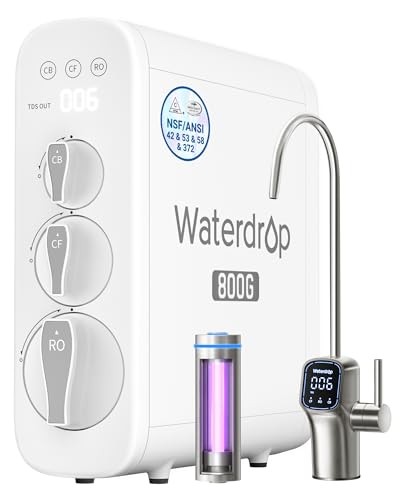
In conclusion, the Waterdrop G3P800 Water Filter System positions itself as a high-performance, modern reverse osmosis solution designed for households with serious water quality demands. Its combination of NSF/ANSI certifications, high 800 GPD output, efficient water usage, and advanced multi-stage filtration delivers both measurable purification results and a noticeably improved daily drinking experience.
The tankless, space-saving design and smart faucet features further enhance usability, making the system particularly well suited for larger families, busy kitchens, and users seeking consistent, on-demand filtration without the limitations of traditional storage tanks. While minor considerations such as operational noise during dispensing and a slightly higher upfront cost may be relevant for some buyers, these factors are generally outweighed by the system’s efficiency, reliability, and long-term value.
Overall, the Waterdrop G3P800 stands out as a well-engineered and dependable under-sink RO system for users who prioritize water purity, performance, and modern convenience, making it a strong contender in the premium home water filtration category.