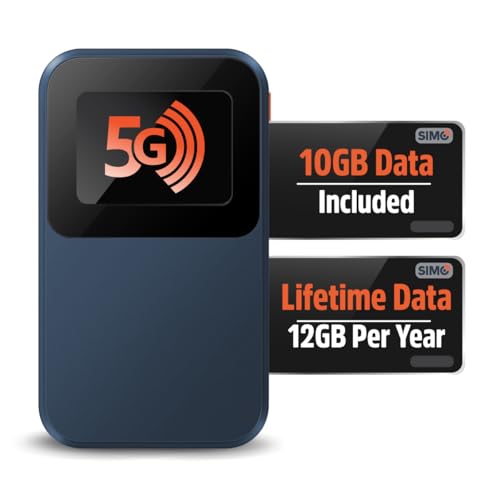
Pros of the SIMO Solis 5G WiFi Mobile Hotspot
1. Global Connectivity and True Multi-Carrier Support
One of the strongest advantages of the SIMO Solis 5G WiFi Mobile Hotspot is its genuinely global connectivity. Instead of locking users into a single carrier or region-specific SIM card, the device automatically connects to over 300 partner networks across more than 140 countries. This virtual multi-carrier approach means the hotspot continuously selects the strongest available signal in a given location, rather than forcing users onto a weaker network. For international travelers, digital nomads, and remote professionals who move between countries frequently, this eliminates the hassle of swapping SIM cards, negotiating roaming plans, or dealing with incompatible local carriers.
2. Reliable and Consistent Internet Speeds Across Regions
In real-world use, many users report that the Solis hotspot delivers surprisingly stable and usable internet speeds across a wide range of regions, including North America, Europe, Asia, and parts of Central America. Even in areas where local cellular reception is inconsistent, the device often maintains a workable connection thanks to its ability to switch between multiple carriers. This reliability makes it suitable not just for basic messaging, but also for video calls, cloud-based work, navigation, and media streaming—tasks that are often problematic on unstable roaming connections.
3. Simple, App-Driven Setup with Minimal Technical Friction
Ease of use is another area where the Solis hotspot performs well. Setup is handled through the Solis mobile app, which guides users step by step through device activation, plan selection, and connection management. Most users report being online within minutes of unboxing, without the need for technical knowledge or manual network configuration. This simplicity makes the device accessible not only to tech-savvy users, but also to travelers, families, and business users who just want reliable connectivity without a learning curve.
4. Flexible Data Plans with Free Lifetime Monthly Data
A unique and highly practical benefit of the Solis hotspot is the inclusion of 1GB of free high-speed data every month for the lifetime of the device. This ensures that users always have at least basic connectivity available, even when they are not actively purchasing data plans. Beyond that, Solis offers flexible, contract-free data options that can be purchased on a daily, monthly, or pay-as-you-go basis. This model works particularly well for occasional travelers or backup-internet users who don’t want to commit to ongoing subscription fees.
5. Long Battery Life with Built-In Power Bank Functionality
Battery performance is frequently highlighted as a major strength. With up to 24 hours of runtime on a single charge, the Solis hotspot can comfortably last through long travel days, remote work sessions, or emergency situations without constant recharging. In addition, the built-in power bank feature allows the device to charge smartphones and other small electronics, adding extra utility when access to outlets is limited. For travelers and outdoor users, this dual-purpose design reduces the number of devices they need to carry.
6. Multi-Device Support for Families and Teams
The ability to connect up to 16 devices simultaneously makes the Solis hotspot well suited for group use. Families traveling together, small teams on work trips, or remote workers managing multiple devices can all stay connected through a single hotspot. Users report stable performance even when several devices—such as laptops, tablets, phones, and smart accessories—are connected at the same time. This makes it a practical alternative to hotel WiFi or unreliable public networks.
7. Durable, Travel-Ready Physical Design
The physical build of the Solis hotspot is designed with travel in mind. Its rugged, military-grade casing holds up well to frequent packing, transport, and daily handling. Users note that the device feels solid and dependable, even during outdoor activities or extended trips where electronics are more likely to experience bumps, drops, or environmental exposure. This durability reinforces its positioning as a serious travel tool rather than a fragile consumer gadget.
8. Dependable Backup Internet for Emergencies and Remote Areas
Beyond travel use, many users value the Solis hotspot as a reliable backup internet solution. During power outages, local ISP failures, or in rural and remote areas with limited infrastructure, the device can provide essential connectivity for communication, navigation, and work. Several users describe situations where the Solis hotspot served as their primary connection when other options failed, making it a valuable emergency tool for both home and travel scenarios.
9. USB Tethering for Direct, Stable Connections
In addition to standard WiFi sharing, the Solis hotspot supports USB tethering, allowing users to connect directly to a laptop or compatible device. This can be especially useful in environments with heavy wireless interference or when maximum connection stability is required. USB tethering also helps conserve battery life and ensures uninterrupted connectivity for tasks such as video conferencing or file uploads.
10. Responsive and Helpful Customer Support
Customer support is another area that receives consistent positive feedback. Users frequently mention that Solis’ support team is responsive, knowledgeable, and willing to assist with setup, billing questions, or troubleshooting. For a product that relies on global network partnerships and app-based services, accessible and competent support significantly improves the overall ownership experience and builds confidence for long-term use.
Overall Pros Summary
Taken together, the SIMO Solis 5G WiFi Mobile Hotspot stands out for its global flexibility, dependable connectivity, and travel-friendly design. It is particularly well suited for international travelers, remote workers, and users who value convenience, reliability, and contract-free data access over raw peak speeds.
Cons of the SIMO Solis 5G WiFi Mobile Hotspot
1. Does Not Work on Cruise Ships or at Sea
Although the SIMO Solis hotspot offers impressive global coverage across land-based cellular networks, it does not function on cruise ships or at sea. Several users expressed disappointment after discovering that the device could not connect during cruises, forcing them to rely on the often expensive and slower ship-provided WiFi services. This limitation is understandable given that cruise ships rely on satellite-based connectivity rather than traditional cellular networks, but it does reduce the device’s usefulness for travelers who frequently take cruises or spend time offshore.
2. Less Reliable Connectivity in Moving Vehicles
While the Solis hotspot performs well in stationary environments such as hotels, cafés, or temporary workspaces, some users reported reduced reliability when using the device in moving vehicles. In cars, buses, or trains—especially when traveling through rural areas or regions with sparse cellular infrastructure—the connection can fluctuate or drop as the device switches between carriers and towers. For navigation, messaging, or light browsing this may be manageable, but users who need continuous, stable connectivity while in motion may find this limitation frustrating.
3. Occasional Signal Dropouts Requiring Manual Reconnection
A small number of users mentioned experiencing occasional signal dropouts where the hotspot temporarily loses its connection and requires a restart to reconnect. While these incidents do not appear to be frequent, they can be inconvenient when they occur at critical moments, such as during navigation, video calls, or time-sensitive work tasks. The need for manual intervention slightly undermines the otherwise “set-it-and-forget-it” appeal of the device, especially for users who depend on uninterrupted access.
4. Limited Free High-Speed Data for Heavy Usage
The inclusion of 1GB of free high-speed data per month is a valuable safety net, but it is relatively limited for modern data usage. Users who rely on video streaming, frequent video conferencing, cloud backups, or remote work applications will likely exhaust the free allocation quickly. While additional data plans are available and flexible, heavy users should expect to purchase extra data regularly, which can add to long-term costs compared to unlimited local SIM plans in certain regions.
5. Slower Upload Speeds Compared to Download Performance
Several users noted that while download speeds are generally solid—often in the range of 10–20 Mbps—upload speeds can be noticeably slower. This imbalance may not affect basic browsing or media consumption, but it can impact activities that rely on upstream bandwidth, such as uploading large files, live streaming, cloud-based collaboration, or frequent video calls. For users whose workflows depend heavily on uploads rather than downloads, this performance characteristic is worth considering.
Overall Cons Perspective
Overall, the drawbacks of the SIMO Solis 5G WiFi Mobile Hotspot are mostly situational rather than fundamental flaws. The device prioritizes global flexibility and ease of use over specialized scenarios like maritime travel or high-bandwidth professional workloads. For most travelers and general users, these limitations are manageable—but understanding them upfront helps set realistic expectations.
Frequently Ask Questions (FAQ)
FAQ 1: Can the SIMO Solis 5G replace a local SIM card when traveling?
For short-term travel and multi-country trips, the SIMO Solis can effectively replace local SIM cards. Its multi-carrier virtual network automatically connects to the strongest available signal without manual configuration. However, for long-term stays in a single country with heavy data usage, a local unlimited SIM may still be more cost-effective.
FAQ 2: Is the SIMO Solis 5G suitable for remote work and video conferencing?
Yes, for general remote work tasks such as email, cloud tools, messaging, and moderate video calls, the Solis performs well. That said, users who rely on frequent high-resolution video conferencing or large file uploads should be aware that upload speeds may be more limited compared to wired broadband or premium local SIM plans.
FAQ 3: Does the SIMO Solis work without inserting a SIM card?
Yes. The SIMO Solis does not require a physical SIM card. It connects through a virtual multi-carrier network managed by Solis, eliminating the need for SIM swapping, roaming agreements, or carrier configuration.
FAQ 4: How expensive is data usage over time?
The included 1GB of free high-speed data per month is useful for light or emergency connectivity. Additional data is purchased on a pay-as-you-go basis, which is convenient for occasional use but may become costly for heavy, long-term data consumption. It is best viewed as a flexible travel or backup solution rather than a replacement for unlimited home internet.
FAQ 5: Can the SIMO Solis be used as a backup internet during outages?
Yes. Many users rely on the Solis as a backup internet source during power outages or ISP failures. Its independent cellular-based connectivity and long battery life make it a practical emergency option when traditional networks are unavailable.
FAQ 6: Is the SIMO Solis secure compared to public WiFi?
Yes. Using a personal hotspot like the SIMO Solis is generally more secure than connecting to public WiFi networks in hotels, airports, or cafés. It reduces exposure to unsecured networks and potential data interception.
Final Verdict
The SIMO Solis 5G WiFi Mobile Hotspot is a strong, well-rounded solution for travelers, remote workers, and digital nomads who need dependable internet access across multiple countries without the hassle of swapping SIM cards. Its multi-carrier global coverage, long-lasting battery life, flexible pay-as-you-go data plans, and rugged build quality make it particularly well-suited for international travel, mobile work, and emergency backup connectivity.
While it is not without limitations—such as the lack of cruise ship support, occasional signal dropouts in motion, and relatively limited free monthly data—these drawbacks are situational rather than fundamental. For most users, they are outweighed by the device’s convenience, portability, and ability to automatically connect to the strongest available network in unfamiliar locations.
Overall, the SIMO Solis 5G stands out as a practical and reliable portable hotspot for anyone who values global flexibility over carrier-specific plans. It is especially recommended for frequent travelers, professionals working remotely across borders, and users seeking a dependable backup internet option when local networks are unreliable or unavailable.