
I still remember the first time I tried to slice a tomato with a dull chef’s knife—squash, slip, frustration, a ruined salad, and a lesson learned. For beginners, the right sharpener changes that moment into a small, fast ritual that keeps knives cutting safely and predictably. People shop for the best knife sharpeners for beginners because they want reliable results with minimal technique, safety built into the tool, and a sensible price. Common mistakes are picking a tool that’s either too aggressive (removes metal unnecessarily) or too fiddly (whetstones with zero guidance), or buying a cheap gadget that makes knives feel sharp briefly but leaves inconsistent edges.
What matters most when choosing is how the sharpener matches your priorities. If you want instant, no-sweat results, a guided pull-through or compact carbide/diamond tool is ideal. If you’re interested in learning proper edges and protecting expensive blades, a guided whetstone or a precision angle system is the smarter investment. Different buyers value speed, control, or long-term blade care, so a single “best” doesn’t fit everyone. My top overall pick balances beginner-friendly repeatability with the ability to grow into more advanced sharpening tasks.
If you need a quick snapshot before diving into deep reviews, the comparison table below lays out the main strengths of each option and links to the full reviews so you can jump straight to the model that fits your kitchen and skill level.
Best Knife Sharpeners For Beginners Comparison Table
| Product | Best For | Main Strength | Key Specs |
|---|---|---|---|
| Work Sharp Precision Adjust Elite | Repeatable Results | Fixed-angle, multiple abrasives | 15–30° adjustable, 7 abrasives |
| Sharp Pebble Complete Whetstone (Built-In Guides) | Learning Whetstones | Guided angles for beginners | 1000/6000 grit, 15/17/20/22° guides |
| Sharp Pebble Premium Whetstone 1000/6000 | Value Whetstone Kit | High-quality aluminum oxide stone | 1000/6000 grit, bamboo base |
| Intelitopia Dual Grit Whetstone Set | Complete Stone Kit | Full accessory set for learning | 400/1000 & 3000/8000 grit, strop |
| EDOVEN Rolling Knife Sharpener | Consistent Edges | Magnetic angle guide, diamond+ceramic discs | 15° & 20°, diamond + ceramic discs |
| AIERLIAN Rolling Knife Sharpener | Precision Polishing | Diamond + ceramic discs, strop included | 15° & 20°, #400 diamond, #3000 ceramic |
| Kitchellence 4-in-1 3-Stage Sharpener | Budget Everyday Sharpening | Fast pull-through sharpening, glove included | 3-stage slots, diamond rod, polishing slot |
| Longzon 5-in-1 Knife Sharpener | All-Purpose Budget Tool | Multiple slots, including scissors | 4-stage sharpening, non-slip base, glove |
| AccuSharp Knife Sharpener | Simplest Fast Touch-Ups | Single-step carbide/diamond edge setting | Ergonomic handle, tungsten carbide blade |
If you want the full breakdown of each model’s strengths and who it suits, read on—the reviews below give more context and real-world use cases to help you decide.
1. Best Overall: Work Sharp Precision Adjust Elite Knife Sharpener

One reason this option stands out is its combination of a guided, repeatable system and a wide range of abrasives. For beginners who want a tool that removes guesswork, the Precision Adjust Elite locks in set angles between 15 and 30 degrees and provides multiple abrasive grits. That means you can reprofile an old edge, sharpen a dull blade, and then refine and strop for a polished finish without learning freehand whetstone technique. A home chef told me they used this system to rescue a decade-old Santoku; it took patience but delivered a factory-like edge that lasted through months of heavy use.
In daily use, the system feels deliberate rather than fiddly. The tri-abrasive rods index quickly, and swapping between grits is straightforward, which makes longer sharpening sessions less tedious. Beginners benefit from the angle control and the tactile feedback when grinding. There are real-world tradeoffs: it is larger and pricier than a simple pull-through sharpener, and it takes time to learn the sequence. Yet if you’re building a small sharpening habit and want consistent, professional-style results, this unit grows with you.
Pros
- Highly repeatable fixed-angle sharpening for consistent edges
- Multiple abrasive grits, including diamond, ceramic, and leather strop
- Works for a wide range of straight-edge knives
- Solid build and backed by a multi-year warranty
- Good choice for moving beyond quick touch-ups to actual edge restoration
Cons
- Higher upfront cost than basic pull-through sharpeners
- Larger footprint and more parts to manage
- Requires following a sequence for best results
For buyers who want a dependable, long-term sharpening platform that still suits a beginner, the Work Sharp Precision Adjust Elite is hard to beat. It performs best in kitchens where several different knives need service or for hobbyists who plan to learn sharpening fundamentals. If you only want the fastest one-stroke refreshes for cheap knives, a compact pull-through would be simpler and cheaper. Choose this model when you value consistency and the option to refine and strop for a truly sharp edge.
To buy this product, click here.
2. Best Beginner-Friendly Whetstone: Sharp Pebble Complete Whetstone Knife Sharpening System

For cooks who want to learn proper edge geometry without feeling lost, a whetstone with built-in angle guides is an excellent teacher. This Sharp Pebble kit adds guidance to traditional wetstone sharpening by offering preset angles such as 15°, 17°, 20° and 22°. I’ve seen new users make far fewer errors when a physical guide limits their wrist movement. One home baker in my neighborhood learned to get a razor edge on her paring knives and went from mangled peaches to clean, precise slices in a weekend.
The wetstone surface itself is forgiving. The 1000/6000 grit progression refines an edge after initial repair, and the non-slip base keeps the stone steady during practice. Real-life sharpening with this setup feels meditative: the sound of water, the little metal burr that appears and then disappears on the leather strop. It requires more time and a gentle hand than guided pull-through tools, but you’ll finish with a nuanced edge that’s kinder to high-quality blades. Beginners who like tactile learning and want long-term knife care will appreciate this route.
Pros
- Built-in angle guides reduce guesswork for beginners
- 1000/6000 grit covers the sharpening and polishing stages
- Stable non-slip base and water-only use for easy cleanup
- Teaches freehand skills while protecting expensive knives
- Durable stones that can outlast cheap alternatives
Cons
- Requires more time and practice than pull-through sharpeners
- Wetstone maintenance, such as flattening, may be necessary over time
This system is for beginners who want to learn and who own knives worth preserving. It performs best when you accept that sharpening will be a practiced ritual rather than a two-second fix. If you hate mess or need instant fixes, this is probably not the fastest option. If you enjoy the sensory feedback of stropping and the control of angle work, this becomes a rewarding tool that keeps knives in top shape.
To buy this product, click here.
3. Best Value Whetstone Kit: Sharp Pebble Premium Whetstone Knife Sharpening System

For many new cooks, the whetstone can be intimidating, but the Sharp Pebble Premium kit eases that with clear instructions, a bamboo base, and an angle guide. I’ve tested this stone on a mix of western and Japanese knives and found it forgiving and effective. One friend used the 1000 side to refurbish a dented chef’s knife rescued from a yard sale, then the 6000 side to bring it to a fine edge that sliced paper cleanly and held up through a week of prep work.
The stone’s aluminum oxide composition takes metal predictably and polishes to a tidy finish on the finer grit. Practical advantages include low maintenance—water only—plus a rubberized base that stops the stone from sliding. This kit isn’t flashy, but it gives newcomers the essentials without confusing extras. If you want a durable, reliable whetstone that won’t break the bank while still delivering real edge improvement, this is a strong pick.
Pros
- Trusted dual-grit combo for sharpening and polishing
- Sturdy bamboo base and angle guide included
- Water-only use makes cleanup simple
- Good documentation and beginner-friendly ebook
- Works on a wide range of kitchen knives
Cons
- No built-in angle stops, so some practice is needed for consistency
- Requires regular flattening if used heavily
Choose this Sharp Pebble kit when you want good performance for the price, and you’re willing to spend a little time developing a reliable stroke. It’s a practical middle ground between cheap stones and premium kits and suits buyers who will invest a handful of sessions to get sharp, long-lasting edges.
To buy this product, click here.
4. Best Complete Stone Kit: Intelitopia Complete Knife Sharpening Stone Set

If you want a full toolkit so you don’t have to shop for accessories later, Intelitopia’s set covers the bases: coarse stones for re-profiling, fine stones for polishing, a flattening stone, an angle guide, a strop, and bases. That means beginners can practice every stage of edge work without hunting for add-ons. I watched an enthusiastic home chef go from nervous beginner to confidently maintaining his knives across several sessions using the included angle guide; having both coarse and super-fine stones in one box made the learning curve smoother.
The dual-sided whetstones and flattening stone give you flexibility to repair and refine blades of varying conditions. It’s not a single-stroke convenience tool, so it rewards patience. The leather strop is a practical touch for removing burrs and refining the edge. This kit is best for people who want to learn true sharpening techniques with everything in one box rather than buying piecemeal items.
Pros
- Comprehensive accessory set for full sharpening workflow
- Multiple grits, including very coarse and very fine stones
- Comes with flattening stone and leather strop
- Non-slip base and angle guide make practice safer
Cons
- Larger learning curve compared with pull-through sharpeners
- More pieces to store and maintain
This Intelitopia kit is ideal for deliberate beginners who want to learn proper technique and have a complete set to experiment with. If you prefer instant fixes or are short on counter space, opt for a compact pull-through. If you’re building a sharpening toolkit that can tackle everything from chipped edges to fine polishing, this delivers strong value.
To buy this product, click here.
5. Best For Consistent Results: EDOVEN Rolling Knife Sharpener

If consistency and minimal technique are your top priorities, rolling sharpeners with magnetic angle guides deliver surprisingly professional results. The EDOVEN unit uses a magnetic support to hold the knife at a fixed 15° or 20° angle, and its diamond plus ceramic discs let you reshape and then polish without guessing the correct wrist position. A friend who slices a lot of citrus finds this tool removes variability from weekend sharpening chores, giving repeatable, thin edges ideal for delicate work.
The magnetic angle guide adds confidence to each pass, while the diamond disc quickly addresses dull edges. It is quieter than power sharpeners and simpler than freehand stones. The tradeoff is that rolling systems suit straight-edge knives best and are less ideal for heavily serrated blades. For everyday kitchen knives that need repeatable touch-ups, this is a highly practical option that helps beginners get consistent results fast.
Pros
- Magnetic angle guide produces repeatable results
- Two-stage system: diamond for shaping, ceramic for polishing
- Compact, stable design with non-slip base
- Good balance of speed and control for beginners
Cons
- Not suitable for serrated knives
- The magnetic system works best with reasonably straight blades
Choose this if you want a safe, repeatable sharpening process without mastering the whetstone technique. It performs best as a maintenance tool for quality kitchen knives, keeping edges aligned and polished between deeper sharpening sessions. Avoid it if you need a tool for serrations or for aggressively re-profiling very damaged steel.
To buy this product, click here.
6. Best For Polished Edges: AIERLIAN Rolling Knife Sharpener

For beginners who want a refined finish, the AIERLIAN roller sharpener combines a diamond disc and a fine ceramic disc, then finishes on a leather strop. I’ve used similar setups to polish fillet knives for weekend BBQs, and the difference in slicing is immediate: cleaner cuts with less tearing. The roller design keeps the angle steady with magnetic supports, which means you can polish confidently without worrying about ruining the geometry.
This unit’s premium wood base and strong magnets make the process feel grounded and deliberate. The included leather strop removes burrs and leaves a smooth, shaving-capable edge on properly hardened steel. It is not the fastest path to a working edge on a very dull knife, but it’s exceptional at refining and maintaining edges once the heavy work has been done. If your knives are in decent condition and you want a sharp, silky finish, this model rewards patience.
Pros
- Diamond + ceramic discs for shaping and polishing
- Magnetic angle support for consistent results
- Leather strop included for a razor-smooth finish
- Sturdy wood construction feels premium
Cons
- Less effective on severely damaged or very dull blades
- Not compatible with serrated knives
This is a great pick for beginners who are past the “touch-up only” phase and want to preserve a fine edge. It performs best when used as part of a maintenance routine after an initial reprofile or when specialty knives need a polished finish. Skip it if you need an all-in-one re-shaper for chipped or abused blades.
To buy this product, click here.
7. Best Budget Everyday Sharpener: 4-in-1 Kitchen Knife Accessories 3-Stage Sharpener
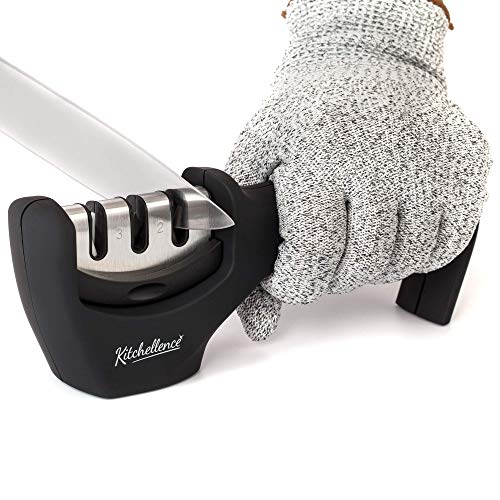
For cooks who want an inexpensive, no-nonsense way to restore a working edge, this 3-stage pull-through sharpener gets the job done with minimal fuss. The first slot includes a diamond rod to repair and straighten, the second restores the V-shape, and the third polishes. It comes with a cut-resistant glove and a non-slip base, which makes kitchen sharpening less nerve-wracking for newcomers. I keep one similar tool in a drawer for quick morning prep—two or three strokes and a tired knife becomes usable again for slicing bread or vegetables.
The ergonomics are friendly to both right- and left-handed users, and the ABS housing is lightweight. This style is not designed to replace whetstones or precision systems for serious edge work, but it’s fast and safe for routine maintenance. If you like the idea of a quick fix you can use before every cooking session, this is a cost-effective way to keep knives functional without learning more advanced techniques.
Pros
- Fast, easy pull-through system for quick touch-ups
- Includes cut-resistant gloves and a non-slip base for safety
- Three-stage progression addresses repair, sharpening, and polishing
- Compact and affordable
Cons
- Less precise than guided stones or angle systems
- Not suitable for high-end knives where edge geometry matters
Buy this if you want a dependable, budget-friendly tool that makes dull knives usable again without the learning stone technique. It performs best as a maintenance tool for mid-range kitchen knives. Avoid it if you need to reprofile very dull blades or you own expensive Japanese knives that require gentle, consistent angle control.
To buy this product, click here.
8. Best Budget All-Purpose: Longzon 5-in-1 Knife Sharpener

For shoppers who want a single compact tool to handle scissors, straight knives, and basic repairs, the Longzon 5-in-1 gives a versatile, low-cost option. Its staged slots cover everything from coarse repairs to fine honing, and it includes a cut-resistant glove and non-slip base so beginners feel safer during use. I’ve used similar tools to quickly tune up picnic knives and table cutlery before small gatherings; they’re great for shaving a minute off prep time when a zippy blade matters.
While it is more versatile than a single-stage sharpener, this tool is still a simplified system. It won’t replace stone sharpening for high-end knives, but it’s highly convenient for everyday household blades and for people who want straightforward maintenance without the time commitment of wetstone sharpening. The design suits renters, students, or gift buyers looking for practical value.
Pros
- Multiple slots, including scissors and fine sharpening
- Includes cut-resistant glove and non-slip base
- Space-saving and user-friendly for quick jobs
- Very affordable
Cons
- Simplified abrasives can be aggressive on premium steels
- Limited control over edge angle vs guided systems
This is the right choice for people who need a small, all-around sharpener to keep household knives working well. It performs best for general-purpose kitchen blades and occasional scissor sharpening. Don’t expect precision reprofiling or a polished finish on premium knives.
To buy this product, click here.
9. Best Simple Touch-Up: AccuSharp Knife Sharpener

Sometimes the best beginner tool is the one you actually use. The AccuSharp hand-held sharpener simplifies the task to a couple of safe strokes and an ergonomic handle that protects fingers. It uses diamond-honed tungsten carbide for quick edge setting, which is ideal when a blade needs a rapid rescue before dinner service. A neighbor with little patience for whetstones swears by this tool for making a dull paring knife usable within seconds.
The device is extremely compact and reliable; set it in a drawer, and it’s always there when a blade needs help. Because it is a coarse edge setter, it wears away steel more quickly than a less aggressive honing method, so use it sparingly on high-end knives. Still, for the beginner who wants a dependable, immediate fix, this is a practical and long-lasting choice.
Pros
- Very fast edge setting in seconds
- Ergonomic handle with finger guard for safety
- Durable tungsten carbide sharpening element
- Compact and easy to store
Cons
- Coarser action removes more metal than gentler methods
- Not ideal for precision or polishing stages
This AccuSharp model is for busy cooks who need a fast, consistent touch-up tool and are willing to accept that it’s not a precision resharpening system. It performs best when used occasionally to restore bite, rather than as the only maintenance method for expensive knives.
To buy this product, click here.
Best Knife Sharpeners For Beginners FAQ
What type of sharpener is easiest for a total beginner?
Manual pull-through sharpeners and compact carbide or diamond hand sharpeners are the easiest starting points. They guide the blade angle for you and deliver usable results in a few strokes. Rolling systems with fixed magnetic angle guides are also straightforward and give more consistent, repeatable edges once you learn the basic motions.
Are whetstones a bad idea for beginners?
Whetstones are not a bad idea, but they do require more practice and care. Beginners benefit from stones that include angle guides or non-slip bases. Learning on a guided whetstone helps you develop good technique and preserves expensive knives better than aggressive pull-through systems if you plan to keep your knives long-term.
How often should beginners sharpen their knives?
Rather than sharpening frequently, aim for regular honing and occasional sharpening. Hone with a ceramic rod or stropping after every few uses to realign the edge, and sharpen (stone, guided system, or pull-through) when the knife begins to drag on food or no longer slices cleanly. For typical home use, sharpening every few months is common; heavy users may need more frequent maintenance.
Will a cheap sharpener ruin my knives?
Cheap sharpeners can damage edges if they remove too much material or use an improper angle. To avoid damage, use budget tools for quick touch-ups on inexpensive knives, and switch to guided stones or adjustable-angle systems for high-quality blades. Follow the manufacturer’s instructions and avoid excessive passes.
Can I sharpen serrated knives with these tools?
Most pull-through sharpeners and whetstones are for straight edges. Some multi-stage sharpeners include a serrated slot or specialized tools exist to reprofile serrations. Rolling systems and many whetstones are not appropriate for serrated knives unless specifically designed for them.
How do I choose the right angle for my knives?
Typical western-style kitchen knives use angles between 20° and 22°, while Japanese-style knives often use 15° or 17°. If you’re unsure, follow the factory edge angle or choose a mid-range angle like 20° for a balance between sharpness and edge durability. Guided systems and angle-stopping stones remove the guesswork for beginners.
Is an electric sharpener a good choice for beginners?
Electric sharpeners can be user-friendly and fast, but they can also remove a lot of metal if misused. For beginners, choose trusted brands with angle guides and multiple stages. If you prefer minimal effort and have many knives to service, a quality electric model is a practical option, but plan to learn proper use to avoid over-grinding.
What maintenance does a whetstone need?
Whetstones absorb water and will eventually develop high or low spots. Use a flattening stone or lapping plate periodically to restore a flat surface. Keep stones clean, soak or wet according to the manufacturer, and store them dry to prevent cracks. Regular maintenance preserves performance and gives more predictable sharpening results.
Final Verdict
Beginners have more effective choices than ever. For someone who wants repeatable, high-quality edges without fretting over freehand technique, the Work Sharp Precision Adjust Elite offers a system that grows with your skills and provides dependable results across a range of knives. If you prefer to learn the craft and protect expensive blades, the Sharp Pebble guided whetstone system is an excellent training tool that teaches real sharpening fundamentals while protecting edges with preset angles.
For immediate, budget-friendly fixes, compact pull-through sharpeners like the Kitchellence 3-stage model or the AccuSharp handheld deliver quick, safe touch-ups that make knives usable right away. Rolling sharpeners and magnetic-guided units such as the EDOVEN and AIERLIAN models sit in the middle ground, offering repeatable polishing and maintenance without the complexity of wetstones. Match your choice to how much time you want to invest, whether you own high-end knives, and whether you prefer instant fixes or learning a long-term skill. With the right tool and a bit of practice, even beginners can keep kitchen blades working beautifully for years.