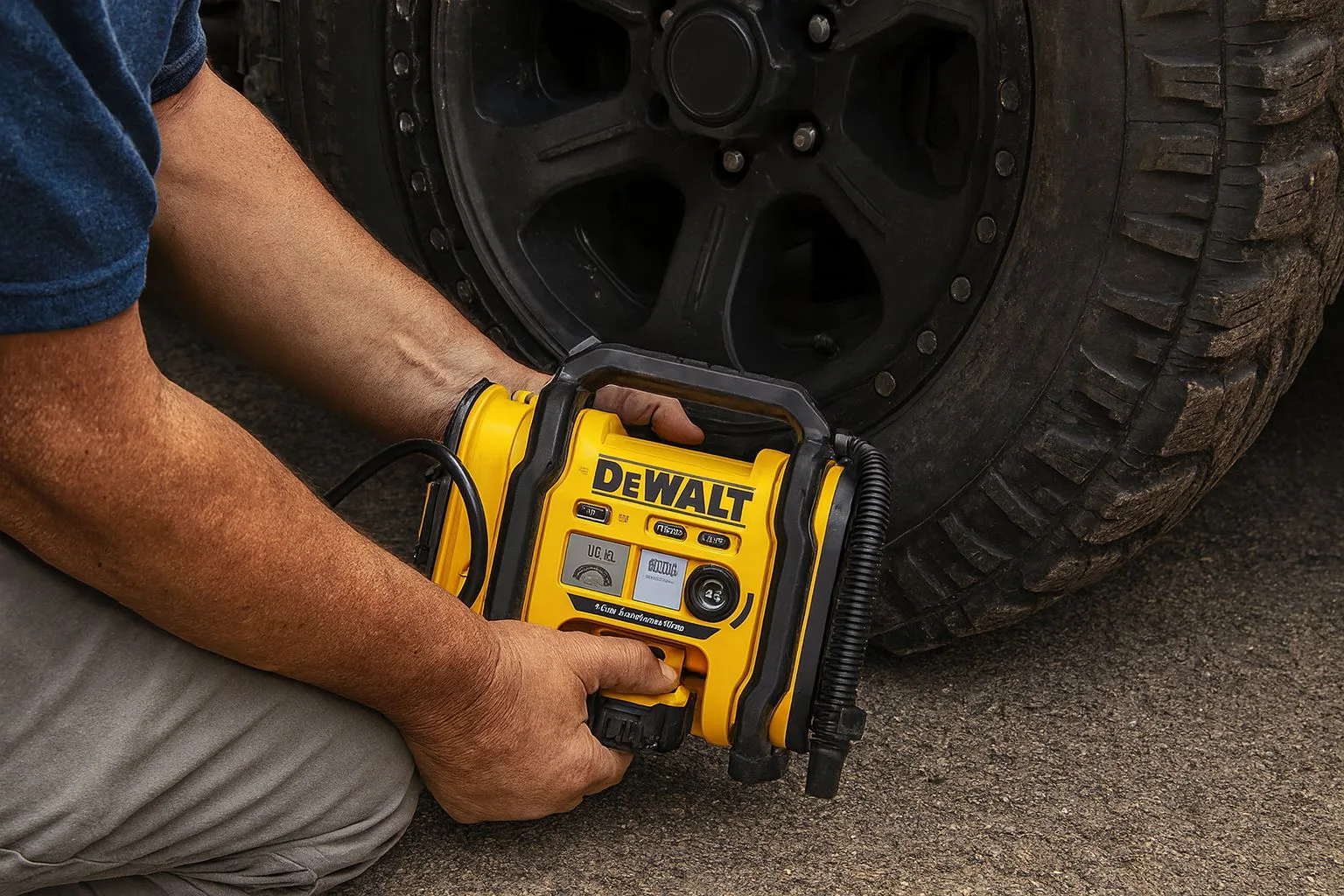
Introduction of the DEWALT 20V MAX Tire Inflator
Picture this: It’s a chilly morning and you’re about to drive to work when you notice one tire looks a bit saggy. Or perhaps you’re on a road trip in the middle of nowhere and the dashboard tire pressure warning light flickers on. In these moments, having a reliable tire inflator in your trunk can save the day.
Maintaining proper tire pressure is crucial for safety, fuel efficiency, and tire longevity. However, checking and topping up tires can be a hassle if you’re constantly visiting gas stations or dealing with flimsy 12V cigarette-lighter pumps. This is where a reliable portable tire inflator becomes a game-changer. The DEWALT 20V MAX Cordless Tire Inflator (model DCC020IB) is a powerful, battery-powered air compressor designed to make inflating tires and other items convenient and quick. In this comprehensive review, we’ll dive deep into what this DEWALT inflator offers, how it performs in real-world scenarios, and why it stands out as a top choice for anyone in need of a portable air pump.
DEWALT is a brand renowned for rugged and dependable power tools, and the DCC020IB inflator carries that legacy into the realm of tire pumps. Unlike many generic inflators, this unit is built like a tool – sturdy, efficient, and loaded with practical features. It’s part of DEWALT’s 20V MAX lineup, meaning if you already own DEWALT cordless tools, you can use the same batteries to power this inflator. Even if you’re new to the ecosystem, the flexibility, performance, and build quality of this inflator aim to justify its place in your garage, car trunk, or workshop.
Why a Portable Tire Inflator is a Must-Have Tool
If you’ve ever driven on underinflated tires, you know the car can feel sluggish and fuel economy suffers. In fact, studies have shown that for every 1 PSI drop in tire pressure, you can lose about 0.2% in fuel efficiency, and underinflated tires wear out faster on the edges. There’s also the safety aspect – improperly inflated tires (especially severely underinflated ones) are more prone to overheating and can lead to blowouts at high speeds.
Many people rely on gas station air pumps or small 12V cigarette-lighter compressors to manage tire pressure, but these solutions have drawbacks. Gas station pumps can be inconvenient (or out of order when you need them), and those cheap plug-in inflators are often slow, noisy, and not built to last. A portable tire inflator like the DEWALT DCC020IB gives you the power to maintain your tires on your own schedule and at your location – whether that’s in your driveway before a road trip or on the side of a remote highway after getting a puncture.
The ability to quickly adjust tire pressure has more benefits than just emergencies. For example, you can optimize your tire pressures for heavy loads or towing, then adjust them back afterward. Off-road enthusiasts often air down their tires for better traction on trails, then need to air them back up for pavement – a portable inflator makes this easy without needing a full-size compressor on hand. Even seasonal temperature swings (like the first cold snap of autumn that triggers your tire pressure warning) become a non-issue when you have a reliable inflator ready to go.
In short, having a portable inflator means less hassle and more peace of mind. You’ll save time, avoid waiting in lines or fiddling with unreliable pumps, and you’ll be more likely to keep your tires at optimal pressure – which translates to safer driving, better gas mileage, and longer tire life. Now, among the choices of portable inflators, let’s see how the DEWALT 20V MAX model distinguishes itself with features and performance.
Key Features Overview
Product Name & Model: DEWALT 20V MAX Corded/Cordless Air Inflator (DCC020IB). This is essentially a compact air compressor that can inflate tires and more, operating on DEWALT’s 20-volt battery platform as well as other power sources. Being a “Tool Only” model, it’s sold without a battery or charger (ideal for those who already own DEWALT batteries).
Quick Specifications
-
Max Pressure: 160 PSI (suitable for car/truck tires, bike tires, etc.)
-
High-Pressure Hose Air Flow: ~0.5 SCFM @ 90 PSI (approximately)
-
High-Volume Hose Air Flow: ~15 SCFM (free flow for inflatables)
-
Power Sources: 20V MAX Lithium-ion Battery / 12V DC (vehicle outlet) / 110V AC (with adapter)
-
Auto Shut-Off: Yes, in high-pressure mode (digital pressure preset)
-
Pressure Units: PSI, BAR (user-selectable on digital gauge)
-
LED Light: Yes, integrated in handle
-
Product Weight: ~5.5 lbs (bare tool only, without battery)
-
Product Dimensions: ~11.9″ (L) x 5.2″ (W) x 9.8″ (H)
-
Noise Level: ~77 dB (similar to loud conversation)
-
Included Accessories: Presta valve adapter, ball needle, tapered nozzle, high-volume hose, 12V DC cord
-
Warranty: 3-Year Limited Warranty (plus 1 year free service, 90-day money-back guarantee)
-
Three Power Options: A standout feature is its versatile power compatibility. You can run the inflator in three ways: via a 20V MAX lithium-ion battery (for cordless operation), using a 12V DC vehicle outlet (with the included car adapter cord), or plugging into a standard 110V AC outlet (with an optional AC power adapter sold separately). This triple power source design means you’re never stuck – whether you’re at home, on the road, or off the grid, you have a way to power the unit.
-
High-Pressure and High-Volume Modes: The DCC020IB is not limited to just car tires. It includes two inflation modes through different hose connections. The high-pressure mode (using the attached rubber hose with a threaded metal chuck) is for things like car and truck tires, bike tires, and sports balls – basically anything requiring higher PSI. This mode can inflate up to 160 PSI and features an automatic shut-off when your set pressure is reached. The second is a high-volume mode (using a larger diameter hose stored on board) that’s meant for low-pressure, high-volume inflatables like air mattresses, pool floats, or rafts. In high-volume mode you can also connect the hose to a deflation port to suck air out of items for quick takedown after use.
-
Digital Gauge with Auto Shut-Off: Gone are the days of guessing or constantly checking a separate gauge. This inflator has a built-in digital pressure gauge that allows you to set your desired pressure (in increments of 0.5 PSI). You simply dial in the target pressure on the display and hit start – the unit automatically shuts off when the pressure is reached. This ensures accurate inflation and frees you from babysitting the process. The digital display is backlit, making it easy to read even in low light conditions (and you can toggle units between PSI and BAR if needed).
-
Integrated LED Work Light: Built into the top of the handle is an LED light. This is extremely handy for nighttime emergencies or dark environments, allowing you to see the tire valve and operate the inflator safely. The light has its own on/off switch, so you can use it independently of the compressor. While it’s not the brightest flashlight, it provides enough illumination to get the job done when you’re inflating a tire on a dim roadside or in a shadowy garage at night. (It’s a steady beam, not an SOS strobe.)
-
Sturdy Build and Design: Weighing about 5.5 lbs (without battery) and constructed with DEWALT’s signature yellow-and-black high-impact plastic, the inflator feels solid and ready for heavy use. It has a large top handle that makes carrying easy, and heavy-duty rubber feet on the bottom that absorb vibration and prevent the unit from “walking” or creeping due to motor vibrations. This stability is especially useful when running on hard surfaces; the inflator won’t dance around or tip over during operation. The bright yellow color also makes it easy to spot in your trunk or workshop.
-
Onboard Accessory Storage: All the little extras you need for inflation are included and store neatly on the unit itself. The inflator comes with a threaded chuck on the high-pressure hose, plus adapters: a Presta valve adapter(for bicycle tires), a sports ball needle, and a plastic tapered nozzle for inflating air mattresses or pool toys via the high-volume hose. These attachable bits have dedicated storage slots/clips on the unit, so you don’t lose them. Even the 12V DC car power cord tucks into its own compartment on the side of the inflator. This thoughtful storage design means everything stays organized and is there when you need it.
-
Safety and Durability Features: Because it’s a tool-oriented inflator, it has some robust features not found on cheap pumps. The motor is capable of delivering high pressure and is designed with heat dissipation in mind. There are recommendations in the manual to ensure longevity (like letting it cool for a few minutes after 10 minutes of continuous run at very high pressures). The inflator is oil-free, so no maintenance is needed on the pump itself. DEWALT backs the tool with a 3-year limited warranty, plus 1 year of free service and a 90-day money-back guarantee, reflecting confidence in its durability and build quality.
In summary, the DEWALT DCC020IB’s feature set is geared towards versatility and ease of use. It’s designed to be a one-stop solution for a variety of inflation tasks – robust enough for jobsite or farm use, yet convenient and user-friendly for everyday consumers. Next, we’ll explore each of these aspects in more detail, starting with how the inflator is powered and why having multiple power options is a big advantage.
Power Sources: Cordless Freedom and Corded Backups
One of the defining advantages of the DEWALT 20V MAX Inflator is its flexible power options. This versatility truly sets it apart from many competitors and ensures you can use it in virtually any situation.
20V MAX Battery Power (Cordless Operation)
The primary way most users will utilize this inflator is with a rechargeable 20-volt battery pack. If you’re already invested in DEWALT’s 20V MAX cordless tool system, you likely have one or more batteries at your disposal. The inflator accepts any DEWALT 20V MAX lithium-ion slide-on battery pack – from compact 1.5Ah packs to larger capacity packs (it even works with the FlexVolt batteries that are 60V/20V). Using a battery makes the inflator completely cordless, which is incredibly convenient: you can walk around your vehicle to each tire without dragging any cords, take the unit to a soccer field to inflate balls, or bring it camping to top up an air mattress in a tent.
Battery Life & Performance: One natural question is how many tires you can inflate on a single battery charge. This depends on the battery’s capacity (Amp-Hours, Ah). With a middle-of-the-road battery – for example, a 3.0Ah pack (DEWALT DCB230) – the manufacturer indicates you can inflate over 6 average car tires (from flat to around 35 PSI) or about 3-4 light truck/SUV tires on one charge. In practical terms, a fully charged battery should handle topping off all four tires of your car multiple times, or even filling a completely flat tire or two, without issue. If you use a larger battery, like a 5.0Ah or 6.0Ah, you can expect proportionally more runtime – easily enough for roadside emergencies or a day of inflating equipment on the job.
It’s worth noting that batteries and chargers are sold separately (unless you buy a kit or bundle that includes them). So if this is your first DEWALT tool, you’ll need to factor in the purchase of a battery and charger. Many users who already own other DEWALT tools just use what they have. DEWALT’s chargers typically juice up a 5.0Ah battery in about 90 minutes (less for smaller packs). It’s good practice to keep your battery topped off – perhaps recharge it after each significant use – so that the inflator is always ready when you need it. DEWALT batteries also have built-in charge indicator lights (press a button on the battery to see charge level), which is handy to check before starting a job.
12V DC Vehicle Accessory Power
The DEWALT inflator also comes with a 12-volt DC car adapter cord stored in a side compartment. This cord plugs into a vehicle’s cigarette lighter/accessory socket. That means even if your 20V battery is dead (or you don’t have one), you can still run the inflator off your vehicle’s battery by using the car’s 12V outlet. This adds a layer of backup security, especially on road trips or if you’re the kind who forgets to charge tools.
The included 12V cord is about 13.5 feet long, which is usually sufficient to reach all four tires of most vehicles from a single outlet. If your vehicle’s 12V port is in the dash, you might run the cord out a window or door to reach the rear tires. In many cars, that length works without issue; if you have a very large vehicle or a trailer, you may need an extension or to reposition once. (Some vehicles also have an outlet in the trunk or cargo area, which makes it even easier.)
When using the inflator via the car outlet, it’s often advisable (though not strictly required for short tasks) to have the engine running or the ignition in accessory mode. This prevents the inflator from draining your car’s battery, especially if you’re filling multiple tires. The inflator can draw up to ~10 amps at 12V under heavy load, which is significant. In most cases, topping off a tire or two won’t put a dent in your car’s battery, but if you’re inflating, say, four tires from very low pressures, the last thing you want is to fix your tires only to find your car won’t start. So, best practice: engine on for extended use.
One benefit of the DEWALT’s design is that the 12V cord is removable. If you don’t need it, it stays tucked away; if you do, you plug it in internally. Do note that repacking the cord into its compartment can require a bit of patience to coil it neatly (just as it came from the factory). Take care not to pinch the cord when closing the little door. The internal storage keeps the cord from getting tangled with other items and keeps everything neat.
110V AC (Household Outlet) Capability
The third power option is a standard wall outlet (110/120V AC), which is less common in portable inflators. However, the AC adapter for the inflator is sold separately by DEWALT (part number N557514). The inflator has an input port (inside that same side compartment) for a two-prong AC adapter plug. This adapter essentially converts your wall power to 13.8V DC at high amperage to run the inflator, similar to how a laptop power brick works for a computer.
If you plan to frequently use the inflator in a garage or workshop, it might be worth getting the AC adapter so you can plug it in directly. It effectively turns the inflator into a corded unit when needed. Battery, car, or wall – you have all options. Many users, however, rely primarily on battery or car power and don’t bother with the AC adapter. It really depends on your use case: if you envision using it at home a lot and want to save your battery for other tasks, the AC adapter is a nice add-on (just keep in mind it’s an extra expense and can sometimes be tricky to find in stock).
Some buyers were initially surprised that the AC cord wasn’t included, expecting the unit to have a built-in plug. But considering that not everyone needs AC capability (and to keep the initial cost down for those who don’t), DEWALT made it optional. The inflator itself already has the internal electronics to accept AC via that port – you just need the correct adapter cable.
Possibility of Added Cost: The need to buy a battery/charger (if you don’t have them) and the AC adapter (if you want wall power) does mean the DEWALT inflator can be a bit more investment up front compared to an all-in-one kit. However, for those in the DEWALT ecosystem, it’s less of an issue, and you’re paying for a high-quality tool. It’s a conscious choice: you pay a premium for flexibility and durability.
In real life, having these three power options means the inflator is ready for any scenario. For example, you might normally keep it in your car with a battery attached for roadside emergencies. If that battery happens to be low, you still have the 12V cord to fall back on using your vehicle’s power. And if you bring it into your workshop for a project, you can plug it into the wall (if you bought the adapter) to save battery charge. This kind of multi-source power capability is rare in inflators and is a major selling point of the DCC020IB. It aligns with DEWALT’s professional/jobsite approach – whatever power you have available, this inflator can use it.
(On a small note, if you use DEWALT’s largest FlexVolt batteries – those big 60V/20V packs – the inflator can run on them too. The manual suggests placing the inflator on its face (battery compartment up) when using those heavier packs so it doesn’t tip over, since the FlexVolt batteries are quite large. With regular 20V packs, the inflator remains very stable upright.)
Inflation Performance and Speed
When it comes to any inflator, a key question is: How fast and effectively can it pump air? The DEWALT 20V MAX inflator holds up well for a portable unit, delivering performance that satisfies most personal and even some professional needs.
-
Inflation Speed for Tires: In testing and specs, the DCC020IB can inflate a standard car tire (for example, a 235/45R17) from completely flat (0 PSI) to about 35 PSI in roughly 4 to 5 minutes. For a larger tire, like a light truck tire (say a 275/65R18), it takes around 8 to 9 minutes to go from 0 to 35 PSI. These are impressively quick times for a compact cordless inflator. In practical terms, if one of your sedan’s tires is just a bit low (e.g., 25 PSI and you want 35 PSI), this inflator will top it up in well under a minute. If you need to fill a tire from flat after repairing a puncture, you’re looking at only a few minutes of wait time. That’s a far cry from some cheap 12V plug-ins that might take 15 minutes or struggle to even reach 35 PSI.
-
Handling High Pressure: This inflator is rated up to 160 PSI capability. That covers virtually any automotive or bicycle tire you’re likely to encounter – car tires typically require 30-45 PSI, SUVs and light trucks maybe 45-80 PSI, and bicycles anywhere from 40 PSI (mountain bike) to 120 PSI (road bike). While it can reach high pressures, its duty cycle should be respected: DEWALT recommends not running the unit continuously for more than about 10 minutes, especially at pressures above 100 PSI, without a cool-down. In practice, very few tasks will run it that long straight. But if you were inflating something like an RV tire to 110 PSI, you might pause halfway to let it rest for a minute. (The device will likely be able to do it without stopping, but it’s good for longevity to give that break.) As for airflow, DEWALT’s specs indicate roughly 0.5 SCFM at 90 PSI for the high-pressure mode. For context, a small generic inflator might be only 0.2-0.3 SCFM, while a heavy-duty off-road compressor could be 2-5 SCFM. The DEWALT sits well above the tiny units and below the big dedicated compressors – fitting its role as a portable, convenient inflator rather than an industrial machine. The auto shut-off in high-pressure mode ensures you won’t over-inflate even if you step away for a moment.
-
High-Volume Output: For items like air mattresses, inflatable boats, or pool floats, inflation speed is more about volume than pressure. The DEWALT’s separate high-volume hose pushes a lot of air (rated around 15.2 SCFMfree-flow). In practice, you can inflate a typical queen-size air mattress in a minute or two. That’s on par with many standalone air bed pumps. Big pool floats or beach toys will inflate quickly as well. One thing to remember: in high-volume mode, the inflator does not auto shut off (since you’re usually filling something until it’s “full” by feel, not to a specific PSI). So you’ll manually turn it off when the item is inflated to your liking. And if you attach the hose to the deflate port, it will suck the air out of an item, making pack-up much faster for things like camping mattresses or rafts. The high-volume function essentially turns the inflator into a multi-purpose blower/vac for inflatables, which is incredibly handy if you have these items.
-
Accuracy of the Gauge: Speed is one thing, but accuracy is just as important – you don’t want to under or overinflate your tires. The DEWALT inflator’s digital gauge has proven to be very accurate. In most cases, the shut-off stops exactly at the target pressure or within ±0.5 PSI. Many users have cross-checked it with good quality tire pressure gauges or the car’s TPMS readings and found it spot on. If needed, the gauge can be calibrated (the manual outlines a procedure to recalibrate zero if, for example, you move to a much higher elevation where ambient pressure differs – a thoughtful feature for those in mountain regions). For everyday use, you can trust the reading on the DEWALT – it eliminates the “inflate a bit, check with separate gauge, add a bit more, check again” dance that comes with using less precise inflators.
-
Noise Level: Inflators and compressors make noise, and the DEWALT is no exception. It’s rated around 77 dB, which is about the sound of a loud conversation or a vacuum cleaner. In use, it’s a deep motor hum with a higher-pitched piston sound underlying it – not shrill or unbearable. Because it fills things relatively quickly, you won’t be listening to it drone on for too long. The rubber feet on the bottom also help dampen vibration noise by preventing the unit from rattling against the ground. If you’re using it on concrete, you’ll hear mostly the motor; if on dirt or grass, it will be a bit quieter. No hearing protection is needed for short typical use, but as with any loud tool, you wouldn’t want to operate it inches from your ear for a long time. Most users find the noise completely acceptable given the performance.
Bottom Line on Performance: For the vast majority of common uses – car tires, pickup truck tires, bike tires, sports equipment, lawn equipment tires, and various inflatables – the DEWALT inflator has more than enough oomph. It’s significantly faster and more capable than the little $30 plastic inflators, which often struggle or burn out. While it’s not as brutally fast as a shop compressor or specialized off-road air pump (those can cost much more and weigh a ton), it strikes a balance by being fast enough while remaining portable. Unless you’re routinely airing up very large tires (like 35” off-road tires daily) or need to inflate dozens of items in a row, you’ll find the speed and power of the DCC020IB very satisfying. It turns the chore of inflating into a quick, almost effortless task.
Ease of Use and Design Details
Having lots of features is great, but they need to be user-friendly in practice. DEWALT has clearly put thought into making this inflator straightforward to operate even for those who have never used a compressor before. Let’s break down some aspects of day-to-day use:
Controls and Interface
On the front of the inflator is a simple control panel that’s intuitive to use. There are two small digital screens side by side. The left screen displays the current pressure of whatever is connected (when you attach the hose to a tire, it will show the tire’s existing PSI). The right screen shows the target pressure that you set. Below the screens is a chunky rotary dial (it looks like a volume knob) which you turn to adjust the target pressure up or down. It clicks in 0.5 PSI increments, and you’ll see the right screen change accordingly.
There are also a few buttons: a main power button (to turn the unit on/off), a start/stop button (shaped like a play/pause symbol, to begin or halt inflation), and a mode button in the middle with icons on it. The mode button toggles between the high-pressure and high-volume modes. In normal mode (for tires, etc.), the right screen displays the target PSI. When you press the mode button to select high-volume mode, that right screen shows a little icon (like air waves) instead of a number, indicating it’s in inflation mode for inflatables. Press it again and it might show a deflate icon (if it has separate indicators for using the deflation port).
Operating it is straightforward: attach the appropriate hose to your item (screw on the tire chuck or plug in the high-volume hose), set the desired pressure, and press the start button. The inflator will run and automatically stop when it reaches the set pressure (in high-pressure mode). If you need to stop sooner, you can hit the pause button at any time. You can also adjust the target pressure on the fly with the dial even while it’s running – say you set 35 PSI but then decide to go to 36 PSI, just turn the knob and it will recognize the new target and continue.
How to Use the DEWALT Inflator (Step-by-Step)
Using this inflator is straightforward, but here’s a quick step-by-step guide for inflating a vehicle tire:
-
Check the Recommended Pressure: Find the recommended PSI for your tire (usually on the driver’s door jamb sticker or in the owner’s manual). For example, it might say 35 PSI for your front tires.
-
Prepare the Inflator: Attach a charged 20V battery to the inflator (or plug the 12V cord into your car’s outlet if you’re using vehicle power). Place the inflator near the tire that needs air, and flip open the side compartment door to access the 12V cord only if you’re going to use it. Make sure the inflator’s power switch is off before connecting any power.
-
Connect to the Tire: Remove the valve cap from your tire’s valve stem. Take the DEWALT’s high-pressure hose (the rubber hose on the side) and screw the metal chuck onto the valve stem clockwise. You’ll hear a brief hiss of air when it first makes contact; continue tightening until it’s snug. The chuck’s threading ensures no air leaks during inflation.
-
Set the Target Pressure: Press the power button to turn on the inflator – the digital screens will light up. Use the dial to set your target pressure (e.g., 35 PSI) on the right-hand screen. Ensure the inflator is in high-pressure mode (the tire icon should be indicated, not the high-volume mode icon).
-
Inflate: Press the start (play) button. The inflator will begin pumping air. You can stand by and watch; the left screen will show the tire’s rising pressure in real time. In a few minutes or less, once the tire reaches the set 35 PSI, the inflator will automatically stop. (You’ll hear the motor wind down and then silence.)
-
Disconnect and Finish: Press the pause/stop button to ensure the unit is off (it should have stopped automatically, but it’s good practice). Unscrew the chuck from the valve stem – you may hear a tiny psst of air when you first loosen it; that’s just the hose pressure releasing and is minimal. Quickly screw the valve cap back onto your tire’s valve. Turn off the inflator (if it isn’t already off). That’s it – your tire is now properly inflated!
These same steps apply to other items like bicycle tires (just use the Presta adapter on the chuck for Presta valves) or sports balls (screw the ball needle onto the chuck). For sports balls, you might set a lower target (e.g., a basketball might take 8 PSI). For bike tires, maybe 60 PSI for a hybrid bike, or 100 PSI for a road bike – whatever is appropriate, set it and let the DEWALT do its thing. The auto shut-off will prevent over-inflation, which is super helpful for delicate things like balls that could burst if overfilled.
Attaching Hoses and Adapters
The inflator comes with two types of hoses for different tasks, and switching between them is easy:
-
High-Pressure Hose: This is the primary hose for tires and high-pressure items. It’s a rubber hose about 2 feet long, permanently attached to the inflator’s left side. At the end is a threaded Schrader chuck (brass/metal). This chuck screws onto standard tire valves (Schrader valves) like those on car tires, bike tires, etc. It provides a very secure, leak-free connection. It does take a few seconds to twist on, but the benefit is it doesn’t let air escape while inflating or when disconnecting (unlike some clamp-on style connectors that can let out a burst of air when you remove them). If you need to inflate a Presta valve (the skinny valves on some bicycles), use the Presta adapter: screw that small adapter onto the tire’s Presta valve, then screw the inflator’s chuck onto the adapter – it effectively converts the Presta to Schrader interface. For sports balls, there’s an inflation needle – you screw the needle into the chuck (finger tight) and then insert the needle into the ball’s valve. The high-pressure hose is used for anything where you want to set a PSI.
-
High-Volume Hose: This is a larger diameter, short plastic hose that comes clipped onto the unit (often on the rear or side). It’s used for low-pressure, high-volume inflation/deflation. To use it, you plug it into the ports on the right side of the inflator. There are two ports: one labeled for inflation (blowing out) and one for deflation (sucking in). Plug the high-volume hose into the appropriate port depending on what you want to do. The hose has a simple round outlet where you can attach the plastic tapered nozzle (that nozzle presses into things like pool float valves or air mattress valves). When you select the high-volume mode on the inflator, it will route air through this hose. Since these applications typically don’t have a specific PSI (you fill an air mattress until it’s firm enough), the inflator won’t auto shut-off in this mode – you’ll stop it manually when done. The high-volume hose is detachable; after use, you can coil it back up and clip it onto the onboard storage so it’s out of the way.
Switching modes is as simple as pressing that mode button we mentioned. High-pressure mode uses the fixed rubber hose (no need to press any mode button if you’re using the default hose). If you plug in the high-volume hose, you press the mode button to toggle to the high-volume setting (you’ll see the icon change on the screen). The inflator will then push a lot of air but not track pressure on the digital gauge for that hose. Always remember to move the hose to the deflate portif you want to suck air out of something – a handy feature for quick cleanup.
LED Light and Nighttime Use
The built-in LED work light is a small but extremely useful feature. It’s located at the top of the unit, integrated into the carrying handle. There’s a separate little button to turn the light on or off. DEWALT making it independent means you can have the light on without the compressor running, which is great in scenarios like finding the valve stem in the dark before you start inflating.
For example, imagine you have a flat on a dark roadside: you can grab the inflator, click on the LED, and it will cast enough light to locate the tire valve and see what you’re doing. It’s not going to light up a whole lot beyond a small area, but it’s ample for its purpose – essentially functioning as a task light. Some inflators or jump starters have lights that also blink or have SOS modes; the DEWALT’s light does not flash, it’s just a steady beam. While an SOS mode could have been a nice extra, the primary goal here is illumination for inflating, and it does that job well.
One neat aspect is if you keep the inflator in your vehicle, you also have a backup flashlight of sorts. Need to find something you dropped under the seat? Grab the inflator and use the LED. It’s another example of how the tool is geared towards real-world convenience.
Portability and Storage
Despite housing a capable motor and multiple power options, the DCC020IB is relatively compact and highly portable. Its approximate dimensions are 11.9″ x 5.2″ x 9.8″, and it weighs about 5.5 lbs (without a battery). With a typical 4.0Ah battery attached, the weight might go up to around 7 lbs. That’s still very manageable – comparable to a medium-sized bag of sugar or a small dumbbell.
The form factor is like a small box with a handle – some describe it as looking a bit like a small “Autobot” or a lunchbox. It’s sturdy and can be carried in one hand easily by the top handle. There’s no separate carry case included, but because everything (hoses, cords, adapters) stores onboard, the unit itself is the package. You can literally grab it and go without needing to gather any extra accessories.
For car storage, it fits nicely in a trunk corner, under a tonneau cover in an SUV cargo area, or even under some truck seats. It’s not so large that it eats up a lot of space. Many users keep it alongside other emergency gear like a jack or jumper cables. The fact that it’s not too heavy means even if you need to carry it a decent distance (say you have to walk over to help someone else in a parking lot), it’s not burdensome.
The build materials (high-impact plastic and rubber) mean you don’t have to baby it. You can set it down on pavement, gravel, or dirt without worry. The bottom feet keep the base slightly elevated, so you’re not scratching the main body on rough ground. If it gets a bit dirty, you can wipe it off. It’s not water-proof, so you shouldn’t leave it sitting out in the rain, but it can handle the usual outdoor conditions for the duration of inflating a tire in the rain (just don’t soak it – common sense applies).
In terms of appearance, the DEWALT yellow makes it stand out. You’re not likely to lose sight of it, and it’s got that professional-tool look. Some owners mention that just like other DEWALT tools, it feels like something meant to be used regularly – nothing flimsy. The design also has venting on the sides to keep the motor cool, but they’re positioned in a way to minimize debris ingress.
One tip for storage: if you’re keeping it in your car long-term, it’s a good idea to remove the battery and store the battery separately (especially in very hot or cold climates) until you need it. Extreme heat can diminish battery life, so maybe keep the battery in a glove box or somewhere with a bit more insulation rather than the trunk floor on a scorching day. And as always, check the battery’s charge level periodically.
To sum up, the portability of the DEWALT inflator means you’re likely to bring it along on trips and actually use it often, as opposed to some bulky equipment that gets left in the garage. It’s an extremely practical size for the capability it delivers.
(One more note on stability: if you use a very large FlexVolt battery, as mentioned, the unit can get slightly top-heavy. The manual advises laying the inflator flat (back down) in that case. With the common 2Ah-5Ah 20V batteries, this isn’t a problem and you can use it upright as normal.)
Versatility: Use Cases for the DEWALT Inflator
One of the strongest selling points of the DEWALT 20V MAX inflator is just how many different uses it has. It’s not limited to car tires by any means. Here’s a look at various scenarios and how the inflator performs in each:
-
Car Tires (Sedans, SUVs, Minivans): The most common use. Whether you’re dealing with a slow leak, a seasonal drop in pressure, or you’ve just repaired a flat, this inflator makes it easy to get your car’s tires to the proper PSI. For regular sedan tires (around 30-35 PSI), it will top them off very quickly. If a tire is completely flat, you can usually inflate it back to full in around 5 minutes or less. The auto shut-off means you can set 35 PSI and focus on other prep (like getting a spare ready or cleaning up) while it works, and it will stop right on the number. If your vehicle has a tire pressure monitoring system (TPMS), you’ll likely find it reports the pressure accurately after using the DEWALT to fill up. The portability also means you can move around the car with ease – no dragging an air hose that gets caught on tires or doors. Also, imagine not having to drive on an underinflated tire to find a gas station air pump (which might be broken or cost $2 in quarters) – you handle it right at home or wherever you are. For multi-vehicle households, one person can be using the inflator on one car while another battery is charging, then swap if needed for the second car.
-
Truck & SUV Tires: Larger tires (including light truck tires on pickups, or SUV tires) often require higher pressure (40-50+ PSI) and have more air volume. The DEWALT inflator has the capability to fill these as well. It will take a bit longer than a small car tire, but it still does it at a respectable pace. For example, inflating a light truck tire from 20 PSI up to 35 PSI might take around 6-8 minutes, which is reasonable. If you tow a trailer or carry heavy loads, you might be adjusting your tire pressures frequently – this inflator makes that convenient to do in your driveway before setting off. It’s also powerful enough for E-rated truck tires (which might go to 70-80 PSI); just keep an eye on those very high pressures and give the unit a break if needed as you approach the upper end. But many users with Ford F-150s, Ram 2500s, etc., have used this inflator successfully for their tire needs. It’s great for maintaining correct tire pressure on your daily driver truck or SUV, which can improve fuel mileage and tire longevity (important when replacements for those big tires are expensive!).
-
Off-Road and Overlanding Use: For off-road enthusiasts who air down their tires for trail driving (to increase traction on sand, rocks, etc.), having a dependable inflator for re-inflation is critical. The DEWALT inflator can handle common off-road tire sizes (e.g., 33″, 35″ tires) albeit with a bit of patience. Expect a few minutes per tire to go from, say, 18 PSI back up to 35 PSI – not instantaneous, but quite acceptable while you pack up gear or chat with friends. If you’re airing up four large tires, it’s best to have a high-capacity battery (or use the 12V car cord) and perhaps give the unit a short cool-down break after a couple of tires. Compared to carrying a big onboard air compressor or heavy CO2 tank, the DEWALT is much more compact and easier to manage – it’s a trade-off of slightly longer inflation time for a simpler, lighter setup. Many overlanders include this inflator in their rig because it’s reliable and doesn’t occupy much space. Plus, being able to operate on a battery means you can walk it over to a buddy’s vehicle or an ATV on the trail to help them out, without needing to string hoses or worry about whose 12V outlet to use.
-
Bicycle Tires: For cyclists, this inflator is a dream come true. It replaces the need for a floor pump and does the job in seconds. It works for both Schrader valves (common on mountain bikes, cruisers, kids’ bikes) and Presta valves (common on road bikes, some higher-end mountain bikes) using the adapter. Road bike tires that require 80-120 PSI can be pumped up quickly – and you can dial in something precise like 95.5 PSI if you wanted to, thanks to the 0.5 PSI increments. This level of precision and ease is fantastic for road cyclists who are particular about tire pressure. For mountain bikes or fat tires, the high-volume of those tires is handled well by the inflator – it might only need a few seconds to add a few PSI. If you’re a cyclist heading to a start of a ride, you can bring the inflator in your car, quickly top off tires in the parking lot (no manual pumping), and get on the trail with full confidence. It’s also useful for seating tubeless tires on rims – often a quick burst of air is needed to pop the tire bead into place; while a shop compressor is the go-to for that, the DEWALT on high-pressure mode can sometimes deliver enough continuous air to seat a stubborn bike tire (removing the valve core can help increase flow in such cases). And remember, the auto shut-off prevents over-inflating and blowing out a tube – a very nice safety net compared to using CO2 cartridges or rough guessing with a hand pump.
-
Motorcycle & ATV Tires: Motorcycles typically run tires in the 30-40 PSI range for street bikes, and lower for off-road bikes. The DEWALT inflator is more than capable of handling these. It’s small enough to take on a support vehicle when you go dirt biking or ATV riding. ATVs and UTVs often have low-pressure tires (5-10 PSI for ATVs, 20-30 PSI for UTVs) but larger volume – the high-volume hose could even be used to rapidly fill an ATV tire, or just stick with the standard hose and you’ll still fill them fast. If you trailer your ATVs, you can set the trailer tire pressures with the inflator, then adjust the ATVs’ tires when you offload, all with the same device. For long motorcycle tours, some riders toss this inflator in a saddlebag (especially if they already carry a 20V battery for other tools or lights) for peace of mind, as it’s faster and more robust than the tiny 12V pumps made for bikes.
-
Sports Balls: Basketballs, footballs, soccer balls – the DEWALT inflator handles them effortlessly. No more manual hand pumps or those awkward foot pumps. Using the included needle, you can inflate a completely flat basketball to proper pressure (around 8 PSI) in about 20 seconds. And you can be sure it’s at exactly the pressure you want – for instance, NBA regulation is about 7.5-8.5 PSI; you could set 8.0 and trust it. For a batch of kids’ soccer balls before practice, this tool is a huge time saver. You can literally line up a few balls and do each one in a few seconds, versus several minutes and a tired arm with a hand pump. Coaches, physical education teachers, and soccer moms/dads love this thing for that reason. Even oddballs like speed bags or playground balls can be inflated with the needle adapter. The auto shut-off is great here too: balls have small volume so they inflate fast, and the shut-off prevents accidentally overdoing it and popping a ball.
-
Air Mattresses and Camping Gear: If you camp or host guests on an air mattress, you’ll appreciate the DEWALT’s high-volume mode. Instead of a separate air bed pump, you can just use this. It will inflate a twin or queen air mattress in a minute or two. And perhaps even more conveniently, it will deflate it when you’re packing up – sucking all the air out so you can roll the mattress tightly. That’s a huge help, because anyone who has tried to manually deflate an air bed knows it’s hard to get every last bit of air out. Same goes for inflatable camping pads, rafts, or pool floats. For instance, if you have a big inflatable kayak or a float for the lake, the high-volume mode can fill it much faster (and firmer) than a manual pump. Just remember to stop it before it starts getting too firm, since there’s no auto-stop in this mode – use your hand to feel the firmness of the item. The included tapered nozzle fits many common valves by just pressing in and creating a seal. If you have something like a large bounce house (some folks do for backyard parties), note that this inflator isn’t a blower for continuous airflow (those usually require a different type of fan/blower), but for simple inflatables that hold air, it’s perfect.
-
Yard & Home Equipment: Wheelbarrow tires, garden cart tires, stroller wheels, small trailer tires – these are the kind of neglected items that often go flat or underinflated. The DEWALT makes it trivial to keep them filled. Those small tires often need high pressure (some wheelbarrow tires say 60-80 PSI), and the inflator handles that easily. You can also use the blower nozzle on the high-volume hose to blow dust or debris out of something (like cleaning out a garage corner or blasting dirt from lawn mower deck crevices). It’s not as strong as a dedicated blower or air compressor with a nozzle, but for light duty blowing, it can serve in a pinch. Some people have used the inflator to pressure test things like irrigation lines or to winterize sprinkler systems by blowing them out (again, it’s limited by duty cycle and pressure, but for small systems it can work). These are more niche uses, but it goes to show that having a portable source of pressurized air opens up a lot of possibilities.
-
Emergency Preparedness: Keeping the DEWALT inflator in your car is an excellent idea for roadside emergencies. Pair it with a can of tire sealant or a plug kit, and you can often fix a minor tire issue yourself and continue on. For example, if you pick up a nail, you could plug the hole with a tire plug kit and then use the inflator to refill the tire to proper pressure – all in 10-15 minutes, without waiting for a tow truck. In winter, cold weather often triggers low-pressure warnings; with this inflator, you can rectify that in your driveway in no time. The reliability and speed mean you’re more likely to keep your tires in a safe condition rather than putting it off. And beyond tires, the fact that it can run off your car’s 12V means even if the battery for it isn’t charged, as long as your car battery is okay, you have compressed air ready. This could be useful in countless little emergency situations (inflating an air suspension bag to level a heavy load, adding air to a spare tire that’s been stored a while, etc.). It’s like having a mini gas-station air pump with you wherever you go.
In each of these scenarios, the DEWALT inflator demonstrates its adaptability. It’s robust enough for heavy-duty needs (like multiple truck tires or frequent use) yet convenient for delicate tasks (like tweaking road bike pressures by a PSI). The ability to go cordless means you can bring it to wherever the item that needs inflating is – you’re not constrained to within cord distance of an outlet or vehicle. This leads owners to report that they use the inflator more often than expected – because it’s so easy, you’ll proactively check and adjust tire pressures, inflate that ball that’s a bit soft, and generally keep things in better shape. Over time, that can mean improved gas mileage, longer tire life, and more fun (properly inflated sports balls bounce better, after all!). It’s a tool that proves its worth every time you use it.
How Does the DEWALT Inflator Compare to Other Solutions?
It’s useful to understand where the DCC020IB stands in the landscape of tire inflation devices. Without naming specific competing models, here’s a general comparison with other common options:
-
Vs. Standard 12V Plug-in Inflators: These are the small compressors that plug into your car’s cigarette lighter. They’re cheap and compact, but often very slow and fragile. Many 12V plug-ins struggle to inflate one tire without overheating, and their gauges (if they have one) are often inaccurate. By contrast, the DEWALT inflator is faster (often cutting inflation time in half or more) and built to a much higher standard. It can inflate multiple tires in a session and keep on going. The digital gauge and auto shut-off on the DEWALT ensure precision that the little analog dials on cheap inflators can’t match. Additionally, the DEWALT isn’t tethered by a short cord when using a battery – you’re free to move around. The obvious trade-off is cost: the DEWALT is an investment (especially with battery), whereas some plug-ins are $30. Also, the DEWALT is bulkier than a tiny inflator that might fit in your glove box. But you’re paying for reliability and performance; it’s the difference between a disposable gadget and a long-term tool.
-
Vs. Manual Pumps (Foot Pumps or Hand Pumps): Manual pumps are old-school but require no electricity, which is nice in theory. In practice, inflating a car tire with a foot pump is an exhausting task that could take hundreds of pumps and quite a long time (and you still might not hit full PSI). Hand pumps are fine for bicycles or balls but not realistic for car tires. The DEWALT inflator removes the physical effort entirely – it’s push-button easy. It also fills things far faster than you likely could manually. For example, pumping a bike tire to 100 PSI by hand is doable but takes time and muscle; the DEWALT does it in seconds while you watch. Manual pumps do have the advantage of never running out of power, but given the DEWALT’s multiple power options, it nearly always has a way to run. In essence, the inflator is a huge quality-of-life improvement over manual methods, especially for anyone who might have difficulty with the exertion (older individuals, those with injuries, etc.).
-
Vs. Other Cordless Inflators: DEWALT isn’t the only company making battery-powered inflators. Other tool brands have their versions, and there are some generic cordless inflators as well. The DEWALT generally ranks at the top end of cordless inflators in terms of build quality and features. For instance, not all cordless inflators have an AC option – DEWALT does. Not all have auto shut-off or such an accurate gauge – DEWALT does. Some other brands might have slightly smaller form factors or a bit less weight, but often that’s because they use lighter-duty components. The DEWALT’s ability to run up to 160 PSI also outclasses many (some cordless inflators max out at 100-120 PSI). The high-volume mode is another plus that not all competitors include. In short, within the cordless inflator category, the DCC020IB is positioned as a professional-grade unit, suitable for those who will use it frequently and demand longevity. Cheaper cordless models might be fine for occasional use but have been reported to fail under heavy use or have less precise gauges. DEWALT’s long history in power tools gives a bit of confidence here – it feels like a mini compressor built with similar standards to their drills and impact wrenches.
-
Vs. Full-Size Air Compressors: If you have a big air compressor in your garage (say a 20-gallon tank unit), that’s obviously a powerhouse – it can inflate a tire in under a minute and run pneumatic tools. However, those are not portable in the sense of taking with you on the road, and setup can be a pain (waiting for the tank to fill, dragging out a long hose, needing AC power). The DEWALT inflator can’t match the raw power or continuous duty of a shop compressor – it’s not designed to run air tools or fill huge air tanks. But for tire inflation, the DEWALT often gets the job done nearly as conveniently and you avoid the overhead of dealing with a big compressor for a small task. It’s a case of using the right tool for the job: for one or two tires, the DEWALT is actually more convenient than firing up a giant compressor. Many people with big compressors still keep this DEWALT around for quick jobs. Think of it like this: a full-size compressor is great for a tire shop or if you’re airing up 8 truck tires back-to-back. For everyday maintenance, the DEWALT inflator is far more practical. Also, a full compressor isn’t going to come with you in the car trunk or help you on a trail – the DEWALT will.
Overall, the DEWALT 20V MAX inflator carves out a sweet spot between the tiny emergency inflators and the heavy-duty garage compressors. It offers near-compressor performance for common tasks in a package you can carry with one hand. Compared to cheap 12V inflators, it’s a significant upgrade in speed, reliability, and features. Compared to other cordless inflators, it holds its own or leads in most categories. And while a big compressor might beat it in pure output, the DEWALT wins in portability and ease for routine use.
If you only need to very occasionally top off a tire and you don’t mind waiting, a budget inflator could suffice. But if you value your time, want something that just works every time, and appreciate having a quality tool, the DEWALT clearly justifies itself. It’s an instance of “you get what you pay for,” and what you get is a versatile inflator ready for almost any inflation job, anywhere.
Limitations and Things to Consider
No product is perfect for everyone. While the DEWALT inflator is an excellent tool, here are some limitations or drawbacks to keep in mind:
-
Higher Initial Cost: This inflator is a premium product. When you add up the tool, a battery, charger, and possibly the AC adapter, the cost will be several times that of a generic inflator. For some, that’s hard to justify for an inflator. It’s worth considering value over time – this DEWALT will likely last for years (and through many sets of tires and countless refills). It’s also likely to actually get used because it works so well. If you factor that in, plus the potential to use the battery and charger for other tools, the cost makes sense for a lot of folks. But if budget is the primary concern and you don’t anticipate heavy use, you might consider simpler options.
-
Inflation Speed on Very Large Tires: While the DEWALT is quick on average tires, those with extremely large tires (e.g., off-road trucks with 35-37″ tires, or dually truck tires) will find that it does take some time and possibly multiple battery cycles to inflate all of them from low PSI. For example, airing up four 35″ off-road tires from 15 PSI to 35 PSI could take roughly 10 minutes each (just an estimate), and a single small battery might not do all four without a recharge or swap. The inflator isn’t really meant to be a high-volume compressor for heavy-duty off-roading groups – there are specialized compressors for that. It will do it in a pinch (and people have used it for that), but if you frequently inflate very large tires, you might want to carry a second battery or use the 12V cord to avoid running out of juice. In summary, it’s perfect for standard tires and occasional big tire use, but it’s not the fastest choice for repeated large tire fills (as one might expect).
-
Noise and Vibration: While the noise level is moderate and usually not a big complaint, remember that it does make noise. If you were hoping for a silent operation (perhaps using it late at night in a quiet neighborhood), keep in mind it will be audible. It’s not obnoxiously loud like some cheap inflators that whine, but it’s comparable to a vacuum cleaner sound. Vibration-wise, the unit stays put thanks to rubber feet, but you will see it vibrate a bit. On an uneven surface, ensure it’s stable so it doesn’t wobble or fall over (again, mainly a consideration with a big battery pack). Some users have put it on a rubber mat or even just a piece of cardboard on rough ground to help stabilize – generally it’s fine on its own though.
-
Threaded Chuck Takes a Moment: The screw-on chuck design, while very secure, means it’s not a quick pop-on/pull-off action. It takes maybe 5 seconds to screw on and 5 to unscrew. For most this is trivial, but if you’re used to a clamp lever connector, it’s a different motion. The reason DEWALT went with threaded is likely durability and a guaranteed seal. Lever clamps can wear out or sometimes not fit certain valves well. If you really prefer a clamp style, you can purchase a separate clamp-on chuck and attach it to the hose (some users do this, it just screws onto the hose in place of the provided chuck). But be aware, doing so might introduce slight leaks or loss of precision, and you’d lose the benefit of the original design. For most, the threaded chuck becomes second nature and they appreciate that no air is lost when disconnecting (a common problem with quick-release chucks).
- No Dedicated Carry Case: This is a minor nitpick, but the inflator doesn’t come with a carrying case or bag. Many DEWALT tools (drills, etc.) often come with a bag or case in kits, but since this is sold bare tool, you just get the cardboard box. The unit itself, as discussed, stores all parts on board, so a case isn’t necessary for functionality. However, if you like to keep your tools in bags or want to keep the inflator and maybe a battery/charger together, you’d have to improvise a storage solution. Some users repurpose a small duffel or tool bag to put the inflator in, especially if storing it in a car trunk to prevent it from bouncing around. Others just set it in place as-is. There are aftermarket hard cases available (originally intended for other devices but that fit this inflator) if you really want one. But again, given its durability, the inflator doesn’t require a case – it’s more about organizational preference.
By understanding these considerations, you can make an informed decision. For most people, these “limitations” are relatively minor compared to the benefits, but it’s always good to know what you’re not getting or what to be mindful of.
Customer Feedback Snapshot
Across various retailers and online forums, the DEWALT 20V MAX inflator garners high praise from users. Here’s a quick overview of what real owners often say:
Positive Feedback: Many users love the portability and convenience of the unit, frequently using phrases like “game changer” and “must-have tool.” The ease of setting a pressure and letting it go is a highlight – people enjoy not having to squat by a tire with a separate gauge. The accuracy of the digital gauge is repeatedly confirmed in reviews; lots of folks mention that the auto shut-off hits the exact pressure they intended, and it matches their car’s TPMS or their handheld gauge. Build quality is another common theme – owners describe the inflator as “solidly built,” “not a toy,” and compare it favorably to cheaper inflators that they’ve burned through in the past. Those who already have DEWALT batteries are thrilled at how it integrates into their tool collection (and often comment that they wish they’d bought it sooner).
Another point that comes up is versatility – people have used it on everything from car tires to lawn tractor tires, from sports balls to pool toys. It’s not uncommon to read a review that says, “I bought this just for emergencies, but now I use it all the time for [X, Y, Z].” The LED light gets nods of approval for helping during night use. Also, the fact that it has three power options has actually saved a few people – for instance, one review mentioned their battery died but they were able to still inflate using the car adapter.
Negative or Constructive Feedback: On the critical side, the main points have been what we covered: some felt the price was high, especially if they had to buy a battery/charger on top. A few were disappointed that the AC adapter wasn’t included, feeling that for the price it should have been in the package. A minor number of users have mentioned noise (“it’s a bit loud” – though usually followed by “but that’s expected”). The threaded chuck, as anticipated, got a few grumbles from people who prefer quick clamps, but even some of them noted that it does seal better and they got used to it.
A very small fraction of users reported early failures or defects. For example, one might say their unit wouldn’t shut off at the right pressure (overinflated by a couple PSI) or it stopped working after a few uses. These seem to be rare exceptions (and any mass-produced product can have a few lemons). Importantly, in those cases, DEWALT’s customer service or the retailer usually facilitated a replacement without hassle, and the new unit worked fine. The inflator has a strong warranty, and DEWALT appears to honor it.
Overall Sentiment: The inflator consistently scores around 4.5 to 5 stars on major retailer websites. It’s one of those products that, once people have, they wonder how they lived without it. Many reviews include a line like “worth every penny” or “typical DEWALT quality – very satisfied.” When sorted, the vast majority of reviews are 5-star, with 4-star being next (often for the minor reasons above), and very few 1- or 2-star reviews. This is a good indicator that the product meets or exceeds expectations for most buyers.
In summary, customer feedback aligns with what we’ve discussed: the DEWALT tire inflator is highly regarded for its convenience, build quality, and performance. The few areas of critique (price, accessories not included) are real but don’t detract from the inflator’s functionality and usefulness once someone owns it.
It’s always helpful to hear from actual users, and in this case those voices largely echo the sentiment that if you need a reliable inflator and like DEWALT products, this one is a slam dunk.
Maintenance and Care Tips
One advantage of the DEWALT inflator is that it’s low maintenance. There are no oil changes or major upkeep tasks required – just some good practices to ensure it stays in top shape:
-
Cooling Down: If you’ve been running the inflator for a long stretch (several high-pressure tires back-to-back, or near that 10-minute continuous run mark), let it rest for a few minutes afterward. This allows the internal components to cool down and can prolong its life. The unit has protection circuits to prevent overheating, but it’s always kinder to your tools to not push them to the thermal limit repeatedly.
-
Avoiding Moisture: Keep the inflator dry. It’s not designed to be waterproof. If you use it in light rain, try to shield it (for example, hold an umbrella over it or inflate under a lifted hood or hatch). If it does get wet, dry it off before storage. Never submerge it or leave it out in heavy rain – water and electronics don’t mix.
-
Hose Care: The high-pressure rubber hose is sturdy, but avoid kinking or bending it sharply, as that could weaken it over time. When you’re done using it, screw the hose end back onto its mount or secure it in whatever holster/clip your unit has. This prevents the hose from snagging on things or getting pinched in storage. The high-volume hose, being detachable, should be kept clean and free of sand or grit especially near the connection ports – this ensures a good seal and prevents wear on the o-rings.
-
Accessory Storage: Always return the small adapters (Presta, needle, nozzle) to their onboard storage spots after use. They’re easy to misplace if left loose. The inflator’s built-in compartments/clips keep them safe. It might be tempting, for example, to leave the ball needle attached to the hose – but if you bump it, you could bend or break the needle. Better to remove it and store it properly.
-
Battery Care: If using a DEWALT lithium battery, follow standard Li-ion care guidelines. Don’t store the battery in extreme heat (like in a car during a 100°F summer day for weeks on end) or extreme cold (freezing conditions) if you can avoid it. For long-term storage (months), leave the battery with about 50% charge and store it in a cool, dry place. It’s a good idea to charge the battery every so often (lithium batteries hold charge well but will slowly self-discharge over many months). Also, keep the battery contacts clean – if they get dirty, wipe them with a dry cloth.
-
General Cleaning: The inflator might get dusty or dirty, especially if used outdoors. You can wipe down the exterior with a damp (not wet) cloth. Avoid getting dirt into the valve of the high-pressure hose or into the 12V cord compartment. If you use the high-volume hose in a sandy area (like at a beach), before stowing it away, tap or rinse off the sand (and dry it) so you don’t bring abrasive particles into the storage clip or ports.
-
Periodic Checks: Occasionally, just inspect the inflator. Make sure the hoses are in good condition, the power cord isn’t damaged, and the vents are clear. If you ever hear the unit sounding strange (like a different pitch or any rattling) or it seems to struggle, pause and check that everything is okay (perhaps a hose is kinked or a filter is clogged). There is likely a mesh filter where air is drawn in; if you used the inflator in a very dusty environment, you might gently brush or blow that out to ensure good airflow.
By following these simple care tips, your DEWALT inflator should remain reliable for years to come. It’s built to be tough and hassle-free – a little common-sense maintenance is all that’s needed to keep it running like new. Remember, it’s often those small things (like coiling the cord properly or not leaving it out in the rain) that can make a difference in how a tool holds up over the long run.
Conclusion: Is the DEWALT DCC020IB Inflator Worth It?
After this deep dive, it’s clear that the DEWALT 20V MAX Portable Tire Inflator brings a lot to the table. It’s not often that a tool can be called “life-saving” in a literal sense, but in the context of being stranded with a flat or avoiding a dangerous underinflation situation, this inflator might just earn that praise. For anyone who values quality, reliability, and convenience, the DCC020IB is a top-tier choice in the portable inflator market.
Who will benefit the most? If you’re already a DEWALT 20V tool user, adding this inflator is almost a no-brainer. You likely have compatible batteries, and you’ll gain a super useful capability in your arsenal. If you’re not already on DEWALT, but you do a lot of driving or DIY or have multiple items to inflate, it may still be worth joining the yellow-and-black team for this tool alone. Car enthusiasts, commuters, RV owners, motorcyclists, bicyclists, off-roaders, soccer parents, campers – basically anyone who has tires or inflatables in their life – will find value here. It’s the type of tool that once you have, you’ll wonder how you managed without it.
Value proposition: Yes, the DEWALT inflator costs more upfront than a basic tire pump. But consider the value of your time and peace of mind. No more driving with an underinflated tire to find a gas station, no more fumbling with cheap pumps that might fail when you need them most. Over years of use, it pays for itself in convenience (and possibly in extending tire life and improving fuel economy by keeping tires properly inflated). Not to mention, there’s a safety aspect: keeping tires at correct PSI can prevent accidents. And if you do get a flat, having this tool could get you back on the road faster and safer.
Another aspect of value is the versatility – this isn’t a one-trick pony just for car tires. It’s an air supply for all seasons and reasons. Instead of buying a separate inflator for your sports gear, another for your camping gear, and another for emergencies, the DEWALT does it all. That consolidation means one device (and one thing to maintain) instead of many.
Throughout our analysis, we’ve seen that the DEWALT inflator is user-friendly and thoughtfully designed. There are little touches (like the LED light, the deflation mode, the precise gauge) that show DEWALT considered real use cases. This stands in contrast to some cheap inflators that feel very “barebones” or even poorly designed.
If we had to nitpick, we’d say the main drawback is cost and the need to have a battery system. But if you look at comparable high-quality inflators (from other tool brands or specialized companies), you’ll find the price is actually quite reasonable for what you get. And when you factor in DEWALT’s warranty and customer support network, you’re also buying peace of mind.
In summary, the DEWALT DCC020IB 20V MAX Tire Inflator is absolutely worth it for users who demand a reliable, efficient, and versatile inflation solution. It transforms what can be a messy or frustrating chore into a quick and easy task. It’s the kind of tool that empowers you to take care of things yourself – whether it’s ensuring your tires are at optimal pressure on a Sunday morning, or helping a stranger inflate a flat on the roadside.
Ultimately, if you’re looking for a portable air compressor that packs serious capability into a compact form, the DEWALT 20V MAX Tire Inflator is hard to beat. It’s a tool you can count on in both everyday situations and unexpected emergencies. With this inflator on hand, you’ll have the confidence that you can provide “air support” whenever and wherever needed. It’s an investment in convenience, safety, and quality that we believe will pay off many times over during its service life.
Investing in this DEWALT tire inflator means you’ll always have quick, reliable air on demand – and that’s something every driver (and parent, and cyclist, and outdoor enthusiast…) can appreciate.
Frequently Asked Questions (FAQ)
Q: Does the DEWALT DCC020IB come with a battery and charger?
A: No. This inflator is sold as a “Tool Only,” which means you get the inflator unit and its included accessories (hoses and nozzle adapters, plus the 12V cord), but no battery or charger in the box. If you already have other DEWALT 20V MAX tools, you can use their batteries. Otherwise, you’ll need to purchase a 20V MAX battery (at least one) and a compatible charger separately.
Q: Can I use the inflator with a power outlet at home?
A: Yes, you can – but you’ll need to get the optional DEWALT AC power adapter (part # N557514). The inflator has a port for an AC connection inside the side compartment, but DEWALT does not include the AC adapter in the package. With that adapter, you can plug the inflator into a standard wall outlet (110V AC) and run it as a corded inflator. Without the adapter, you’re limited to a DEWALT battery or a 12V car outlet for power. (Many users find those two options sufficient, but the AC adapter is there if you want it.)
Q: How long is the high-pressure hose and the 12V cord?
A: The high-pressure hose is about 2 feet long. This length is adequate to reach most tire valves comfortably without extra slack getting in the way. The 12V DC cord that comes with the inflator is approximately 13.7 feet long. That length should allow you to plug into a vehicle’s 12V outlet and reach all four tires on most cars. On very large vehicles or trailers, you might have to get creative (maybe use a second outlet if available, or an extension cord for 12V, though be sure it’s rated for the current). But generally, 13-14 feet of cord is enough for typical sedans, SUVs, and pickup trucks to go from the dash to the rear wheels.
Q: Is it loud? Do I need hearing protection?
A: The inflator produces about 77 dB of noise, which is about the level of a loud conversation or a running vacuum cleaner. It’s noticeable but not aggressively loud. You do not need hearing protection for normal use – it’s not like using a jackhammer or circular saw. If you’re inflating something in an enclosed small space, the noise could echo and seem louder, so in those unusual cases you might want to step away while it runs. But for outdoor or garage use, most people find the sound level completely fine. It’s the expected noise of a small compressor motor.
Q: Can it inflate a completely flat car tire?
A: Absolutely. It’s designed to handle from 0 PSI upwards. If you have a completely flat car tire (for instance, after fixing a puncture or mounting a new tire onto a rim), the DEWALT inflator can air it up to full pressure. As mentioned, a typical car tire from 0 to ~35 PSI takes roughly 4-8 minutes depending on size. It’s a good idea to make sure the cause of the flat is addressed (e.g., remove the nail and plug the hole, or replace the tire if it’s a blowout) before fully inflating, otherwise you’re just pumping air into a leak. But in terms of capability, yes – filling a flat tire is well within this inflator’s abilities. Many people have done exactly that in roadside situations and been able to drive away.
Q: Is the pressure gauge accurate? Do I need a separate gauge to double-check?
A: The digital gauge on the DEWALT is very accurate, typically within 0.5 PSI of the actual pressure. It has to be accurate for the auto shut-off to work properly, and DEWALT engineered it well. Most users find that if they set it to 35 PSI, the tire ends up at 35 PSI when checked with a high-quality tire gauge. There’s generally no need for a separate gauge unless you want to verify it out of caution. (It’s never a bad idea to have a good tire gauge on hand, but you likely won’t catch the DEWALT reading wrong.) If you suspect the gauge is off (for example, if you move to a high altitude, sometimes gauges need recalibration), the unit has a calibration procedure – but this is rarely needed.
Q: Can I leave the battery on the inflator when not in use?
A: You can. The inflator doesn’t draw any power when it’s off, so leaving the battery attached is fine and it will be ready to go next time. That said, for very long-term storage (months of disuse), it’s generally a good idea to remove batteries from tools and store them in a moderate environment. Also, if the inflator is kept in a vehicle, extreme heat can be tough on batteries, so some people choose to keep the battery separate (or take it indoors during hot weather). But purely from the device standpoint, leaving the battery in won’t harm the inflator or the battery. Just ensure the inflator’s power is turned off when not in use, so it’s not accidentally running in your trunk.
Q: Is it safe to use in the rain or bad weather?
A: The inflator is not waterproof, so you should avoid direct exposure to heavy rain. However, it can be used briefly in wet conditions with some care. For example, if you have to inflate a tire during a rainstorm, try to shield the unit – perhaps hold it under an umbrella or inside the car with just the hose running out to the tire. The electronics are somewhat protected inside the casing, but water could potentially get in through vents or openings if it’s raining hard. If the inflator does get wet, make sure to dry it off as soon as possible. Also, be cautious with the 12V cord in wet conditions – water in the car’s outlet or on the plug isn’t good. In cold weather, the inflator works fine, though extremely low temperatures might reduce battery efficiency. If you can, keep the battery warm (maybe inside your coat for a few minutes or in a warm spot in the car) until you need to use it. The device itself can operate in cold temps – many users have used it in sub-freezing weather to adjust tire pressures.
Q: What are the dimensions and weight of the unit? Will it fit in my car easily?
A: The inflator measures roughly 11.9 inches long, 5.2 inches wide, and 9.8 inches tall. It weighs about 5.5 pounds as a bare tool. With a typical battery attached, it’s around 7 to 7.5 pounds total. In simple terms, it’s about the size of a small shoebox or a portable lunch cooler. It will easily fit in a car trunk, and even in many vehicles’ under-floor storage compartments or large under-seat compartments. It’s compact enough that finding a spot for it is usually no problem – you can tuck it in a corner of the trunk or cargo area. Some people even keep it in a storage bin with other emergency items. It’s not so small that it would fit in a glove box (nor would you typically need it there), but it’s very car-friendly in terms of size.
Q: What accessories come in the package? Do I need to buy anything extra?
A: In the box, you get: the inflator unit itself, the high-pressure hose (attached), the high-volume hose (usually clipped on the unit), the 12V DC car power cord (inside the compartment), and three small adapters (brass Presta valve adapter, ball inflation needle, plastic tapered nozzle). Essentially, all the bits to connect to various items are included. As discussed, what’s not included is a battery, a charger, or the AC adapter. Those would be extra if you don’t already have them. But to inflate out-of-the-box, you can use the 12V cord with your car – so technically, you don’t have to buy anything extra if you’re okay using your vehicle’s power initially. Most people, however, either have a DEWALT battery to use or will get one to enjoy cordless convenience. No additional nozzles or hoses are needed beyond what’s provided – it’s ready to handle tires, balls, and inflatables with what’s in the package.
(see more details and availability)
Hopefully, these FAQs address any remaining questions about the DEWALT 20V MAX Tire Inflator. It’s a well-thought-out tool, and as you can see, its versatility and user-friendly features cover a wide range of needs. If you do pick one up, you’ll likely quickly appreciate the peace of mind it offers – knowing that fast, easy inflation is always at your fingertips. Happy inflating!
Related Reviews:
- Folex Carpet Spot Remover – Affordable and Powerful One
- DASH Mini Donut Maker Machine Review – Pros and Cons
- Airthereal EVT27 Electric Tankless Water Heater Review Review – Pros and Cons
- MHX Tankless Water Heater Review – Pros and Cons
- Flame King Water Heater Review – Pros and Cons
- FLUENTPOWER Tankless Water Heater Descaling Flush Kit Review – Pros and Cons
- BLACK+DECKER Portable Air Conditioner Review – Pros and Cons